




A cell lacking in the nucleus, also lacks.
(a) Plasma membrane
(b) Mitochondria
(c) Chromosome
(d) Vacuole
Answer
 Verified
595.8k+ views
Hint: Nucleus contains all the genetic information in our body stored in a coded form in a specialized structure that was first discovered by Hofmeister. The name of this genetic information storing unit inside the nucleus was given by Waldeyer. Forty-six pairs of this structure are present in human somatic cells.
Complete answer:
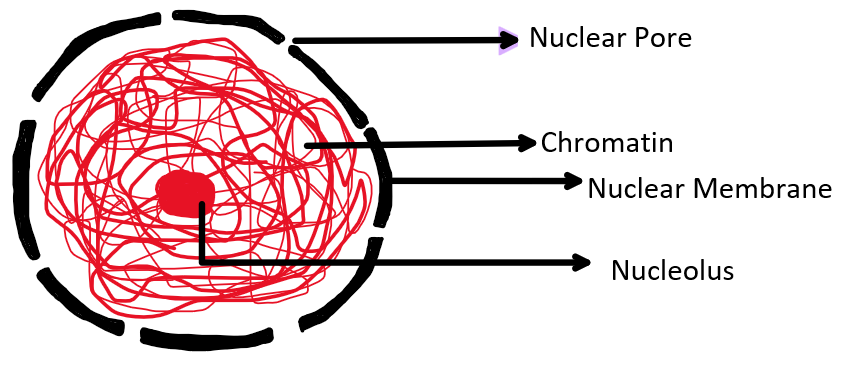
The Chromosome is the physical basis of inheritance and it is present inside the nucleus of every eukaryotic cell. So if a cell lacks a nucleus it will also lack a chromosome. The chromosomes are present in an uncoiled form inside the nucleus which is known as chromatin and can not be distinguished separately in normal conditions. During cell division, these chromatins condense and form chromosomes and therefore as clearly visible at certain stages of the cell cycle (metaphase).
Additional Information:
Types of chromosome based on the position of the centromere are:
Metacentric chromosome: The centromere is present at the center of the chromosome.
Sub-Metacentric: Centromere is located between the center and one end of the chromosome.
Acrocentric: The centromere is located in the subterminal.
Telocentric: Centromere is located at the terminal ends of the chromosome.
The following parts are seen in a eukaryotic chromosome:
-Pellicle
-Matrix
-Chromonema
-Centromere or Primary constriction
-Secondary Constriction or NOR (capable of nucleolus formation)
-Satellite
-Telomeres
So, the correct answer is ‘chromosome’.
Note:
DNA and histone proteins constitute a major portion of the chromosomes. The composition can be given as follows:
DNA-40%
Histone Proteins-50%
Non-Histone Proteins-8.5-9%
RNA-1.5%
Trace amounts of calcium, iron, and magnesium ions are also found.
It should be remembered that in humans all types of chromosomes including metacentric, submetacentric, and acrocentric chromosomes are found but telocentric chromosomes are absent in humans. Therefore during the anaphasic movement, the I shaped chromosome is not seen.
Complete answer:
The Chromosome is the physical basis of inheritance and it is present inside the nucleus of every eukaryotic cell. So if a cell lacks a nucleus it will also lack a chromosome. The chromosomes are present in an uncoiled form inside the nucleus which is known as chromatin and can not be distinguished separately in normal conditions. During cell division, these chromatins condense and form chromosomes and therefore as clearly visible at certain stages of the cell cycle (metaphase).
Additional Information:
Types of chromosome based on the position of the centromere are:
Metacentric chromosome: The centromere is present at the center of the chromosome.
Sub-Metacentric: Centromere is located between the center and one end of the chromosome.
Acrocentric: The centromere is located in the subterminal.
Telocentric: Centromere is located at the terminal ends of the chromosome.
The following parts are seen in a eukaryotic chromosome:
-Pellicle
-Matrix
-Chromonema
-Centromere or Primary constriction
-Secondary Constriction or NOR (capable of nucleolus formation)
-Satellite
-Telomeres
So, the correct answer is ‘chromosome’.
Note:
DNA and histone proteins constitute a major portion of the chromosomes. The composition can be given as follows:
DNA-40%
Histone Proteins-50%
Non-Histone Proteins-8.5-9%
RNA-1.5%
Trace amounts of calcium, iron, and magnesium ions are also found.
It should be remembered that in humans all types of chromosomes including metacentric, submetacentric, and acrocentric chromosomes are found but telocentric chromosomes are absent in humans. Therefore during the anaphasic movement, the I shaped chromosome is not seen.
Recently Updated Pages
Master Class 11 Social Science: Engaging Questions & Answers for Success

Master Class 11 English: Engaging Questions & Answers for Success
Master Class 11 Maths: Engaging Questions & Answers for Success
Master Class 11 Chemistry: Engaging Questions & Answers for Success
Master Class 11 Biology: Engaging Questions & Answers for Success
Master Class 11 Physics: Engaging Questions & Answers for Success
Trending doubts
One Metric ton is equal to kg A 10000 B 1000 C 100 class 11 physics CBSE
Difference Between Prokaryotic Cells and Eukaryotic Cells
How many of the following diseases can be studied with class 11 biology CBSE
Which of the following enzymes is used for carboxylation class 11 biology CBSE
Draw a diagram of a plant cell and label at least eight class 11 biology CBSE
Two of the body parts which do not appear in MRI are class 11 biology CBSE