




When a cell is placed in a hypotonic solution
(a)solute exists in the cell to equalize the concentration on both sides of the membrane.
(b)water exits the cell towards an area of lower solute concentration.
(c)water enters the cell toward the area of higher solute concentration.
(d)solute exists and water enters the cell.
Answer
 Verified
662.4k+ views
Hint: In diffusion, the movement of solute and solvent molecules takes place whereas osmosis is a special kind of diffusion. In osmosis movement, only that component of a solution takes place which is usually present in larger quantities.
Complete answer:
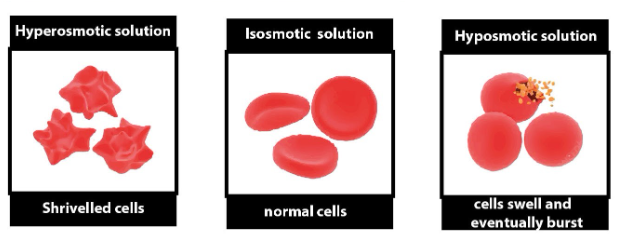
Hypo means “under/beneath” and tonic means the concentration of a solution. A hypotonic solution is one in which the concentration of solutes is greater inside the cell than outside of it which means less solute and more water in the solution. As the concentration of water is higher outside the cell, there is a net movement of water from outside into the cell. Cell gains water and swells up which results in the increase of internal pressure. By the result of hypotonic water is transported into the cell and the cell will burst, that is haemolysis.
Example: The normal range for blood sodium levels is 135 to 145 mEq/L. Hyponatremia occurs when the sodium level in the blood falls below 135 mEq/L.
Additional Information: -Hypotonic solutions are used, when the cell is dehydrated and fluids need to be put back intracellular. This occurs when patients develop diabetic ketoacidosis (DKA) or hyperosmolar hyperglycemia.
-Signs and symptoms hypotonicity in the body causes: drowsiness, headache, muscle weakness, nausea and vomiting.
-A hypertonic solution is one where the concentration of solutes is greater outside the cell than inside it which means more solute and less water in the solution.
-Due to hypertonic water is transported out from the cell. A cell placed in a hypertonic solution will lose water and shrink.
-Solution in which water molecule and solute molecule are equal in concentration is known as an isotonic solution.
-Osmosis is the net movement of water molecules having a certain amount of kinetic energy across a partially permeable membrane. The phenomena in which the two solutions of two different concentrations are separated by the semi-permeable membrane. It is responsible for the gain and loss of water in the cell. The water molecules of the water move from their higher concentration to their lower concentration until the concentration of both the solution becomes equal.
So, the correct answer is ‘water enters the cell toward the area of higher solute concentration.’
Note: - Osmosis is caused by a concentration difference of water.
- When the water has another substance dissolved in it results in the water molecules have less potential to move, this is negative osmotic potential.
- Water molecules always move from less negative to more negative water potential to balance the concentration.
Complete answer:
Hypo means “under/beneath” and tonic means the concentration of a solution. A hypotonic solution is one in which the concentration of solutes is greater inside the cell than outside of it which means less solute and more water in the solution. As the concentration of water is higher outside the cell, there is a net movement of water from outside into the cell. Cell gains water and swells up which results in the increase of internal pressure. By the result of hypotonic water is transported into the cell and the cell will burst, that is haemolysis.
Example: The normal range for blood sodium levels is 135 to 145 mEq/L. Hyponatremia occurs when the sodium level in the blood falls below 135 mEq/L.
Additional Information: -Hypotonic solutions are used, when the cell is dehydrated and fluids need to be put back intracellular. This occurs when patients develop diabetic ketoacidosis (DKA) or hyperosmolar hyperglycemia.
-Signs and symptoms hypotonicity in the body causes: drowsiness, headache, muscle weakness, nausea and vomiting.
-A hypertonic solution is one where the concentration of solutes is greater outside the cell than inside it which means more solute and less water in the solution.
-Due to hypertonic water is transported out from the cell. A cell placed in a hypertonic solution will lose water and shrink.
-Solution in which water molecule and solute molecule are equal in concentration is known as an isotonic solution.
-Osmosis is the net movement of water molecules having a certain amount of kinetic energy across a partially permeable membrane. The phenomena in which the two solutions of two different concentrations are separated by the semi-permeable membrane. It is responsible for the gain and loss of water in the cell. The water molecules of the water move from their higher concentration to their lower concentration until the concentration of both the solution becomes equal.
So, the correct answer is ‘water enters the cell toward the area of higher solute concentration.’
Note: - Osmosis is caused by a concentration difference of water.
- When the water has another substance dissolved in it results in the water molecules have less potential to move, this is negative osmotic potential.
- Water molecules always move from less negative to more negative water potential to balance the concentration.
Recently Updated Pages
Which will be the least stable resonating structure class 11 chemistry CBSE

How many 5 digit telephone numbers can be construc-class-11-maths-CBSE
How do you find the angle of the resultant vector class 11 physics CBSE
Draw labelled diagram of the following i Gram seed class 11 biology CBSE
1 Quintal is equal to a 110 kg b 10 kg c 100kg d 1000 class 11 physics CBSE
What is the need and importance of classification class 11 biology CBSE
Trending doubts
Find the value of the expression given below sin 30circ class 11 maths CBSE
One Metric ton is equal to kg A 10000 B 1000 C 100 class 11 physics CBSE
10 examples of friction in our daily life
Draw a diagram of a plant cell and label at least eight class 11 biology CBSE
Difference between physical and chemical change class 11 chemistry CBSE
Proton was discovered by A Thomson B Rutherford C Chadwick class 11 chemistry CBSE