




A cell, an ammeter and a voltmeter are all connected in series. The ammeter reads a current $I$ and the voltmeter reads a potential difference $V$. If a torch bulb is connected across the voltmeter, then,
(A) both $I$ and $V$ will increase
(B) both $I$ and $V$ will decrease
(C) $I$ will increase but $V$ will decrease
(D) $I$ will decrease but $V$ will increase
Answer
 Verified
599.4k+ views
Hint
To solve this problem we have to know about the series and parallel connection formula for resistance. Because in addition to this circuit, the torch bulb is connected. The torch bulb acts as a resistor, so we have to know about the series and parallel connection formula for the resistor.
Complete step by step solution
The ammeter is a device which is used to determine the amount of current flows in the circuit. And the voltmeter is the device which is used to determine the potential difference across any two points. In this circuit, certain components allow the electric current to flow and some components resist the electric current to flow. The motion of electrons constitutes the flow of electric current. These electrons are not free to move within a conductor.
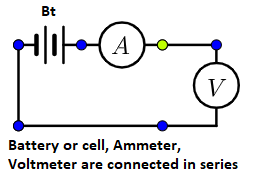
If the motion of electron is retarded by some conductor is called resistor. And also, the component which has some applicable resistance is called a resistor. A component of given size which offers low resistance is called a good conductor. If the component has resistance it is a poor conductor. An insulator is a component which has high resistance. If the torch bulb is connected across the voltmeter, the torch bulb is a component of very low resistance. Thus, the current $I$ will increase and the voltage or potential difference $V$ will decrease.
Hence, the option (C) is correct.
Note
It is very important to know about the resistance and the relation between the resistance and the current and the relation between the resistance and the voltage. And to know about the potential difference and the function of a torch bulb whether it acts as a conductor or resistor.
To solve this problem we have to know about the series and parallel connection formula for resistance. Because in addition to this circuit, the torch bulb is connected. The torch bulb acts as a resistor, so we have to know about the series and parallel connection formula for the resistor.
Complete step by step solution
The ammeter is a device which is used to determine the amount of current flows in the circuit. And the voltmeter is the device which is used to determine the potential difference across any two points. In this circuit, certain components allow the electric current to flow and some components resist the electric current to flow. The motion of electrons constitutes the flow of electric current. These electrons are not free to move within a conductor.
If the motion of electron is retarded by some conductor is called resistor. And also, the component which has some applicable resistance is called a resistor. A component of given size which offers low resistance is called a good conductor. If the component has resistance it is a poor conductor. An insulator is a component which has high resistance. If the torch bulb is connected across the voltmeter, the torch bulb is a component of very low resistance. Thus, the current $I$ will increase and the voltage or potential difference $V$ will decrease.
Hence, the option (C) is correct.
Note
It is very important to know about the resistance and the relation between the resistance and the current and the relation between the resistance and the voltage. And to know about the potential difference and the function of a torch bulb whether it acts as a conductor or resistor.
Recently Updated Pages
Three beakers labelled as A B and C each containing 25 mL of water were taken A small amount of NaOH anhydrous CuSO4 and NaCl were added to the beakers A B and C respectively It was observed that there was an increase in the temperature of the solutions contained in beakers A and B whereas in case of beaker C the temperature of the solution falls Which one of the following statements isarecorrect i In beakers A and B exothermic process has occurred ii In beakers A and B endothermic process has occurred iii In beaker C exothermic process has occurred iv In beaker C endothermic process has occurred

Master Class 10 Social Science: Engaging Questions & Answers for Success
Master Class 10 Science: Engaging Questions & Answers for Success
Master Class 10 Maths: Engaging Questions & Answers for Success
Master Class 10 General Knowledge: Engaging Questions & Answers for Success
Master Class 10 Computer Science: Engaging Questions & Answers for Success
Three beakers labelled as A B and C each containing 25 mL of water were taken A small amount of NaOH anhydrous CuSO4 and NaCl were added to the beakers A B and C respectively It was observed that there was an increase in the temperature of the solutions contained in beakers A and B whereas in case of beaker C the temperature of the solution falls Which one of the following statements isarecorrect i In beakers A and B exothermic process has occurred ii In beakers A and B endothermic process has occurred iii In beaker C exothermic process has occurred iv In beaker C endothermic process has occurred
Master Class 10 Social Science: Engaging Questions & Answers for Success
Master Class 10 Science: Engaging Questions & Answers for Success
Trending doubts
Explain the Treaty of Vienna of 1815 class 10 social science CBSE
In cricket, what is the term for a bowler taking five wickets in an innings?
Who Won 36 Oscar Awards? Record Holder Revealed
What is the median of the first 10 natural numbers class 10 maths CBSE
Why is it 530 pm in india when it is 1200 afternoon class 10 social science CBSE
What is deficiency disease class 10 biology CBSE