



A cart is moving horizontally along a straight line with constant speed 30m/s. A particle is to be fired vertically upwards from the moving cart in such a way that it returns to the cart at the same point from where it was projected after the cart has moved 80m. At what speed (relative to the cart in m/s) must the projectile be fired? (g= $10m{s^{ - 2}}$).
A. 10
B. $10\sqrt 8 $
C. $\dfrac{{40}}{3}$
D. None of these
Answer
 Verified
660k+ views
Hint: There are two components of the motion of the particle. A horizontal motion because it is fired from a horizontally moving cart and vertical motion as it is fired upwards relative to the cart. Use kinematic equations of motion of particles by substituting time required by the cart to move 80m. The particle should also take the same time to return back to the same point.
Complete answer:
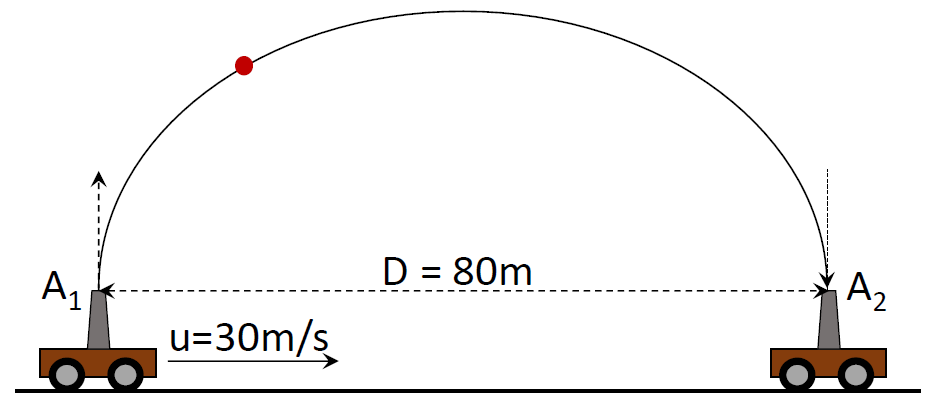
As shown in the above diagram, let the particle be fired in the upward direction at point A1 and return back to the firing point while the cart has moved to A2, covering a distance, $D = 80m$. The speed of the cart during this motion is a constant, $u = 30m/s$. Since speed = distance/time, we can calculate the time taken to cover above distance as $t = \dfrac{D}{u} = \dfrac{{80}}{{30}} = \dfrac{8}{3}s$.
For the particle to return back to the same point of cart, the particle should take the same time as calculated above. Figure shows a rough trajectory of the particle. Now the particle is fired in a vertical direction relative to the cart. Thus the particle will have two components of motion. First one can be considered as the horizontal motion travelled with the same velocity as the cart. Second one is the vertical direction relative to the cart under the effect of acceleration due to gravity. This motion is also called the projectile motion. In the above calculated time, the particle will have to reach the highest point and move downwards. Since the particle is moving under the influence of gravity in the vertical direction, its vertical velocity will decrease to zero by the time it reaches the highest point of the trajectory. Its velocity at that point will be purely horizontal.
Let us consider the vertical motion from the point particle is fired and the point it reaches the maximum point. We have to calculate the vertical velocity by which the particle was fired and let it be${v_1}$. As discussed before, its vertical velocity at highest point, ${v_2} = 0m/s$. Time taken to reach the point is half the time taken for the cart to reach from A1 to A2. We can say this because, both the points are at the same horizontal level and the vertical motion is purely motion under gravity which is constant before and after the highest point. We also considered the fact that there are no other forces acting on the particle during its flight. Using the first kinematic equation which is as follows:
${v_2} = {v_1} + a{t_1}$, where $a = - g = - 10m{s^{ - 2}}$and ${t_1} = \dfrac{t}{2} = \dfrac{8}{{2 \times 3}} = \dfrac{4}{3}s$. (Here we consider the conventional sign with upward as positive.). Substituting the values, we get,
$0 = {v_1} - 10 \times \dfrac{4}{3}$
${v_1} = \dfrac{{40}}{3}m/s$
Comparing the final result with the above given choices, we can say that option C is correct.
Note: The particle is shot at a particular height from the ground as shown in the diagram, which does not affect the time and velocity by which it was fired. It will only affect the maximum height the particle reaches relative to the ground. Above exercises are based on ideal motions but in reality other forces will affect the projectile motions, for instance, on windy days, the air will exert drag force on the particle.
Complete answer:
As shown in the above diagram, let the particle be fired in the upward direction at point A1 and return back to the firing point while the cart has moved to A2, covering a distance, $D = 80m$. The speed of the cart during this motion is a constant, $u = 30m/s$. Since speed = distance/time, we can calculate the time taken to cover above distance as $t = \dfrac{D}{u} = \dfrac{{80}}{{30}} = \dfrac{8}{3}s$.
For the particle to return back to the same point of cart, the particle should take the same time as calculated above. Figure shows a rough trajectory of the particle. Now the particle is fired in a vertical direction relative to the cart. Thus the particle will have two components of motion. First one can be considered as the horizontal motion travelled with the same velocity as the cart. Second one is the vertical direction relative to the cart under the effect of acceleration due to gravity. This motion is also called the projectile motion. In the above calculated time, the particle will have to reach the highest point and move downwards. Since the particle is moving under the influence of gravity in the vertical direction, its vertical velocity will decrease to zero by the time it reaches the highest point of the trajectory. Its velocity at that point will be purely horizontal.
Let us consider the vertical motion from the point particle is fired and the point it reaches the maximum point. We have to calculate the vertical velocity by which the particle was fired and let it be${v_1}$. As discussed before, its vertical velocity at highest point, ${v_2} = 0m/s$. Time taken to reach the point is half the time taken for the cart to reach from A1 to A2. We can say this because, both the points are at the same horizontal level and the vertical motion is purely motion under gravity which is constant before and after the highest point. We also considered the fact that there are no other forces acting on the particle during its flight. Using the first kinematic equation which is as follows:
${v_2} = {v_1} + a{t_1}$, where $a = - g = - 10m{s^{ - 2}}$and ${t_1} = \dfrac{t}{2} = \dfrac{8}{{2 \times 3}} = \dfrac{4}{3}s$. (Here we consider the conventional sign with upward as positive.). Substituting the values, we get,
$0 = {v_1} - 10 \times \dfrac{4}{3}$
${v_1} = \dfrac{{40}}{3}m/s$
Comparing the final result with the above given choices, we can say that option C is correct.
Note: The particle is shot at a particular height from the ground as shown in the diagram, which does not affect the time and velocity by which it was fired. It will only affect the maximum height the particle reaches relative to the ground. Above exercises are based on ideal motions but in reality other forces will affect the projectile motions, for instance, on windy days, the air will exert drag force on the particle.
Recently Updated Pages
Which will be the least stable resonating structure class 11 chemistry CBSE

How many 5 digit telephone numbers can be construc-class-11-maths-CBSE
How do you find the angle of the resultant vector class 11 physics CBSE
Draw labelled diagram of the following i Gram seed class 11 biology CBSE
What is the need and importance of classification class 11 biology CBSE
The way in which the sparrows expressed their sorrow class 11 english CBSE
Trending doubts
One Metric ton is equal to kg A 10000 B 1000 C 100 class 11 physics CBSE
Find the value of the expression given below sin 30circ class 11 maths CBSE
1 Quintal is equal to a 110 kg b 10 kg c 100kg d 1000 class 11 physics CBSE
Draw a diagram of nephron and explain its structur class 11 biology CBSE
10 examples of friction in our daily life
Proton was discovered by A Thomson B Rutherford C Chadwick class 11 chemistry CBSE