




A card sheet has been divided into squares each of size $1m{{m}^{2}}$ is being seen from a distance of $9cm$ through a magnifying glass (a converging lens of focal length $9cm$) held close to the eye.
A. What will be the magnification produced by the lens? How much will be the area of each square in the virtual image?
B. What will be the angular magnification (magnifying power) of the lens?
C. Is the magnification in A equivalent to the magnifying power in B? Explain
Answer
 Verified
602.1k+ views
Hint: First of all find out the final image position using the lens equation and using the object and image distances. Find out the magnification. Multiply the square of the magnification factor with the area to get the area of the square of virtual image. These all may help you to solve this question.
Formula used:
The magnifying power of the lens is found out by,
$P=\dfrac{d}{\left| u \right|}$
Where $d=25cm$ and $u$ be the object distance.
Complete answer:
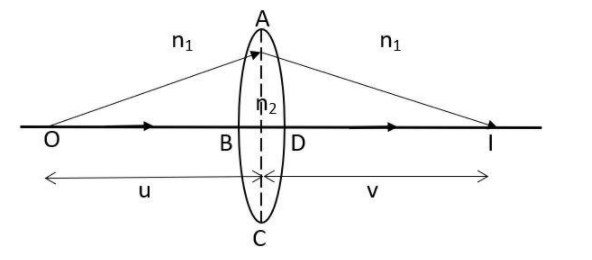
A. Area of each square is given as,
$A=1m{{m}^{2}}$
It is given that the object distance is $u$ and the focal length is $f$ which can be written as,
$\begin{align}
& u=-9cm \\
& f=10cm \\
\end{align}$
We all know that the lens equation is,
$ \dfrac{1}{v}-\dfrac{1}{u}=\dfrac{1}{f}$
Substituting the values in it,
$\begin{align}
& & \dfrac{1}{v}-\dfrac{1}{-9}=\dfrac{1}{10} \\
& v=-90cm
\end{align}$
Therefore the magnification is given by the equation,
$m=\dfrac{v}{u}=\dfrac{-90}{-9}=10$
Hence the area of the squares of the virtual image will be,
${A}'={{m}^{2}}\times A$
Substituting the values in it,
${A}'={{10}^{2}}\times 1=100m{{m}^{2}}$
B. the magnifying power of the lens is given by the equation,
$P=\dfrac{d}{\left| u \right|}$
Where $d=25cm$ and $u$ be the object distance.
Substituting the values in it,
$P=\dfrac{25}{\left| -9 \right|}=2.8$
C. No, magnification of an image by a lens and magnifying power of an optical instrument are different quantities. The angular magnification is the ratio of the angular size of the object to the angular size of the object when it is kept at the near point. Both of these are equal only when the image formed is at the near point $d=25cm$.
Note:
The linear magnification and the angular magnifications are not equal. Linear magnification is given as the ratio of the object size to the image size. And the angular magnification is defined as the ratio of the angle subtended by the object to that of the image.
Formula used:
The magnifying power of the lens is found out by,
$P=\dfrac{d}{\left| u \right|}$
Where $d=25cm$ and $u$ be the object distance.
Complete answer:
A. Area of each square is given as,
$A=1m{{m}^{2}}$
It is given that the object distance is $u$ and the focal length is $f$ which can be written as,
$\begin{align}
& u=-9cm \\
& f=10cm \\
\end{align}$
We all know that the lens equation is,
$ \dfrac{1}{v}-\dfrac{1}{u}=\dfrac{1}{f}$
Substituting the values in it,
$\begin{align}
& & \dfrac{1}{v}-\dfrac{1}{-9}=\dfrac{1}{10} \\
& v=-90cm
\end{align}$
Therefore the magnification is given by the equation,
$m=\dfrac{v}{u}=\dfrac{-90}{-9}=10$
Hence the area of the squares of the virtual image will be,
${A}'={{m}^{2}}\times A$
Substituting the values in it,
${A}'={{10}^{2}}\times 1=100m{{m}^{2}}$
B. the magnifying power of the lens is given by the equation,
$P=\dfrac{d}{\left| u \right|}$
Where $d=25cm$ and $u$ be the object distance.
Substituting the values in it,
$P=\dfrac{25}{\left| -9 \right|}=2.8$
C. No, magnification of an image by a lens and magnifying power of an optical instrument are different quantities. The angular magnification is the ratio of the angular size of the object to the angular size of the object when it is kept at the near point. Both of these are equal only when the image formed is at the near point $d=25cm$.
Note:
The linear magnification and the angular magnifications are not equal. Linear magnification is given as the ratio of the object size to the image size. And the angular magnification is defined as the ratio of the angle subtended by the object to that of the image.
Recently Updated Pages
Master Class 11 Social Science: Engaging Questions & Answers for Success

Master Class 11 Physics: Engaging Questions & Answers for Success
Master Class 11 Maths: Engaging Questions & Answers for Success
Master Class 11 Economics: Engaging Questions & Answers for Success
Master Class 11 Computer Science: Engaging Questions & Answers for Success
Master Class 11 Chemistry: Engaging Questions & Answers for Success
Trending doubts
One Metric ton is equal to kg A 10000 B 1000 C 100 class 11 physics CBSE
There are 720 permutations of the digits 1 2 3 4 5 class 11 maths CBSE
1 Quintal is equal to a 110 kg b 10 kg c 100kg d 1000 class 11 physics CBSE
State and prove Bernoullis theorem class 11 physics CBSE
Difference Between Prokaryotic Cells and Eukaryotic Cells
Discuss the various forms of bacteria class 11 biology CBSE