




A car weighing 100 kg is on a slope that makes an angle ${30^ \circ }$with the horizontal. The component of car’s weight parallel to the slope is ($g = 10m{s^{ - 2}}$)
A. 500 N
B. 1000 N
C. 15000 N
D. 20000 N
Answer
 Verified
611.4k+ views
Hint:There are two kinds of quantities: Scalar and Vector. Scalar quantities are expressed only in terms of magnitude, for example, speed, time, temperature, mass. Vector quantities are expressed in magnitude as well as direction, for example, velocity, force, acceleration, electric field.
Complete step-by-step answer:
Consider a car of mass 100 kg on a slope that makes an angle of ${30^ \circ }$ as shown:
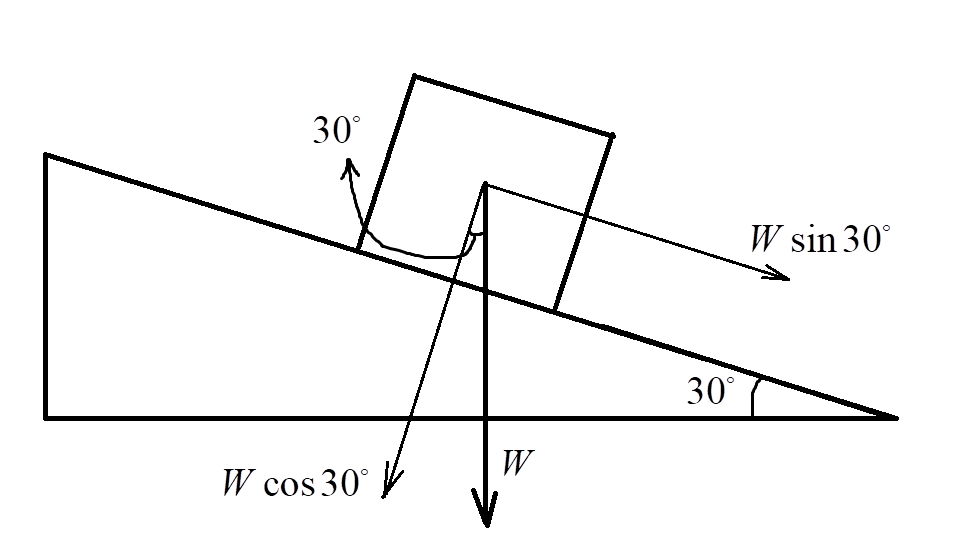
The weight of the car, which is 100 kg, acts vertically in the downward direction as shown.
Since, the weight (or force) is a vector, it can be resolved into 2 components: One horizontal and one vertical component as shown.
If we resolve the weight into 2 components, we have: $W\cos {30^ \circ }$and $W\sin {30^ \circ }$ as shown in the dotted lines in the above figure.
The weight, W = mg
Given,
Mass, m = 100 kg
Acceleration due to gravity, $g = 10m{s^{ - 2}}$
The weight, W = mg = $100 \times 10 = 1000N$
In the problem, they have asked the component of the car’s weight that is parallel to the slope. In this case, we can see that the component of force parallel to the slope is $\sin \theta $.
Hence, the component is, $W\sin {30^ \circ } = W \times \dfrac{1}{2} = 1000 \times \dfrac{1}{2} = 500N$
Hence, the correct option is Option A.
Note: Students generally confuse while writing the horizontal and vertical components of a vector. You can use a simple and handy thumb rule as shown here:
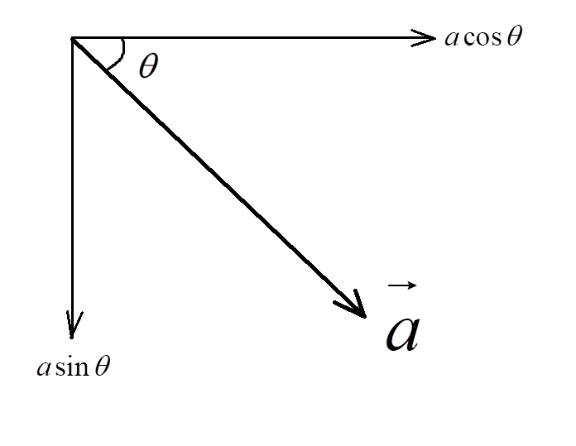
Consider a vector $\vec a$ inclined at angle $\theta $ as shown in the above figure: - The line that is attached to the angle $\theta $ is designated as $\cos \theta $. - The other line that is not attached to the angle$\theta $ is designated as $\sin \theta $ .
Complete step-by-step answer:
Consider a car of mass 100 kg on a slope that makes an angle of ${30^ \circ }$ as shown:
The weight of the car, which is 100 kg, acts vertically in the downward direction as shown.
Since, the weight (or force) is a vector, it can be resolved into 2 components: One horizontal and one vertical component as shown.
If we resolve the weight into 2 components, we have: $W\cos {30^ \circ }$and $W\sin {30^ \circ }$ as shown in the dotted lines in the above figure.
The weight, W = mg
Given,
Mass, m = 100 kg
Acceleration due to gravity, $g = 10m{s^{ - 2}}$
The weight, W = mg = $100 \times 10 = 1000N$
In the problem, they have asked the component of the car’s weight that is parallel to the slope. In this case, we can see that the component of force parallel to the slope is $\sin \theta $.
Hence, the component is, $W\sin {30^ \circ } = W \times \dfrac{1}{2} = 1000 \times \dfrac{1}{2} = 500N$
Hence, the correct option is Option A.
Note: Students generally confuse while writing the horizontal and vertical components of a vector. You can use a simple and handy thumb rule as shown here:
Consider a vector $\vec a$ inclined at angle $\theta $ as shown in the above figure: - The line that is attached to the angle $\theta $ is designated as $\cos \theta $. - The other line that is not attached to the angle$\theta $ is designated as $\sin \theta $ .
Recently Updated Pages
Master Class 9 General Knowledge: Engaging Questions & Answers for Success

Master Class 9 Maths: Engaging Questions & Answers for Success
Master Class 9 Science: Engaging Questions & Answers for Success
Master Class 9 English: Engaging Questions & Answers for Success
Master Class 9 Social Science: Engaging Questions & Answers for Success
Class 9 Question and Answer - Your Ultimate Solutions Guide
Trending doubts
One Metric ton is equal to kg A 10000 B 1000 C 100 class 11 physics CBSE
Difference Between Prokaryotic Cells and Eukaryotic Cells
Two of the body parts which do not appear in MRI are class 11 biology CBSE
1 ton equals to A 100 kg B 1000 kg C 10 kg D 10000 class 11 physics CBSE
10 examples of friction in our daily life
Name the Largest and the Smallest Cell in the Human Body ?