




A car slows down uniformly from a speed of 21.0${m}/{s}\;$ to rest in 6.00 sec. How far did it travel in that time?
Answer
 Verified
559.2k+ views
Hint: The car is slowing down from a speed of 21.0${m}/{s}\;$ to rest (0.00${m}/{s}\;$) in 6.00 sec which means the acceleration of car is negative, so by calculating acceleration and using third equation of motion we can calculate total distance traveled before coming to rest.
Formula used:
${{U}^{2}}_{f}-{{U}^{2}}_{i}=2aS$
Complete Step by step solution:
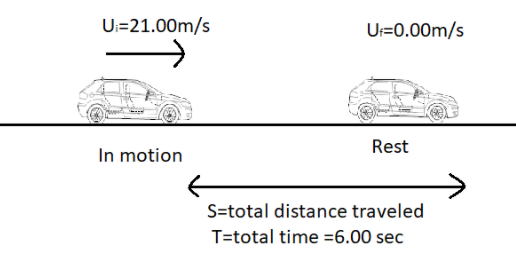
Initial speed ${{U}_{i}}$=21.0${m}/{s}\;$,
Final speed ${{U}_{f}}$=0.00${m}/{s}\;$,
Time taken $T$= 6.00 sec,
So, acceleration $a=\dfrac{{{U}_{f}}-{{U}_{i}}}{T}=\dfrac{0.00-21.00}{6.00}=-3.5{m}/{{{s}^{2}}}\;$
Now, by using third equation of motion we have,
${{U}^{2}}_{f}-{{U}^{2}}_{i}=2aS$
Here, $S$ is distance travel by an object in a given interval of time.
$S=\dfrac{{{U}^{2}}_{f}-{{U}^{2}}_{i}}{2a}=\dfrac{{{\left( 0.00 \right)}^{2}}-{{\left( 21.00 \right)}^{2}}}{2\times \left( -3.5 \right)}=63.0m$
Additional information:
Equations of motion describes the behavior of motion and are used to calculate distance, time, velocity or acceleration of an object. First equation is based on velocity- time as if object having some initial velocity that final velocity must be equal to initial plus the acceleration time of total time, second equation is based on position time where position of an object can be calculated with respect to time and acceleration and the last one is based on position velocity where final velocity depends on acceleration and displacement of an object. The mathematical expression of three equations are
$v=u+at$
$s=ut+\dfrac{1}{2}a{{t}^{2}}$
${{v}^{2}}={{u}^{2}}+2as$
Here, $v$ (final speed), $u$(initial speed), $t$ (total time), $a$ (acceleration) and $s$(distance traveled).
Note:
If we are using the third equation of motion acceleration must be constant (positive or negative), for e.g. in our question acceleration is constant. If not then we can’t apply the equation of motion.
Formula used:
${{U}^{2}}_{f}-{{U}^{2}}_{i}=2aS$
Complete Step by step solution:
Initial speed ${{U}_{i}}$=21.0${m}/{s}\;$,
Final speed ${{U}_{f}}$=0.00${m}/{s}\;$,
Time taken $T$= 6.00 sec,
So, acceleration $a=\dfrac{{{U}_{f}}-{{U}_{i}}}{T}=\dfrac{0.00-21.00}{6.00}=-3.5{m}/{{{s}^{2}}}\;$
Now, by using third equation of motion we have,
${{U}^{2}}_{f}-{{U}^{2}}_{i}=2aS$
Here, $S$ is distance travel by an object in a given interval of time.
$S=\dfrac{{{U}^{2}}_{f}-{{U}^{2}}_{i}}{2a}=\dfrac{{{\left( 0.00 \right)}^{2}}-{{\left( 21.00 \right)}^{2}}}{2\times \left( -3.5 \right)}=63.0m$
Additional information:
Equations of motion describes the behavior of motion and are used to calculate distance, time, velocity or acceleration of an object. First equation is based on velocity- time as if object having some initial velocity that final velocity must be equal to initial plus the acceleration time of total time, second equation is based on position time where position of an object can be calculated with respect to time and acceleration and the last one is based on position velocity where final velocity depends on acceleration and displacement of an object. The mathematical expression of three equations are
$v=u+at$
$s=ut+\dfrac{1}{2}a{{t}^{2}}$
${{v}^{2}}={{u}^{2}}+2as$
Here, $v$ (final speed), $u$(initial speed), $t$ (total time), $a$ (acceleration) and $s$(distance traveled).
Note:
If we are using the third equation of motion acceleration must be constant (positive or negative), for e.g. in our question acceleration is constant. If not then we can’t apply the equation of motion.
Recently Updated Pages
Master Class 11 Computer Science: Engaging Questions & Answers for Success

Master Class 11 Business Studies: Engaging Questions & Answers for Success
Master Class 11 Economics: Engaging Questions & Answers for Success
Master Class 11 English: Engaging Questions & Answers for Success
Master Class 11 Maths: Engaging Questions & Answers for Success
Master Class 11 Biology: Engaging Questions & Answers for Success
Trending doubts
There are 720 permutations of the digits 1 2 3 4 5 class 11 maths CBSE
Discuss the various forms of bacteria class 11 biology CBSE
Explain zero factorial class 11 maths CBSE
What organs are located on the left side of your body class 11 biology CBSE
Draw a diagram of nephron and explain its structur class 11 biology CBSE
How do I convert ms to kmh Give an example class 11 physics CBSE