




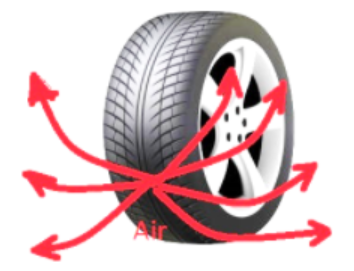
A car runs over a nail which makes a hole in it. The air in the tire leaks out. Why does the air leave the tire?
A. The pressure inside the tire is greater than pressure outside
B. The pressure inside the tire is less that the pressure outside
C. The temperature inside the tire is greater than the temperature outside
D. The temperature inside the tire is less than the temperature outside
Answer
 Verified
611.7k+ views
Hint: Any physical quantity tries to decrease it’s contained energy in some form. As the gas inside the tire is highly compressed, the gas molecules are closer to each other and their collisions increase, causing an increase in the pressure. As the pressure inside the tire is greater than the pressure outside and thus create a uniform pressure, between the tire and the surrounding atmosphere.
Complete answer:
The tire is filled with gas, which is compressed under high pressure.
When the car runs over the nail, the tire gets punctured. This tiny puncture allows for a free passage for the highly compressed gas.
It is in the nature of all physical quantities to reduce the contained energy, in some form. For instance, consider vacuum. Your vacuum cleaner actually tries to reduce its pressure. The air around the vacuum cleaner is at higher pressure compared to the vacuum inside. This results in passage of atmospheric air (including nearby particles obviously) into the vacuum. This action looks like suction.
The same is happening with a punctured tire. The pressure outside is substantially low. Thus, to reduce the pressure, the gas travels outside at high speed. This is sometimes heard as a loud boom, due to the sudden expansion of gases.
So, the correct option is A.
Note:
Due to Newton’s law of Cooling, as there is a sudden expansion of gases, there might be drop in temperature in nearby surroundings of the puncture nonetheless it doesn’t occur due to the temperature differences.
Complete answer:
The tire is filled with gas, which is compressed under high pressure.
When the car runs over the nail, the tire gets punctured. This tiny puncture allows for a free passage for the highly compressed gas.
It is in the nature of all physical quantities to reduce the contained energy, in some form. For instance, consider vacuum. Your vacuum cleaner actually tries to reduce its pressure. The air around the vacuum cleaner is at higher pressure compared to the vacuum inside. This results in passage of atmospheric air (including nearby particles obviously) into the vacuum. This action looks like suction.
The same is happening with a punctured tire. The pressure outside is substantially low. Thus, to reduce the pressure, the gas travels outside at high speed. This is sometimes heard as a loud boom, due to the sudden expansion of gases.
So, the correct option is A.
Note:
Due to Newton’s law of Cooling, as there is a sudden expansion of gases, there might be drop in temperature in nearby surroundings of the puncture nonetheless it doesn’t occur due to the temperature differences.
Recently Updated Pages
Master Class 11 Social Science: Engaging Questions & Answers for Success

Master Class 11 English: Engaging Questions & Answers for Success
Master Class 11 Maths: Engaging Questions & Answers for Success
Master Class 11 Chemistry: Engaging Questions & Answers for Success
Master Class 11 Biology: Engaging Questions & Answers for Success
Master Class 11 Physics: Engaging Questions & Answers for Success
Trending doubts
Differentiate between an exothermic and an endothermic class 11 chemistry CBSE
One Metric ton is equal to kg A 10000 B 1000 C 100 class 11 physics CBSE
Difference Between Prokaryotic Cells and Eukaryotic Cells
There are 720 permutations of the digits 1 2 3 4 5 class 11 maths CBSE
Two of the body parts which do not appear in MRI are class 11 biology CBSE
Which gas is abundant in air class 11 chemistry CBSE