




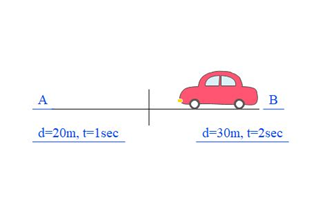
A car moving with uniform acceleration on a road covers twenty meters in the first second and thirty meters in the next second. What is its acceleration?
$\begin{align}
& a)20m{{s}^{-2}} \\
& b)10m{{s}^{-2}} \\
& c)30m{{s}^{-2}} \\
& d)5m{{s}^{-2}} \\
\end{align}$
Answer
 Verified
628.8k+ views
Hint: Calculate the velocity of the car in the first second in terms of acceleration. As the acceleration is uniform, we can use the same acceleration for the next second too. Therefore, in the next step, substitute the velocity in terms of acceleration and we can get the answer.
Formula used:
$\begin{align}
& s=ut+\dfrac{1}{2}a{{t}^{2}} \\
& \\
\end{align}$
Complete step-by-step answer:
Let us assume the velocity and the acceleration of the car as $u,a$respectively. For the first second, the time taken and distance travelled will be:$1\sec ,20m$. Now, applying the above formula we get,
$\begin{align}
& s=ut+\dfrac{1}{2}a{{t}^{2}} \\
& 20=u(1)+\dfrac{1}{2}a{{(1)}^{2}} \\
& u=20-\dfrac{a}{2} \\
\end{align}$
In the next second, the distance travelled by the car and time taken will be equal to $\begin{align}
& s=20+30=50m \\
& t=1+1=2\sec \\
\end{align}$
Now, substitute these values in above formula, we get,
$\begin{align}
& 50=u(2)+\dfrac{1}{2}a{{(2)}^{2}} \\
& 50=2u+2a \\
& 50=2(20-\dfrac{a}{2})+2a \\
& 50=40+a \\
& a=10m{{s}^{-2}} \\
\end{align}$
Therefore, the correct answer is option B.
So, the correct answer is “Option B”.
Additional Information: An object is said to be having uniform acceleration, when the object is speeding up at a constant rate. The rate of acceleration is constant. If the car's velocity is continuously changing like first speeding up then slowing down again speeding up, it is not called as uniform acceleration. The acceleration of the body will be zero when the velocity is constant or uniform. If acceleration is constant or uniform, the acceleration will not be equal to zero. Examples for uniformly accelerated motion will be a ball rolling down an inclined plane. A freely falling body always travels with uniform acceleration as the downward force is due to acceleration of gravity. Air resistance must be neglected in this case.
Note: In the above question, the car travels a total of fifty meters in the next second. We usually mistake it by taking the distance travelled as only thirty meters for the next second. Also, the time taken to travel fifty seconds will be a total two seconds but not one second.
Formula used:
$\begin{align}
& s=ut+\dfrac{1}{2}a{{t}^{2}} \\
& \\
\end{align}$
Complete step-by-step answer:
Let us assume the velocity and the acceleration of the car as $u,a$respectively. For the first second, the time taken and distance travelled will be:$1\sec ,20m$. Now, applying the above formula we get,
$\begin{align}
& s=ut+\dfrac{1}{2}a{{t}^{2}} \\
& 20=u(1)+\dfrac{1}{2}a{{(1)}^{2}} \\
& u=20-\dfrac{a}{2} \\
\end{align}$
In the next second, the distance travelled by the car and time taken will be equal to $\begin{align}
& s=20+30=50m \\
& t=1+1=2\sec \\
\end{align}$
Now, substitute these values in above formula, we get,
$\begin{align}
& 50=u(2)+\dfrac{1}{2}a{{(2)}^{2}} \\
& 50=2u+2a \\
& 50=2(20-\dfrac{a}{2})+2a \\
& 50=40+a \\
& a=10m{{s}^{-2}} \\
\end{align}$
Therefore, the correct answer is option B.
So, the correct answer is “Option B”.
Additional Information: An object is said to be having uniform acceleration, when the object is speeding up at a constant rate. The rate of acceleration is constant. If the car's velocity is continuously changing like first speeding up then slowing down again speeding up, it is not called as uniform acceleration. The acceleration of the body will be zero when the velocity is constant or uniform. If acceleration is constant or uniform, the acceleration will not be equal to zero. Examples for uniformly accelerated motion will be a ball rolling down an inclined plane. A freely falling body always travels with uniform acceleration as the downward force is due to acceleration of gravity. Air resistance must be neglected in this case.
Note: In the above question, the car travels a total of fifty meters in the next second. We usually mistake it by taking the distance travelled as only thirty meters for the next second. Also, the time taken to travel fifty seconds will be a total two seconds but not one second.
Recently Updated Pages
Master Class 11 English: Engaging Questions & Answers for Success

Master Class 11 Social Science: Engaging Questions & Answers for Success
Master Class 11 Maths: Engaging Questions & Answers for Success
Master Class 11 Biology: Engaging Questions & Answers for Success
Master Class 11 Physics: Engaging Questions & Answers for Success
Master Class 11 Chemistry: Engaging Questions & Answers for Success
Trending doubts
One Metric ton is equal to kg A 10000 B 1000 C 100 class 11 physics CBSE
Difference Between Prokaryotic Cells and Eukaryotic Cells
Find the value of the expression given below sin 30circ class 11 maths CBSE
Difference between physical and chemical change class 11 chemistry CBSE
Two of the body parts which do not appear in MRI are class 11 biology CBSE
Draw a diagram of a plant cell and label at least eight class 11 biology CBSE