




A car moves with speed $60km/h$ for $1$ hour in east direction and with same speed for $30\min $in south direction. The displacement of car from initial position is:
A. $60km$
B. $303km$
C. $30\sqrt 5 km$
D. $60\sqrt 2 km$
Answer
 Verified
580.5k+ views
Hint: Calculate the displacement in the both the directions using the formula of displacement. Then use Pythagoras theorem to find the required solution.
Formula used:
$s = vt$ . . . (1)
Where,
$s$ is the displacement
$v$ is velocity
$t$ is time
Complete step by step answer:Observe the diagram
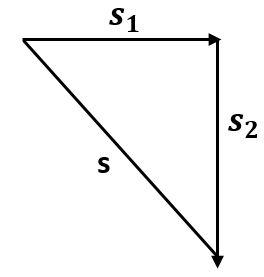
Let ${s_1}$ be the displacement in the east direction with velocity ${v_1}$ and time ${t_1}$
It is given in the question that
${v_1} = 60km/h$ and
${t_1} = 1h$
Therefore, from equation (1), we get
${s_1} = {v_1}{t_1}$
$ = 60 \times 1$
$ \Rightarrow {s_1} = 60km$
Now, let \[{s_2}\] be the displacement in the east direction with velocity ${v_2}$ and time ${t_2}$
It is given in the question that that the car maintained the same speed while travelling the distance ${s_2}$
And the time taken is ${t_2} = 30\min = \dfrac{1}{2}h$
${s_2} = {v_2}{t_2}$
$ = 60 \times \dfrac{1}{2}$
${s_2} = 30km$
Now, by observing the diagram and using Pythagoras theorem, we can say that the total displacement by the car is
$s = \sqrt {s_1^2 + s_2^2} $
$ = \sqrt {{{60}^2} + {{30}^2}} $
$ = \sqrt {3600 + 900} $
$ = \sqrt {4500} $
$ \Rightarrow s = 30\sqrt 5 km$
Therefore, the total displacement done by the car is $30\sqrt 5 km$
Therefore, from the above explanation, the correct answer is, option (C) $30\sqrt 5 km$
Note:The formula used in this question is very easy. The question does not depend on the formula. It depends on the concept that the displacement is the shortest distance between two points. So to solve this question, you should know that the angle between the two given displacements would be ${90^0}$ and hence, we can use Pythagoras theorem to solve this question.
Formula used:
$s = vt$ . . . (1)
Where,
$s$ is the displacement
$v$ is velocity
$t$ is time
Complete step by step answer:Observe the diagram
Let ${s_1}$ be the displacement in the east direction with velocity ${v_1}$ and time ${t_1}$
It is given in the question that
${v_1} = 60km/h$ and
${t_1} = 1h$
Therefore, from equation (1), we get
${s_1} = {v_1}{t_1}$
$ = 60 \times 1$
$ \Rightarrow {s_1} = 60km$
Now, let \[{s_2}\] be the displacement in the east direction with velocity ${v_2}$ and time ${t_2}$
It is given in the question that that the car maintained the same speed while travelling the distance ${s_2}$
And the time taken is ${t_2} = 30\min = \dfrac{1}{2}h$
${s_2} = {v_2}{t_2}$
$ = 60 \times \dfrac{1}{2}$
${s_2} = 30km$
Now, by observing the diagram and using Pythagoras theorem, we can say that the total displacement by the car is
$s = \sqrt {s_1^2 + s_2^2} $
$ = \sqrt {{{60}^2} + {{30}^2}} $
$ = \sqrt {3600 + 900} $
$ = \sqrt {4500} $
$ \Rightarrow s = 30\sqrt 5 km$
Therefore, the total displacement done by the car is $30\sqrt 5 km$
Therefore, from the above explanation, the correct answer is, option (C) $30\sqrt 5 km$
Note:The formula used in this question is very easy. The question does not depend on the formula. It depends on the concept that the displacement is the shortest distance between two points. So to solve this question, you should know that the angle between the two given displacements would be ${90^0}$ and hence, we can use Pythagoras theorem to solve this question.
Recently Updated Pages
Master Class 11 Computer Science: Engaging Questions & Answers for Success

Master Class 11 Business Studies: Engaging Questions & Answers for Success
Master Class 11 Economics: Engaging Questions & Answers for Success
Master Class 11 English: Engaging Questions & Answers for Success
Master Class 11 Maths: Engaging Questions & Answers for Success
Master Class 11 Biology: Engaging Questions & Answers for Success
Trending doubts
One Metric ton is equal to kg A 10000 B 1000 C 100 class 11 physics CBSE
There are 720 permutations of the digits 1 2 3 4 5 class 11 maths CBSE
Discuss the various forms of bacteria class 11 biology CBSE
Draw a diagram of a plant cell and label at least eight class 11 biology CBSE
State the laws of reflection of light
Explain zero factorial class 11 maths CBSE