




A car moves towards east with velocity 20 m/s then moves towards north with velocity 15 m/s. What will be the resultant velocity and direction?
Answer
 Verified
558.6k+ views
Hint:Show the direction of velocity towards the east and towards the north in the diagram. It will form a right angle triangle. Then using Pythagoras theorem, you can determine the magnitude of resultant velocity. Using the property of trigonometry, express the angle between resultant velocity and velocity towards the east.
Complete step by step answer:
We have given that the car moves towards east with velocity \[{v_x} = 20\,{\text{m/s}}\] and then towards with velocity \[{v_y} = 15\,{\text{m/s}}\].
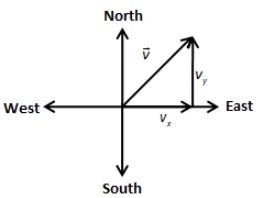
From the above figure, we can express the magnitude of resultant velocity \[v\] as,
\[v = \sqrt {v_x^2 + v_y^2} \]
Here, \[{v_y}\] is the velocity towards the north and \[{v_x}\] is the velocity towards the east.
Substituting \[{v_x} = 20\,{\text{m/s}}\] and \[{v_y} = 15\,{\text{m/s}}\] in the above equation, we get,
\[v = \sqrt {{{\left( {20} \right)}^2} + {{\left( {15} \right)}^2}} \]
\[ \Rightarrow v = \sqrt {400 + 225} \]
\[ \Rightarrow v = \sqrt {625} \]
\[ \Rightarrow v = 25\,{\text{m/s}}\]
Therefore, the resultant velocity of the particle is 25 m/s.
We can determine the direction of the resultant velocity using the simple trigonometry as follows,
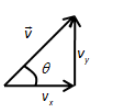
From the above figure, we can write,
\[\tan \theta = \dfrac{{{v_y}}}{{{v_x}}}\]
Here, \[{v_y}\] is the velocity towards the north and \[{v_x}\] is the velocity towards the east.
Substituting \[{v_x} = 20\,{\text{m/s}}\] and \[{v_y} = 15\,{\text{m/s}}\] in the above equation, we get,
\[\tan \theta = \dfrac{{15}}{{20}}\]
\[ \Rightarrow \tan \theta = 0.75\]
\[ \Rightarrow \theta = {\tan ^{ - 1}}\left( {0.75} \right)\]
\[ \therefore \theta = 37^\circ \]
Thus, the direction of resultant velocity is \[37^\circ \]towards the north with respect to east.
Note:One can also define the east direction as \[\hat i\] and the north direction as \[\hat j\]. Therefore, the direction of resultant velocity would be \[\vec v = {v_x}\hat i + {v_y}\hat j\]. The direction of velocity can be stated as \[37^\circ \] northeast. To determine the angle made by the resultant vector, the velocity is not necessarily converted into m/s since it is the ratio of two velocities.
Complete step by step answer:
We have given that the car moves towards east with velocity \[{v_x} = 20\,{\text{m/s}}\] and then towards with velocity \[{v_y} = 15\,{\text{m/s}}\].
From the above figure, we can express the magnitude of resultant velocity \[v\] as,
\[v = \sqrt {v_x^2 + v_y^2} \]
Here, \[{v_y}\] is the velocity towards the north and \[{v_x}\] is the velocity towards the east.
Substituting \[{v_x} = 20\,{\text{m/s}}\] and \[{v_y} = 15\,{\text{m/s}}\] in the above equation, we get,
\[v = \sqrt {{{\left( {20} \right)}^2} + {{\left( {15} \right)}^2}} \]
\[ \Rightarrow v = \sqrt {400 + 225} \]
\[ \Rightarrow v = \sqrt {625} \]
\[ \Rightarrow v = 25\,{\text{m/s}}\]
Therefore, the resultant velocity of the particle is 25 m/s.
We can determine the direction of the resultant velocity using the simple trigonometry as follows,
From the above figure, we can write,
\[\tan \theta = \dfrac{{{v_y}}}{{{v_x}}}\]
Here, \[{v_y}\] is the velocity towards the north and \[{v_x}\] is the velocity towards the east.
Substituting \[{v_x} = 20\,{\text{m/s}}\] and \[{v_y} = 15\,{\text{m/s}}\] in the above equation, we get,
\[\tan \theta = \dfrac{{15}}{{20}}\]
\[ \Rightarrow \tan \theta = 0.75\]
\[ \Rightarrow \theta = {\tan ^{ - 1}}\left( {0.75} \right)\]
\[ \therefore \theta = 37^\circ \]
Thus, the direction of resultant velocity is \[37^\circ \]towards the north with respect to east.
Note:One can also define the east direction as \[\hat i\] and the north direction as \[\hat j\]. Therefore, the direction of resultant velocity would be \[\vec v = {v_x}\hat i + {v_y}\hat j\]. The direction of velocity can be stated as \[37^\circ \] northeast. To determine the angle made by the resultant vector, the velocity is not necessarily converted into m/s since it is the ratio of two velocities.
Recently Updated Pages
Master Class 11 English: Engaging Questions & Answers for Success

Master Class 11 Maths: Engaging Questions & Answers for Success
Master Class 11 Biology: Engaging Questions & Answers for Success
Master Class 11 Social Science: Engaging Questions & Answers for Success
Master Class 11 Physics: Engaging Questions & Answers for Success
Master Class 11 Accountancy: Engaging Questions & Answers for Success
Trending doubts
One Metric ton is equal to kg A 10000 B 1000 C 100 class 11 physics CBSE
Discuss the various forms of bacteria class 11 biology CBSE
Draw a diagram of a plant cell and label at least eight class 11 biology CBSE
State the laws of reflection of light
Explain zero factorial class 11 maths CBSE
10 examples of friction in our daily life