




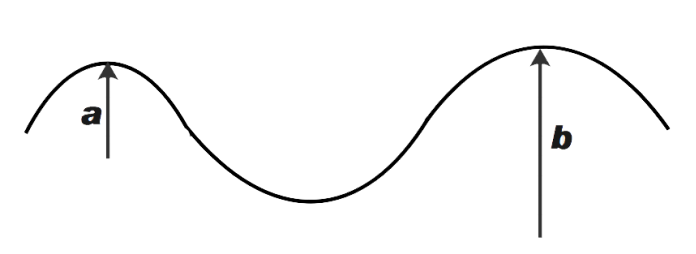
A car moves at constant speed on a road as shown in the figure. The normal force by the road on the car is when it is at point A and B respectively. Information to decide the relation of
A. \[{{N}_{A}}={{N}_{B}}\]
B. \[{{N}_{A}}>{{N}_{B}}\]
C. \[{{N}_{A}}<{{N}_{B}}\]
D. insufficient
Answer
 Verified
621.6k+ views
Hint: In this question we are being asked to find the relation between \[{{N}_{A}}\] and \[{{N}_{B}}\]. From the figure, it is clear that radius of curve a is less than radius of curve b. \[{{N}_{A}}\] and \[{{N}_{B}}\] are the normal forces at point A and B. We know that, formula for calculating the normal force on a curved road, states the relation between velocity and the radius of the curve. The velocity is not given as constant at both points.
Formula used:
\[N=mg-\dfrac{m{{v}^{2}}}{r}\]
Where,
Mg is the weight of the car
V is the velocity
And r is the radius of the curve
Complete step-by-step answer:
From the figure, we can say that radius of curve a say \[{{r}_{A}}\]is less than radius of curve B say \[{{r}_{B}}\]. We know that, weight of the car will remain constant at all times. The velocity at point a and point b is given as constant
Now,
We know from formula,
\[N=mg-\dfrac{m{{v}^{2}}}{r}\]
We can say that the normal force N is directly proportional to square of velocity v and inversely proportional to the radius of curve r.
Now, the normal force at point a say \[{{N}_{A}}\] can be given as
\[{{N}_{A}}=mg-\dfrac{m{{v}_{A}}^{2}}{{{r}_{A}}}\] ……………. (1)
Similarly, the normal force at point b say\[{{N}_{B}}\] can be given as
\[{{N}_{B}}=mg-\dfrac{m{{v}_{B}}^{2}}{{{r}_{B}}}\] ………………………….. (2)
Now let us assume that \[{{N}_{A}}\] = \[{{N}_{B}}\]
Therefore, from (1) and (2)
We can say that,
\[mg-\dfrac{m{{v}_{A}}^{2}}{{{r}_{A}}}=mg-\dfrac{m{{v}_{B}}^{2}}{{{r}_{B}}}\]
On solving we get,
\[\dfrac{{{v}_{A}}^{2}}{{{r}_{A}}}=\dfrac{{{v}_{B}}^{2}}{{{r}_{B}}}\]
But we know that velocity is constant
Therefore,
\[\dfrac{1}{{{r}_{A}}}=\dfrac{1}{{{r}_{B}}}\]
But from the diagram given, we know that \[{{r}_{A}}\] < \[{{r}_{B}}\]
Also, we know that the normal force N is inversely proportional to radius r
Therefore, we can say that our assumption is wrong.
Since \[{{r}_{A}}\] < \[{{r}_{B}}\], we can now say that
\[{{N}_{A}}>{{N}_{B}}\], since the normal force is inversely proportional to r
So, the correct answer is “Option B”.
Note: The normal force is said to be the support force. For a normal force to act on a body the body must be in contact or lying on the surface. The normal force for static objects on a horizontal plane is usually taken as the weight of the object i.e. mg. In such cases normal force is counteracting the weight of the object.
Formula used:
\[N=mg-\dfrac{m{{v}^{2}}}{r}\]
Where,
Mg is the weight of the car
V is the velocity
And r is the radius of the curve
Complete step-by-step answer:
From the figure, we can say that radius of curve a say \[{{r}_{A}}\]is less than radius of curve B say \[{{r}_{B}}\]. We know that, weight of the car will remain constant at all times. The velocity at point a and point b is given as constant
Now,
We know from formula,
\[N=mg-\dfrac{m{{v}^{2}}}{r}\]
We can say that the normal force N is directly proportional to square of velocity v and inversely proportional to the radius of curve r.
Now, the normal force at point a say \[{{N}_{A}}\] can be given as
\[{{N}_{A}}=mg-\dfrac{m{{v}_{A}}^{2}}{{{r}_{A}}}\] ……………. (1)
Similarly, the normal force at point b say\[{{N}_{B}}\] can be given as
\[{{N}_{B}}=mg-\dfrac{m{{v}_{B}}^{2}}{{{r}_{B}}}\] ………………………….. (2)
Now let us assume that \[{{N}_{A}}\] = \[{{N}_{B}}\]
Therefore, from (1) and (2)
We can say that,
\[mg-\dfrac{m{{v}_{A}}^{2}}{{{r}_{A}}}=mg-\dfrac{m{{v}_{B}}^{2}}{{{r}_{B}}}\]
On solving we get,
\[\dfrac{{{v}_{A}}^{2}}{{{r}_{A}}}=\dfrac{{{v}_{B}}^{2}}{{{r}_{B}}}\]
But we know that velocity is constant
Therefore,
\[\dfrac{1}{{{r}_{A}}}=\dfrac{1}{{{r}_{B}}}\]
But from the diagram given, we know that \[{{r}_{A}}\] < \[{{r}_{B}}\]
Also, we know that the normal force N is inversely proportional to radius r
Therefore, we can say that our assumption is wrong.
Since \[{{r}_{A}}\] < \[{{r}_{B}}\], we can now say that
\[{{N}_{A}}>{{N}_{B}}\], since the normal force is inversely proportional to r
So, the correct answer is “Option B”.
Note: The normal force is said to be the support force. For a normal force to act on a body the body must be in contact or lying on the surface. The normal force for static objects on a horizontal plane is usually taken as the weight of the object i.e. mg. In such cases normal force is counteracting the weight of the object.
Recently Updated Pages
Master Class 11 English: Engaging Questions & Answers for Success

Master Class 11 Social Science: Engaging Questions & Answers for Success
Master Class 11 Maths: Engaging Questions & Answers for Success
Master Class 11 Biology: Engaging Questions & Answers for Success
Master Class 11 Physics: Engaging Questions & Answers for Success
Master Class 11 Chemistry: Engaging Questions & Answers for Success
Trending doubts
One Metric ton is equal to kg A 10000 B 1000 C 100 class 11 physics CBSE
Difference Between Prokaryotic Cells and Eukaryotic Cells
Find the value of the expression given below sin 30circ class 11 maths CBSE
1 ton equals to A 100 kg B 1000 kg C 10 kg D 10000 class 11 physics CBSE
Two of the body parts which do not appear in MRI are class 11 biology CBSE
What are hard magnetic materials class 11 physics CBSE