




A car is taking a turn on a level road. It may be thrown outwards because of the
A. Reaction of the ground
B. Frictional force
C. Weight of the car
D. Lack of centripetal force.
Answer
 Verified
641.7k+ views
Hint: For any body to continue in a circular motion, it needs a force acting towards the center known as centripetal force. Turning on a level road is equivalent to travelling along an arc of a circle.
Complete step-by-step answer:
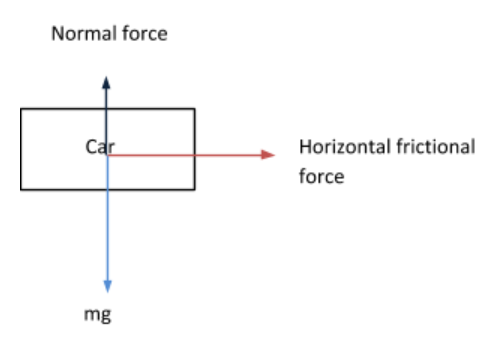
When a car is turning on a level road many forces act on it. As there is no vertical acceleration we can say that the weight acting downwards is cancelled by the upwards normal reaction. Horizontal force acting on the car is due to the friction. As said earlier a force acting on the center of turn, centripetal force is provided by the friction.
This also implies that in a smooth surface, making a turn is more difficult as there is no frictional force to provide the necessary centripetal force. When friction acts inwards it is actually our moment of inertia which opposes the change in direction. Remember that there is no role of centrifugal force in this case.
It is for this reason that usually roads are banked. In the banked roads other than the frictional force a component of normal force also provides the centripetal force.
Therefore we can conclude that it is the lack of centripetal force that causes the car to be thrown outside.
So the correct option is D.
Note: Frictional force is required for taking a turn in a level road. But frictional force is not the reason for the car thrown outside but instead it is friction which provides the necessary centripetal force for the circular motion while taking a turn in a level road. But surely lack of frictional force can throw the car outside since there is not enough centripetal force.
Complete step-by-step answer:
When a car is turning on a level road many forces act on it. As there is no vertical acceleration we can say that the weight acting downwards is cancelled by the upwards normal reaction. Horizontal force acting on the car is due to the friction. As said earlier a force acting on the center of turn, centripetal force is provided by the friction.
This also implies that in a smooth surface, making a turn is more difficult as there is no frictional force to provide the necessary centripetal force. When friction acts inwards it is actually our moment of inertia which opposes the change in direction. Remember that there is no role of centrifugal force in this case.
It is for this reason that usually roads are banked. In the banked roads other than the frictional force a component of normal force also provides the centripetal force.
Therefore we can conclude that it is the lack of centripetal force that causes the car to be thrown outside.
So the correct option is D.
Note: Frictional force is required for taking a turn in a level road. But frictional force is not the reason for the car thrown outside but instead it is friction which provides the necessary centripetal force for the circular motion while taking a turn in a level road. But surely lack of frictional force can throw the car outside since there is not enough centripetal force.
Recently Updated Pages
Master Class 11 English: Engaging Questions & Answers for Success

Master Class 11 Social Science: Engaging Questions & Answers for Success
Master Class 11 Maths: Engaging Questions & Answers for Success
Master Class 11 Biology: Engaging Questions & Answers for Success
Master Class 11 Physics: Engaging Questions & Answers for Success
Master Class 11 Chemistry: Engaging Questions & Answers for Success
Trending doubts
One Metric ton is equal to kg A 10000 B 1000 C 100 class 11 physics CBSE
Difference Between Prokaryotic Cells and Eukaryotic Cells
Find the value of the expression given below sin 30circ class 11 maths CBSE
Difference between physical and chemical change class 11 chemistry CBSE
Two of the body parts which do not appear in MRI are class 11 biology CBSE
Draw a diagram of a plant cell and label at least eight class 11 biology CBSE