




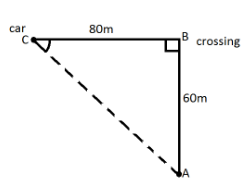
A car approaching a crossing at a speed of \[20m/s\]sounds a horn of frequency \[628Hz\]when \[80m\]from the crossing. The apparent frequency heard by an observer \[60m\]from the crossing on the straight road which crosses the road at right angle is (velocity of sound\[ = 330m/s\])
(A) \[660HZ\]
(B) \[680HZ\]
(C) \[640HZ\]
(D) \[690HZ\]
Answer
 Verified
586.2k+ views
Hint:To solve this question,we have to apply the concept of Doppler effect in sound.
Complete step by step answer:
According to the Doppler Effect in sound, the frequency of sound changes with the relative motions of the source and observer. This change in frequency is called apparent frequency.
Apparent frequency is given by the formula
\[f' = \dfrac{{(v - {v_0})}}{{(v - {v_s})}}f\]
Where \[f'\]is the apparent frequency of the sound?
\[f\]is the real frequency.
\[v\]is the velocity of sound , velocity of sound\[ = 330m/s\].
\[{v_0}\]is the velocity of the observer.
\[{v_s}\]is the velocity of the source.
Here, the source is a moving car. Car’s velocity is denoted as \[{v_s}'\] because the observer and path of the car are in a right angle way.
But this observer and the source are at right angles to each other, as shown in the figure.
Only the cosine component of the car’s velocity is contributed in this equation of Doppler shift. Because car velocity's cosine component is parallel to the direction of the observer.
From the figure \[\tan \theta = AB/BC = \dfrac{{60}}{{80}} = 0.75\]
This angle between the car’s velocity direction and the direction towards the observer from the point \[C\].
\[\theta = {\tan ^{ - 1}}(0.75) = {36.87^0}\]
\[{v_s} = {v_s}'\cos \theta = 20\cos (36.87) = 16m/s\]
Since the observer is at rest \[{v_o}\]is zero.
\[\begin{gathered} \\
f' = \dfrac{{(v - {v_0})}}{{(v - {v_s})}}f = (\dfrac{{330}}{{330 - 16}}) \times 628 = 660Hz \\
\end{gathered} \]
So the answer is (A)\[660HZ\]
Note:Doppler Effect is present in all kinds of waves, including sound waves, electromagnetic waves, etc.This effect is we can see in daily life, like changing in pitch sound of approaching train, supersonic jet, etc.The apparent frequency depends on whether the source is approaches or receding.Doppler Effect has several applications like medical imaging, radars, and more predominantly in astronomy.Velocity of sound in the outer space is zero because sound waves need a medium.
Complete step by step answer:
According to the Doppler Effect in sound, the frequency of sound changes with the relative motions of the source and observer. This change in frequency is called apparent frequency.
Apparent frequency is given by the formula
\[f' = \dfrac{{(v - {v_0})}}{{(v - {v_s})}}f\]
Where \[f'\]is the apparent frequency of the sound?
\[f\]is the real frequency.
\[v\]is the velocity of sound , velocity of sound\[ = 330m/s\].
\[{v_0}\]is the velocity of the observer.
\[{v_s}\]is the velocity of the source.
Here, the source is a moving car. Car’s velocity is denoted as \[{v_s}'\] because the observer and path of the car are in a right angle way.
But this observer and the source are at right angles to each other, as shown in the figure.
Only the cosine component of the car’s velocity is contributed in this equation of Doppler shift. Because car velocity's cosine component is parallel to the direction of the observer.
From the figure \[\tan \theta = AB/BC = \dfrac{{60}}{{80}} = 0.75\]
This angle between the car’s velocity direction and the direction towards the observer from the point \[C\].
\[\theta = {\tan ^{ - 1}}(0.75) = {36.87^0}\]
\[{v_s} = {v_s}'\cos \theta = 20\cos (36.87) = 16m/s\]
Since the observer is at rest \[{v_o}\]is zero.
\[\begin{gathered} \\
f' = \dfrac{{(v - {v_0})}}{{(v - {v_s})}}f = (\dfrac{{330}}{{330 - 16}}) \times 628 = 660Hz \\
\end{gathered} \]
So the answer is (A)\[660HZ\]
Note:Doppler Effect is present in all kinds of waves, including sound waves, electromagnetic waves, etc.This effect is we can see in daily life, like changing in pitch sound of approaching train, supersonic jet, etc.The apparent frequency depends on whether the source is approaches or receding.Doppler Effect has several applications like medical imaging, radars, and more predominantly in astronomy.Velocity of sound in the outer space is zero because sound waves need a medium.
Recently Updated Pages
Master Class 11 Computer Science: Engaging Questions & Answers for Success

Master Class 11 Business Studies: Engaging Questions & Answers for Success
Master Class 11 Economics: Engaging Questions & Answers for Success
Master Class 11 English: Engaging Questions & Answers for Success
Master Class 11 Maths: Engaging Questions & Answers for Success
Master Class 11 Biology: Engaging Questions & Answers for Success
Trending doubts
One Metric ton is equal to kg A 10000 B 1000 C 100 class 11 physics CBSE
There are 720 permutations of the digits 1 2 3 4 5 class 11 maths CBSE
Discuss the various forms of bacteria class 11 biology CBSE
Draw a diagram of a plant cell and label at least eight class 11 biology CBSE
State the laws of reflection of light
Explain zero factorial class 11 maths CBSE