




A cannon of mass $5m$ (including a shell of mass m) is at rest on a smooth horizontal ground, fires the shell with its barrel at an angle $\theta $ with the horizontal at a velocity u relative to the cannon. Find the horizontal distance of the point where the shell strikes the ground from the initial position of the cannon.
A. $\dfrac{{16{u^2}\sin 2\theta }}{{9g}}$
B.$\dfrac{{{u^2}\sin 2\theta }}{{5g}}$
C.$\dfrac{{3{u^2}\sin 2\theta }}{{5g}}$
D.$\dfrac{{8{u^2}\sin 2\theta }}{{5g}}$
Answer
 Verified
578.1k+ views
Hint: The initial momentum of the cannon is zero as it is kept at rest. Resolve the components of initial velocity along parallel and perpendicular to the ground. The calculate time for horizontal and vertical velocity separately. Use that information to solve the above question.
Complete step by step answer:
Let,
Mass of the cannon is $5m$, which is resting on a smooth horizontal ground. The shell is fired at an angle of $\theta $ with the horizontal at a velocity $u.$
Now as the initial momentum of the cannon is zero, as it is at rest.
Let the relative velocity of the cannon be $u.$
From momentum of conservation, we have
$Hmv = m(u + v)$
$\therefore V = \dfrac{4}{3},$
Therefore, the initial velocity$ = (4 + v)$
$ = 4 + (4/3).$
$ = \dfrac{{44}}{3}.$
Now along horizontal, we have
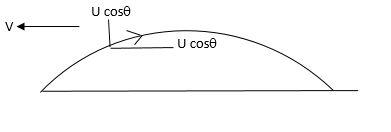
$\therefore 0 = m(u - \cos \theta - v) - 4mv$
$ \Rightarrow v = \dfrac{{4\cos \theta }}{5}$
$\therefore $Velocity of shell along horizontal w.r.t. ground
$ = 4\cos \theta - \dfrac{{u\cos \theta }}{5}$
$ = \dfrac{4}{5}(u\cos \theta )$
Let $x$be the horizontal displacement.
Time required:
$T = \dfrac{{2u\sin \theta }}{g}$
$T = \left( {\dfrac{4}{5}u\cos \theta } \right)\left( {\dfrac{{2u\sin \theta }}{g}} \right)$
$ \Rightarrow T = \dfrac{{4{u^2}\sin 2\theta }}{{5g}}$
Angle of projection$ = \theta $
Range$ = \dfrac{{{4^2}\sin 2\theta }}{{9g}}$
$ = \dfrac{{16{u^2}\sin 2\theta }}{{9g}}$
So, the correct answer is “Option A”.
Note:
The time taken by the projectile to fall back on the ground, will be the same along vertical motion as well as along horizontal motion. So the best way to solve this question is to calculate time using the vertical component of velocity. And then use in for the formula of distance for the horizontal motion, to find range. Maximum horizontal distance covered by a projectile if the angle of projection is ${45^0}$.
Complete step by step answer:
Let,
Mass of the cannon is $5m$, which is resting on a smooth horizontal ground. The shell is fired at an angle of $\theta $ with the horizontal at a velocity $u.$
Now as the initial momentum of the cannon is zero, as it is at rest.
Let the relative velocity of the cannon be $u.$
From momentum of conservation, we have
$Hmv = m(u + v)$
$\therefore V = \dfrac{4}{3},$
Therefore, the initial velocity$ = (4 + v)$
$ = 4 + (4/3).$
$ = \dfrac{{44}}{3}.$
Now along horizontal, we have
$\therefore 0 = m(u - \cos \theta - v) - 4mv$
$ \Rightarrow v = \dfrac{{4\cos \theta }}{5}$
$\therefore $Velocity of shell along horizontal w.r.t. ground
$ = 4\cos \theta - \dfrac{{u\cos \theta }}{5}$
$ = \dfrac{4}{5}(u\cos \theta )$
Let $x$be the horizontal displacement.
Time required:
$T = \dfrac{{2u\sin \theta }}{g}$
$T = \left( {\dfrac{4}{5}u\cos \theta } \right)\left( {\dfrac{{2u\sin \theta }}{g}} \right)$
$ \Rightarrow T = \dfrac{{4{u^2}\sin 2\theta }}{{5g}}$
Angle of projection$ = \theta $
Range$ = \dfrac{{{4^2}\sin 2\theta }}{{9g}}$
$ = \dfrac{{16{u^2}\sin 2\theta }}{{9g}}$
So, the correct answer is “Option A”.
Note:
The time taken by the projectile to fall back on the ground, will be the same along vertical motion as well as along horizontal motion. So the best way to solve this question is to calculate time using the vertical component of velocity. And then use in for the formula of distance for the horizontal motion, to find range. Maximum horizontal distance covered by a projectile if the angle of projection is ${45^0}$.
Recently Updated Pages
Master Class 11 Computer Science: Engaging Questions & Answers for Success

Master Class 11 Business Studies: Engaging Questions & Answers for Success
Master Class 11 Economics: Engaging Questions & Answers for Success
Master Class 11 English: Engaging Questions & Answers for Success
Master Class 11 Maths: Engaging Questions & Answers for Success
Master Class 11 Biology: Engaging Questions & Answers for Success
Trending doubts
One Metric ton is equal to kg A 10000 B 1000 C 100 class 11 physics CBSE
There are 720 permutations of the digits 1 2 3 4 5 class 11 maths CBSE
Discuss the various forms of bacteria class 11 biology CBSE
Draw a diagram of a plant cell and label at least eight class 11 biology CBSE
State the laws of reflection of light
Explain zero factorial class 11 maths CBSE