




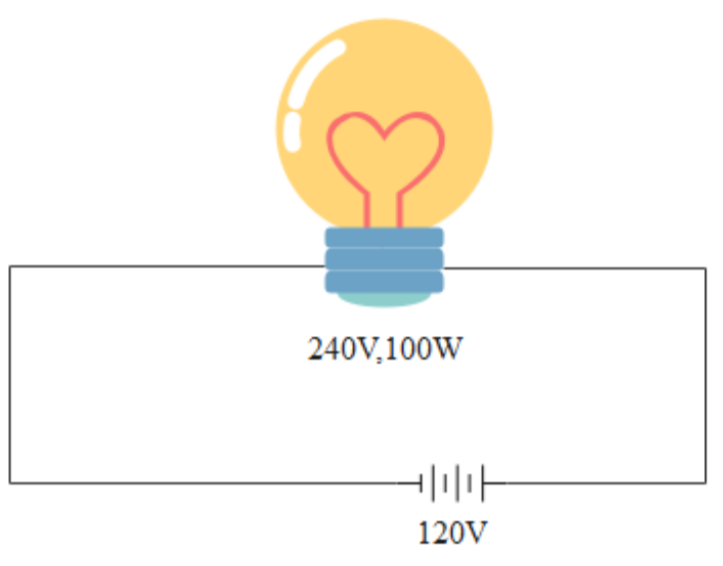
A bulb rated $240V,100W$ is connected to a $120V$ supply. Which of the following is found to be correct?
A. the bulbs fuses
B. the bulb is lighted but is dim
C. the bulb lights up to normal brightness
D. the bulb lighted initially then fuses away
Answer
 Verified
627.9k+ views
Hint: Voltage is the potential difference between the points in an electrical circuit in order to push or pull the charges into the lesser potential side. This causes the charges to flow in the electrical circuit. And the resistance is the opposition provided by the material of wire through which current is flowing. As the resistance is higher, the current flow will be lesser and as the resistance is lower, then the current flow will be maximum. If the resistance is the same then the current flow will be the same. These all may help us to solve this question.
Complete step-by-step solution:
The rating on the bulb is given as,
$V=240V,P=100W$
Here we can see that the maximum potential difference possible for this bulb is given as
$240V$. In the question, it is clearly mentioned that the voltage of the supply to which the bulb is connected is only half of the maximum value. That is,
$V=120V$
From this, we can say that the rated voltage is found to be greater than the supplied voltage. Therefore the bulb will be dim. And also as there is some amount of potential existing, the bulb will be definitely lighted up.
As the resistance of the bulb is not changing and also the voltage has been decreased, the power dissipation will be lesser by the formula,
$H=\dfrac{{{V}^{2}}}{R}t$
Where $t$ be the time taken and \[R\] be the resistance. As the power dissipation is low, the bulb will glow with lesser intensity.
Note: A bulb is an electrical device which is using filaments in order to produce a lighting effect with the use of electric current. There are four types of bulbs. The incandescent bulb, halogen bulb, compact fluorescent bulb, and a light-emitting diode.
Complete step-by-step solution:
The rating on the bulb is given as,
$V=240V,P=100W$
Here we can see that the maximum potential difference possible for this bulb is given as
$240V$. In the question, it is clearly mentioned that the voltage of the supply to which the bulb is connected is only half of the maximum value. That is,
$V=120V$
From this, we can say that the rated voltage is found to be greater than the supplied voltage. Therefore the bulb will be dim. And also as there is some amount of potential existing, the bulb will be definitely lighted up.
As the resistance of the bulb is not changing and also the voltage has been decreased, the power dissipation will be lesser by the formula,
$H=\dfrac{{{V}^{2}}}{R}t$
Where $t$ be the time taken and \[R\] be the resistance. As the power dissipation is low, the bulb will glow with lesser intensity.
Note: A bulb is an electrical device which is using filaments in order to produce a lighting effect with the use of electric current. There are four types of bulbs. The incandescent bulb, halogen bulb, compact fluorescent bulb, and a light-emitting diode.
Recently Updated Pages
Master Class 12 Business Studies: Engaging Questions & Answers for Success

Master Class 12 Chemistry: Engaging Questions & Answers for Success
Master Class 12 Biology: Engaging Questions & Answers for Success
Class 12 Question and Answer - Your Ultimate Solutions Guide
Master Class 11 English: Engaging Questions & Answers for Success
Master Class 11 Social Science: Engaging Questions & Answers for Success
Trending doubts
Which are the Top 10 Largest Countries of the World?
Draw a labelled sketch of the human eye class 12 physics CBSE
Differentiate between homogeneous and heterogeneous class 12 chemistry CBSE
Differentiate between Pyramid of energy and pyramid class 12 biology CBSE
Why is the cell called the structural and functional class 12 biology CBSE
Draw the diagram of the pyramid of energy Explain In class 12 biology CBSE