




A bucket tied at the end of the $ 1.6m $ long string is whirled in a vertical circle with constant speed. What should be the minimum speed so that the coater from the bucket does not spill when the buckets at the highest position? ( $ g = 10m{s^{ - 1}} $ )
(A) $ 16m{s^{ - 1}} $
(B) $ 6.25m{s^{ - 1}} $
(C) $ 4m{s^{ - 1}} $
(D) $ 2m{s^{ - 1}} $
Answer
 Verified
550.5k+ views
Hint : Here, in the question it is clearly said that the bucket is tied to the string and whirled in vertical circle i.e. this is the concept of vertical circular motion. We must have a better understanding of the vertical circular motion and accordingly we can obtain the minimum velocity of the bucket where the coat could not be spilled.
Complete Step By Step Answer:
Let the radius of the vertical circle in which the bucket is whirled is the length of the string be $ R = 1.6m $ , velocity of the bucket be $ v $ and it is constant, $ m $ be the mass of the bucket, $ g $ is the acceleration due to gravity, $ N $ be the normal acting on the body along the radius of the circle.
Let us describe all these terms in the figure below:
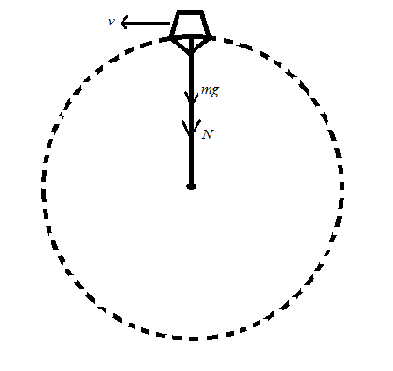
In the above figure we have the bucket tied to the string and whirling around in the vertical circle such that it has the constant velocity.
Now, let us equate the forces acting on the bucket along the radius of the circle.
$ N + mg = {F_C} $ …( the centripetal force $ {F_C} $ is also acting along the radius )
$ {F_C} = \dfrac{{m{v^2}}}{R} $
Therefore, the above equation becomes as:
$ \Rightarrow N + mg = \dfrac{{m{v^2}}}{R} $
$ \Rightarrow N = \dfrac{{m{v^2}}}{R} - mg $
But, $ N \geqslant 0 $ since, we do not want to spill the coat from the bucket
Thus, we have,
$ \Rightarrow \dfrac{{m{v^2}}}{R} - mg \geqslant 0 $
$ \Rightarrow v \geqslant \sqrt {gR} $
Now, minimum velocity at the top of the vertical circle is given by:
$ {v_{\min }} = \sqrt {gR} = \sqrt {10 \times 1.6} m{s^{ - 1}} $
$ \therefore {v_{\min }} = \sqrt {16} m{s^{ - 1}} = 4m{s^{ - 1}} $
Thus, the minimum required velocity at the top of the circle is $ 4m{s^{ - 1}} $
Hence, the correct answer is option C.
Note :
It’s been given in the question that the bucket is in a vertical circle, so it was necessary to use the vertical circular motion concept. As we know that in vertical motion we have to maintain the minimum speed so that we could not spill the coat from the bucket. We have calculated that speed with the help of equating forces acting on a bucket of vertical circle concepts.
Complete Step By Step Answer:
Let the radius of the vertical circle in which the bucket is whirled is the length of the string be $ R = 1.6m $ , velocity of the bucket be $ v $ and it is constant, $ m $ be the mass of the bucket, $ g $ is the acceleration due to gravity, $ N $ be the normal acting on the body along the radius of the circle.
Let us describe all these terms in the figure below:
In the above figure we have the bucket tied to the string and whirling around in the vertical circle such that it has the constant velocity.
Now, let us equate the forces acting on the bucket along the radius of the circle.
$ N + mg = {F_C} $ …( the centripetal force $ {F_C} $ is also acting along the radius )
$ {F_C} = \dfrac{{m{v^2}}}{R} $
Therefore, the above equation becomes as:
$ \Rightarrow N + mg = \dfrac{{m{v^2}}}{R} $
$ \Rightarrow N = \dfrac{{m{v^2}}}{R} - mg $
But, $ N \geqslant 0 $ since, we do not want to spill the coat from the bucket
Thus, we have,
$ \Rightarrow \dfrac{{m{v^2}}}{R} - mg \geqslant 0 $
$ \Rightarrow v \geqslant \sqrt {gR} $
Now, minimum velocity at the top of the vertical circle is given by:
$ {v_{\min }} = \sqrt {gR} = \sqrt {10 \times 1.6} m{s^{ - 1}} $
$ \therefore {v_{\min }} = \sqrt {16} m{s^{ - 1}} = 4m{s^{ - 1}} $
Thus, the minimum required velocity at the top of the circle is $ 4m{s^{ - 1}} $
Hence, the correct answer is option C.
Note :
It’s been given in the question that the bucket is in a vertical circle, so it was necessary to use the vertical circular motion concept. As we know that in vertical motion we have to maintain the minimum speed so that we could not spill the coat from the bucket. We have calculated that speed with the help of equating forces acting on a bucket of vertical circle concepts.
Recently Updated Pages
Master Class 11 Social Science: Engaging Questions & Answers for Success

Master Class 11 Physics: Engaging Questions & Answers for Success
Master Class 11 Maths: Engaging Questions & Answers for Success
Master Class 11 Economics: Engaging Questions & Answers for Success
Master Class 11 Computer Science: Engaging Questions & Answers for Success
Master Class 11 Chemistry: Engaging Questions & Answers for Success
Trending doubts
One Metric ton is equal to kg A 10000 B 1000 C 100 class 11 physics CBSE
There are 720 permutations of the digits 1 2 3 4 5 class 11 maths CBSE
1 Quintal is equal to a 110 kg b 10 kg c 100kg d 1000 class 11 physics CBSE
State and prove Bernoullis theorem class 11 physics CBSE
Difference Between Prokaryotic Cells and Eukaryotic Cells
Which among the following are examples of coming together class 11 social science CBSE