




A bucket of height 8 cm and made up of copper sheet is in the form of frustum of a right circular cone with radii of its lower and upper ends as 3 cm and 9 cm respectively, calculate
$\left( i \right)$ The height of the cone of which the bucket is a part.
$\left( {ii} \right)$ The volume of water which can be filled in the bucket.
$\left( {iii} \right)$ The area of copper sheet required to make the bucket.
Answer
 Verified
651.6k+ views
Hint – In this particular type of question use the concept that in similar triangles the ratio of the respective side length is same and use the concept that volume of the lower part is calculated as subtraction of volume of bigger cone and volume of smaller cone, and the area of the copper sheet required is the total surface area of the bucket = total surface area of the bigger cone – total surface area of the upper smaller cones so use these concepts to reach the solution of the question.
Complete step-by-step answer:
Let ABC be the right circular cone.
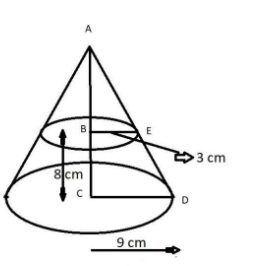
BCDE is the bucket which is in the form of frustum.
The height of the frustum is given which is = 8 cm as shown in the figure.
Therefore, BC = 8 cm
Let the height of the cone be h.
Therefore, AC = h cm.
Now the radii of its lower and upper ends are 3 cm and 9 cm respectively as shown in the figure.
Therefore, BE = 3 cm and CD = 9 cm.
$\left( i \right)$ The height of the cone of which the bucket is a part.
Now the triangle ABE and the triangle ACD is concurrent by the property of angle-angle-angle (AAA).
$\angle BAE = \angle CAD$ (Common)
$\angle ABD = \angle ACD = {90^o}$
$\angle AEB = \angle ADC$ (Alternate angle)
$ \Rightarrow \dfrac{{AB}}{{AC}} = \dfrac{{BE}}{{CD}}$............. (1)
Now the value of AB = height of cone – height of frustum = h – 8 cm.
So substitute the values in equation (1) we have,
$ \Rightarrow \dfrac{{h - 8}}{h} = \dfrac{3}{9}$
Now simplify this we have,
$ \Rightarrow \dfrac{{h - 8}}{h} = \dfrac{1}{3}$
$ \Rightarrow 3h - 24 = h$
$ \Rightarrow 3h - h = 24$
$ \Rightarrow h = \dfrac{{24}}{2} = 12$ Cm.
So, the height of the cone of which the bucket is a part is 12 cm.
$\left( {ii} \right)$ The volume of water which can be filled in the bucket.
As we know that the volume of the cone is $ = \dfrac{1}{3}\pi {\left( {{\text{radius}}} \right)^2}\left( {{\text{height}}} \right)$
So the volume (${V_1}$) of the upper part of the bigger cone which is also a cone is
$ \Rightarrow {V_1} = \dfrac{1}{3}\pi {\left( {BE} \right)^2}\left( {AB} \right) = \dfrac{1}{3}\pi {\left( 3 \right)^2}\left( {h - 8} \right) = \dfrac{1}{3}\pi \left( 9 \right)\left( {12 - 8} \right) = 12\pi $ Cubic cm
Let the volume of the lower part is (${V_2}$) so the volume of the lower part is calculated as subtraction of volume of bigger cone and volume of smaller cone.
Volume (V) of bigger cone is $ = \dfrac{1}{3}\pi {\left( {{\text{radius}}} \right)^2}\left( {{\text{height}}} \right)$
$ \Rightarrow V = \dfrac{1}{3}\pi {\left( {CD} \right)^2}\left( {AC} \right) = \dfrac{1}{3}\pi {\left( 9 \right)^2}\left( {12} \right) = 324\pi $ Cubic cm
So the lower part volume is
$ \Rightarrow {V_2} = V - {V_1}$
$ \Rightarrow {V_2} = 324\pi - 12\pi = 312\pi = 312 \times \dfrac{{22}}{7} = 980.57$ Cubic cm.
So this is the volume of the water which can be filled in the bucket.
$\left( {iii} \right)$ The area of copper sheet required to make the bucket.
The area of the copper sheet required is the total surface area of the bucket = total surface area of the bigger cone – total surface area of the upper smaller cone.
As we know that the total surface area (TSA) of the cone is given as
$ \Rightarrow \pi r\left( {r + l} \right)$
Where l is the slant height of the cone which is given as, $l = \sqrt {{{\left( {{\text{radius}}} \right)}^2} + {{\left( {{\text{height}}} \right)}^2}} $
So the total surface area of the cone is $ = \pi \left( {{\text{radius}}} \right)\left( {{\text{radius}} + \sqrt {{{\left( {{\text{radius}}} \right)}^2} + {{\left( {{\text{height}}} \right)}^2}} } \right)$
So the TSA of the bigger cone is
$\left( {TSA} \right) = \pi \left( {CD} \right)\left( {CD + \sqrt {{{\left( {CD} \right)}^2} + {{\left( {AC} \right)}^2}} } \right) = \pi \left( {\text{9}} \right)\left( {9 + \sqrt {{{\left( {\text{9}} \right)}^2} + {{\left( {{\text{12}}} \right)}^2}} } \right) = 9\pi \left( {9 + \sqrt {81 + 144} } \right)$
$TSA = 9\pi \left( {9 + \sqrt {225} } \right) = 9\pi \left( {9 + 15} \right) = 9\pi \left( {24} \right) = 216\pi $ Square cm.
And the ${\left( {TSA} \right)_1}$ of the smaller cone is
\[{\left( {TSA} \right)_1} = \pi \left( {BE} \right)\left( {BE + \sqrt {{{\left( {BE} \right)}^2} + {{\left( {AB} \right)}^2}} } \right) = \pi \left( 3 \right)\left( {3 + \sqrt {{{\left( 3 \right)}^2} + {{\left( {12 - 8} \right)}^2}} } \right) = 3\pi \left( {3 + \sqrt {9 + 16} } \right) = 3\pi \left( {3 + \sqrt {25} } \right)\]
${\left( {TSA} \right)_1} = 3\pi \left( {3 + \sqrt {25} } \right) = 3\pi \left( {3 + 5} \right) = 24\pi $ Square cm.
So the ${\left( {TSA} \right)_2}$ of the bucket is = TSA – ${\left( {TSA} \right)_1}$= $216\pi - 24\pi = 192\pi $
So the copper sheet required to make the bucket is = $192 \times \dfrac{{22}}{7} = 603.42$ square cm.
So this is the required answer.
Note – Whenever we face such types of questions the key concept we have to remember is that the formula of the volume of the cone and the formula of the total surface area of the cone, so first find out these values of bigger as well as smaller cone as above then subtract these values to get the required volume and the total surface area of the bucket.
Complete step-by-step answer:
Let ABC be the right circular cone.
BCDE is the bucket which is in the form of frustum.
The height of the frustum is given which is = 8 cm as shown in the figure.
Therefore, BC = 8 cm
Let the height of the cone be h.
Therefore, AC = h cm.
Now the radii of its lower and upper ends are 3 cm and 9 cm respectively as shown in the figure.
Therefore, BE = 3 cm and CD = 9 cm.
$\left( i \right)$ The height of the cone of which the bucket is a part.
Now the triangle ABE and the triangle ACD is concurrent by the property of angle-angle-angle (AAA).
$\angle BAE = \angle CAD$ (Common)
$\angle ABD = \angle ACD = {90^o}$
$\angle AEB = \angle ADC$ (Alternate angle)
$ \Rightarrow \dfrac{{AB}}{{AC}} = \dfrac{{BE}}{{CD}}$............. (1)
Now the value of AB = height of cone – height of frustum = h – 8 cm.
So substitute the values in equation (1) we have,
$ \Rightarrow \dfrac{{h - 8}}{h} = \dfrac{3}{9}$
Now simplify this we have,
$ \Rightarrow \dfrac{{h - 8}}{h} = \dfrac{1}{3}$
$ \Rightarrow 3h - 24 = h$
$ \Rightarrow 3h - h = 24$
$ \Rightarrow h = \dfrac{{24}}{2} = 12$ Cm.
So, the height of the cone of which the bucket is a part is 12 cm.
$\left( {ii} \right)$ The volume of water which can be filled in the bucket.
As we know that the volume of the cone is $ = \dfrac{1}{3}\pi {\left( {{\text{radius}}} \right)^2}\left( {{\text{height}}} \right)$
So the volume (${V_1}$) of the upper part of the bigger cone which is also a cone is
$ \Rightarrow {V_1} = \dfrac{1}{3}\pi {\left( {BE} \right)^2}\left( {AB} \right) = \dfrac{1}{3}\pi {\left( 3 \right)^2}\left( {h - 8} \right) = \dfrac{1}{3}\pi \left( 9 \right)\left( {12 - 8} \right) = 12\pi $ Cubic cm
Let the volume of the lower part is (${V_2}$) so the volume of the lower part is calculated as subtraction of volume of bigger cone and volume of smaller cone.
Volume (V) of bigger cone is $ = \dfrac{1}{3}\pi {\left( {{\text{radius}}} \right)^2}\left( {{\text{height}}} \right)$
$ \Rightarrow V = \dfrac{1}{3}\pi {\left( {CD} \right)^2}\left( {AC} \right) = \dfrac{1}{3}\pi {\left( 9 \right)^2}\left( {12} \right) = 324\pi $ Cubic cm
So the lower part volume is
$ \Rightarrow {V_2} = V - {V_1}$
$ \Rightarrow {V_2} = 324\pi - 12\pi = 312\pi = 312 \times \dfrac{{22}}{7} = 980.57$ Cubic cm.
So this is the volume of the water which can be filled in the bucket.
$\left( {iii} \right)$ The area of copper sheet required to make the bucket.
The area of the copper sheet required is the total surface area of the bucket = total surface area of the bigger cone – total surface area of the upper smaller cone.
As we know that the total surface area (TSA) of the cone is given as
$ \Rightarrow \pi r\left( {r + l} \right)$
Where l is the slant height of the cone which is given as, $l = \sqrt {{{\left( {{\text{radius}}} \right)}^2} + {{\left( {{\text{height}}} \right)}^2}} $
So the total surface area of the cone is $ = \pi \left( {{\text{radius}}} \right)\left( {{\text{radius}} + \sqrt {{{\left( {{\text{radius}}} \right)}^2} + {{\left( {{\text{height}}} \right)}^2}} } \right)$
So the TSA of the bigger cone is
$\left( {TSA} \right) = \pi \left( {CD} \right)\left( {CD + \sqrt {{{\left( {CD} \right)}^2} + {{\left( {AC} \right)}^2}} } \right) = \pi \left( {\text{9}} \right)\left( {9 + \sqrt {{{\left( {\text{9}} \right)}^2} + {{\left( {{\text{12}}} \right)}^2}} } \right) = 9\pi \left( {9 + \sqrt {81 + 144} } \right)$
$TSA = 9\pi \left( {9 + \sqrt {225} } \right) = 9\pi \left( {9 + 15} \right) = 9\pi \left( {24} \right) = 216\pi $ Square cm.
And the ${\left( {TSA} \right)_1}$ of the smaller cone is
\[{\left( {TSA} \right)_1} = \pi \left( {BE} \right)\left( {BE + \sqrt {{{\left( {BE} \right)}^2} + {{\left( {AB} \right)}^2}} } \right) = \pi \left( 3 \right)\left( {3 + \sqrt {{{\left( 3 \right)}^2} + {{\left( {12 - 8} \right)}^2}} } \right) = 3\pi \left( {3 + \sqrt {9 + 16} } \right) = 3\pi \left( {3 + \sqrt {25} } \right)\]
${\left( {TSA} \right)_1} = 3\pi \left( {3 + \sqrt {25} } \right) = 3\pi \left( {3 + 5} \right) = 24\pi $ Square cm.
So the ${\left( {TSA} \right)_2}$ of the bucket is = TSA – ${\left( {TSA} \right)_1}$= $216\pi - 24\pi = 192\pi $
So the copper sheet required to make the bucket is = $192 \times \dfrac{{22}}{7} = 603.42$ square cm.
So this is the required answer.
Note – Whenever we face such types of questions the key concept we have to remember is that the formula of the volume of the cone and the formula of the total surface area of the cone, so first find out these values of bigger as well as smaller cone as above then subtract these values to get the required volume and the total surface area of the bucket.
Recently Updated Pages
Basicity of sulphurous acid and sulphuric acid are

Master Class 12 Economics: Engaging Questions & Answers for Success
Master Class 12 Biology: Engaging Questions & Answers for Success
Master Class 11 English: Engaging Questions & Answers for Success
Master Class 11 Physics: Engaging Questions & Answers for Success
Master Class 11 Computer Science: Engaging Questions & Answers for Success
Trending doubts
What is the Total Duration of Football Match?
Explain the Treaty of Vienna of 1815 class 10 social science CBSE
In football, which nation is called "La Roja"?
Why is there a time difference of about 5 hours between class 10 social science CBSE
10 examples of evaporation in daily life with explanations
What is the full form of POSCO class 10 social science CBSE