




A boy weighing 25kg climbs up from the first floor at height 3m above the ground to the third floor at height 9m above the ground. What will be the increase in gravitational potential energy?
A) 1KJ
B) 1.3KJ
C) 1.5KJ
D) None of the above
Answer
 Verified
555k+ views
Hint: We can approach this problem by understanding the gravitational potential energy(U) which is equal to ‘mgh’. Where, “m” is the mass of the object in Kg, “g” is the gravitational constant whose value is , and “h” is the height of the object from the reference or ground position. We have to start first with the given quantities.
Complete answer:
Gravitational potential energy is the energy obtained by an object due to its position with respect to some other object. Now in the given question we are asked to determine the increase in potential energy when a person climbs some height as shown in figure below:
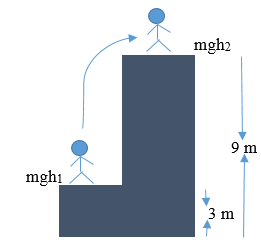
Using the gravitational potential energy formula, the potential energy at the third floor is mgh2 and potential energy at the first floor is $mg{{h}_{1}}$.
In the given question m = 25 kg, g = $10m{{s}^{-1}}$, ${{h}_{1}}$ = 3 m, and ${{h}_{2}}$ = 9 m.
The increase in potential energy will equal to the potential energy of the person at 3rd floor with respect to the potential energy of the person at 1st floor:
Increase in P.E. = mg(${{h}_{2}}$ –${{h}_{1}}$ ) = $25\times 10\times 6$= 1.5 KJ.
Note:
One can also find the increase in potential energy by separately evaluating mgh1 and mgh2 and then subtracting them. The formula for potential energy depends on the force acting on the two objects, in our case these are earth and the person. The person on the third floor will have more potential energy than the person on the first floor because the earth can pull you down through the force of gravity, doing work in the process. Also, Joule’s base standard units are $Kg{{m}^{2}}{{s}^{-1}}$
Complete answer:
Gravitational potential energy is the energy obtained by an object due to its position with respect to some other object. Now in the given question we are asked to determine the increase in potential energy when a person climbs some height as shown in figure below:
Using the gravitational potential energy formula, the potential energy at the third floor is mgh2 and potential energy at the first floor is $mg{{h}_{1}}$.
In the given question m = 25 kg, g = $10m{{s}^{-1}}$, ${{h}_{1}}$ = 3 m, and ${{h}_{2}}$ = 9 m.
The increase in potential energy will equal to the potential energy of the person at 3rd floor with respect to the potential energy of the person at 1st floor:
Increase in P.E. = mg(${{h}_{2}}$ –${{h}_{1}}$ ) = $25\times 10\times 6$= 1.5 KJ.
Note:
One can also find the increase in potential energy by separately evaluating mgh1 and mgh2 and then subtracting them. The formula for potential energy depends on the force acting on the two objects, in our case these are earth and the person. The person on the third floor will have more potential energy than the person on the first floor because the earth can pull you down through the force of gravity, doing work in the process. Also, Joule’s base standard units are $Kg{{m}^{2}}{{s}^{-1}}$
Recently Updated Pages
Master Class 11 English: Engaging Questions & Answers for Success

Master Class 11 Maths: Engaging Questions & Answers for Success
Master Class 11 Biology: Engaging Questions & Answers for Success
Master Class 11 Social Science: Engaging Questions & Answers for Success
Master Class 11 Physics: Engaging Questions & Answers for Success
Master Class 11 Accountancy: Engaging Questions & Answers for Success
Trending doubts
One Metric ton is equal to kg A 10000 B 1000 C 100 class 11 physics CBSE
There are 720 permutations of the digits 1 2 3 4 5 class 11 maths CBSE
Discuss the various forms of bacteria class 11 biology CBSE
Draw a diagram of a plant cell and label at least eight class 11 biology CBSE
State the laws of reflection of light
Explain zero factorial class 11 maths CBSE