




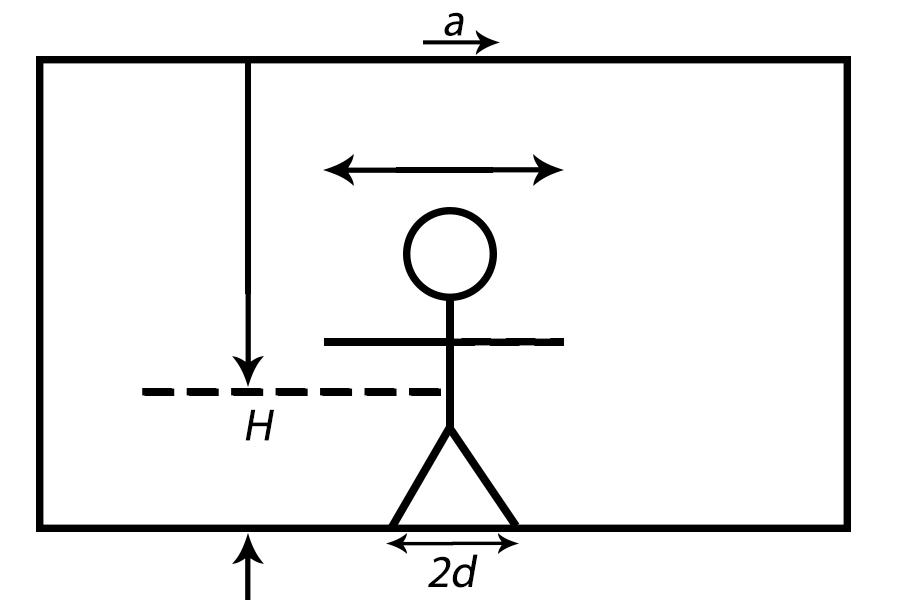
A boy of mass m with his mass centred at height H is standing in a train moving with constant acceleration a. If his legs are wide spread with a distance 2d and he is not taking the help of any support then normal reactions at his feet are given by
A. \[\dfrac{m}{2}\left( {g + \dfrac{{Ha}}{d}} \right);\;\dfrac{m}{2}\left( {g - \dfrac{{Ha}}{d}} \right)\]
B. \[m\left( {a + g} \right);mg\]
C. \[\dfrac{{Hma}}{d};\;\dfrac{m}{2}\left( {g - \dfrac{{Ha}}{d}} \right)\]
D. \[mg;\;mg\]
Answer
 Verified
593.4k+ views
Hint: The above problem can be resolved using the concept and applications of normal reactions, along with the fundamentals of the equilibrium of forces. In this problem, we suppose to balance the vertical component of force, that is the normal reaction acting on both foot. Moreover, the equilibrium is also applied to form some numerical equations, and these equations are then resolved using the substitution method, and this upon solving will provide the magnitude of normal reactions.
Complete step by step answer:
Given data:
The mass of body is, \[m\].
The distance between the centre of mass and standing point is, \[H\].
The distance between the legs is, \[2d\].
Apply the condition of the equilibrium of forces for the normal reaction force as,
\[{N_1} + {N_2} = mg\]…………………………………………. (1)
Here, \[{N_1}\] and \[{N_2}\] are the magnitude of normal reaction force on both the foot respectively and g the magnitude of gravitational acceleration.
The necessary condition of equilibrium for the given problem is,
\[maH = {N_1}d - {N_2}d\]…………………………………………. (2)
Modifying the above equation as,
\[\begin{array}{l}
maH = {N_1}d - {N_2}d\\
{N_1} - {N_2} = \dfrac{{maH}}{d}
\end{array}\]………………………………………… (3)
Solve the equation 3 and 1 to get the values as,
\[{N_1} = \dfrac{m}{2}\left( {g + \dfrac{{aH}}{d}} \right)\]
Now substitute the above value in equation 1 as,
\[\begin{array}{l}
{N_1} + {N_2} = mg\\
\dfrac{m}{2}\left( {g + \dfrac{{aH}}{d}} \right) + {N_2} = mg\\
{N_2} = \dfrac{m}{2}\left( {g - \dfrac{{Ha}}{d}} \right)
\end{array}\]
Therefore, the magnitude of normal reaction at his feet are \[\dfrac{m}{2}\left( {g + \dfrac{{aH}}{d}} \right)\] and \[\dfrac{m}{2}\left( {g - \dfrac{{Ha}}{d}} \right)\] and option (A) is correct.
Note:To resolve the given problem, one must be clear regarding the concept and meaning of the normal reaction forces, along with its applications, to calculate the equilibrium of forces. The equilibrium if forces are said to be maintained when there occurs condition for the zero motion of the body.
Complete step by step answer:
Given data:
The mass of body is, \[m\].
The distance between the centre of mass and standing point is, \[H\].
The distance between the legs is, \[2d\].
Apply the condition of the equilibrium of forces for the normal reaction force as,
\[{N_1} + {N_2} = mg\]…………………………………………. (1)
Here, \[{N_1}\] and \[{N_2}\] are the magnitude of normal reaction force on both the foot respectively and g the magnitude of gravitational acceleration.
The necessary condition of equilibrium for the given problem is,
\[maH = {N_1}d - {N_2}d\]…………………………………………. (2)
Modifying the above equation as,
\[\begin{array}{l}
maH = {N_1}d - {N_2}d\\
{N_1} - {N_2} = \dfrac{{maH}}{d}
\end{array}\]………………………………………… (3)
Solve the equation 3 and 1 to get the values as,
\[{N_1} = \dfrac{m}{2}\left( {g + \dfrac{{aH}}{d}} \right)\]
Now substitute the above value in equation 1 as,
\[\begin{array}{l}
{N_1} + {N_2} = mg\\
\dfrac{m}{2}\left( {g + \dfrac{{aH}}{d}} \right) + {N_2} = mg\\
{N_2} = \dfrac{m}{2}\left( {g - \dfrac{{Ha}}{d}} \right)
\end{array}\]
Therefore, the magnitude of normal reaction at his feet are \[\dfrac{m}{2}\left( {g + \dfrac{{aH}}{d}} \right)\] and \[\dfrac{m}{2}\left( {g - \dfrac{{Ha}}{d}} \right)\] and option (A) is correct.
Note:To resolve the given problem, one must be clear regarding the concept and meaning of the normal reaction forces, along with its applications, to calculate the equilibrium of forces. The equilibrium if forces are said to be maintained when there occurs condition for the zero motion of the body.
Recently Updated Pages
Master Class 11 Social Science: Engaging Questions & Answers for Success

Master Class 11 English: Engaging Questions & Answers for Success
Master Class 11 Maths: Engaging Questions & Answers for Success
Master Class 11 Chemistry: Engaging Questions & Answers for Success
Master Class 11 Biology: Engaging Questions & Answers for Success
Master Class 11 Physics: Engaging Questions & Answers for Success
Trending doubts
Differentiate between an exothermic and an endothermic class 11 chemistry CBSE
One Metric ton is equal to kg A 10000 B 1000 C 100 class 11 physics CBSE
Difference Between Prokaryotic Cells and Eukaryotic Cells
There are 720 permutations of the digits 1 2 3 4 5 class 11 maths CBSE
Two of the body parts which do not appear in MRI are class 11 biology CBSE
Which gas is abundant in air class 11 chemistry CBSE