




A boy of mass M stands on a platform of radius R capable to rotate freely about its axis. The moment of inertia of the platform is I. The system is at rest. The friend of the boy throws a ball of mass m with a velocity v horizontally. The boy on the platform catches it. Find the angular velocity of the system in the process.
A) $\dfrac{{mvR}}{{\left( {M + m} \right){R^2}}}$
B) $\dfrac{{mvR}}{{I + M{R^2}}}$
C) $\dfrac{{mvR}}{{I + m{R^2}}}$
D) $\dfrac{{mvR}}{{I + \left( {M + m} \right){R^2}}}$
Answer
 Verified
584.7k+ views
Hint: The platform starts rotating because the boys try to maintain the balance and frictional force comes into action. After looking at the system we can observe which quantity is conserved and then proceed accordingly.
Moment of Inertia is defined as the product of masses in the system and the square of the distance from the centre.
Complete step by step answer:
The system according to the question can be represented as:
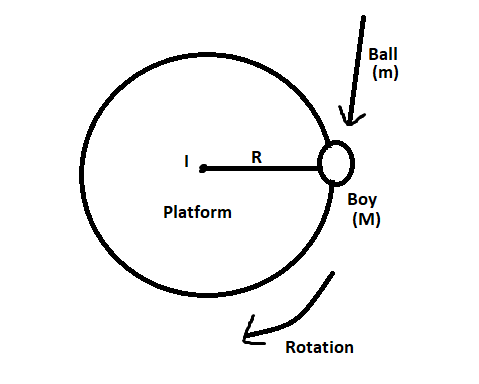
The net external torque is 0 (null) because all the forces acting upon the boy are internal. This implies that the angular momentum is conserved which is given as:
Initial angular momentum = Final angular momentum ________ (1)
Now,
Initial angular momentum = mvR [Product of linear momentum (mv) and distance from centre(R)]
Final angular momentum = Product of Moment of Inertia of the centre after the ball is catched (since the body starts rotating) and the angular speed $\left( \omega \right)$
Moment of Inertia at the centre = product of sum of masses and square of the distance from the centre.
Moment of Inertia of the centre = $[I + (M + m){R^2}]$
Thus, the final angular momentum = $[I + (M + m){R^2}]\omega $
Substituting these values of initial and final angular momentums in (1), we get:
mvR = $[I + (M + m){R^2}]\omega $
Calculating for angular speed $\left( \omega \right)$
$\omega = \dfrac{{mvR}}{{I + \left( {M + m} \right){R^2}}}$
Therefore, the angular velocity of the system in the complete given process is $\dfrac{{mvR}}{{I + \left( {M + m} \right){R^2}}}$, option D).
Note: Linear velocity (in line) is represented by ‘v’ where as angular velocity (in rotational motion) is represented by $'\omega '$ and the relationship is given as $v = \omega r$
Similarly,
Linear momentum is represented by p (p = mv) and angular momentum is denoted by Land the relationship is given as L = pr and thus L = mvr
r in both cases represents the distance of the object from the centre.
Moment of Inertia is defined as the product of masses in the system and the square of the distance from the centre.
Complete step by step answer:
The system according to the question can be represented as:
The net external torque is 0 (null) because all the forces acting upon the boy are internal. This implies that the angular momentum is conserved which is given as:
Initial angular momentum = Final angular momentum ________ (1)
Now,
Initial angular momentum = mvR [Product of linear momentum (mv) and distance from centre(R)]
Final angular momentum = Product of Moment of Inertia of the centre after the ball is catched (since the body starts rotating) and the angular speed $\left( \omega \right)$
Moment of Inertia at the centre = product of sum of masses and square of the distance from the centre.
Moment of Inertia of the centre = $[I + (M + m){R^2}]$
Thus, the final angular momentum = $[I + (M + m){R^2}]\omega $
Substituting these values of initial and final angular momentums in (1), we get:
mvR = $[I + (M + m){R^2}]\omega $
Calculating for angular speed $\left( \omega \right)$
$\omega = \dfrac{{mvR}}{{I + \left( {M + m} \right){R^2}}}$
Therefore, the angular velocity of the system in the complete given process is $\dfrac{{mvR}}{{I + \left( {M + m} \right){R^2}}}$, option D).
Note: Linear velocity (in line) is represented by ‘v’ where as angular velocity (in rotational motion) is represented by $'\omega '$ and the relationship is given as $v = \omega r$
Similarly,
Linear momentum is represented by p (p = mv) and angular momentum is denoted by Land the relationship is given as L = pr and thus L = mvr
r in both cases represents the distance of the object from the centre.
Recently Updated Pages
Master Class 11 Business Studies: Engaging Questions & Answers for Success

Master Class 11 Economics: Engaging Questions & Answers for Success
Master Class 11 Computer Science: Engaging Questions & Answers for Success
Master Class 11 English: Engaging Questions & Answers for Success
Master Class 11 Maths: Engaging Questions & Answers for Success
Master Class 11 Biology: Engaging Questions & Answers for Success
Trending doubts
One Metric ton is equal to kg A 10000 B 1000 C 100 class 11 physics CBSE
Discuss the various forms of bacteria class 11 biology CBSE
Draw a diagram of a plant cell and label at least eight class 11 biology CBSE
State the laws of reflection of light
Explain zero factorial class 11 maths CBSE
10 examples of friction in our daily life