




A boy of height 1.5m with his eyes level at 1.4m stands before a plane mirror of length 0.75m fixed on the wall. The height of the lower edge of the mirror above the floor is 0.8m. then
A) The boy will see his full image
B) The boy cannot see his hair
C) The body cannot see his feet
D) The boy can see neither his hair nor his feet
Answer
 Verified
618k+ views
Hint: First we have to use the theorem for similar triangles. There are 3 triangles formed, the first triangle is formed at height 1.4m, second one is formed at height 0.8m, and then the third triangle has the height y. equate these triangle by using a theorem of similar triangle through this we have to find y. y is the length of image formed.
Complete Step by step solution:
Let y be the length of the image which can`t be seen by the boy.
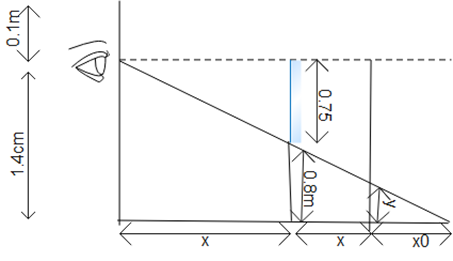
From, similar triangle theorem we get.
$\begin{align}
& \Rightarrow \dfrac{y}{{{x_0}}} = \dfrac{{0.8}}{{x + {x_0}}} \\
& \therefore y = \dfrac{{0.8 \times {x_0}}}{{x + {x_0}}} - - - - (1) \\
\end{align} $
Named above equation as (1)
Similarly, we get
$\dfrac{{1.4}}{{x + x + {x_0}}} = \dfrac{{0.8}}{{x + {x_0}}}$
$\begin{align}
&\Rightarrow 1.4 \times \left( {x + {x_0}} \right) = 0.8 \times \left( {2x + {x_0}} \right) \\
& \therefore {x_0} = \dfrac{x}{3} \
\end{align} $
By rearranging the above equation we get
$x = 3 \times {x_0} - - - - (2)$
Substitute equation (2) in equation (1) we get
$\begin{align}
& \Rightarrow y = \dfrac{{0.8 \times {x_0}}}{{3 \times {x_0} + {x_0}}} \\
& \Rightarrow y = \dfrac{{0.8{x_0}}}{{4{x_0}}} \\
\end{align} $
$\therefore y = 0.2m$
Hence the length of the image he can't see in the mirror is 0.2m i.e he cannot see his feet.
So, option C is the correct answer.
Additional information:
A plane mirror is the mirror which has a flat reflective surface.
Plane mirrors produce virtual images.
Note:
We have basic knowledge, if the size of the mirror was 1.5m or greater than that then only a boy could have seen the image of full body.the minimum size of the mirror required to see his full image of the boy must have half of the boy size.
Complete Step by step solution:
Let y be the length of the image which can`t be seen by the boy.
From, similar triangle theorem we get.
$\begin{align}
& \Rightarrow \dfrac{y}{{{x_0}}} = \dfrac{{0.8}}{{x + {x_0}}} \\
& \therefore y = \dfrac{{0.8 \times {x_0}}}{{x + {x_0}}} - - - - (1) \\
\end{align} $
Named above equation as (1)
Similarly, we get
$\dfrac{{1.4}}{{x + x + {x_0}}} = \dfrac{{0.8}}{{x + {x_0}}}$
$\begin{align}
&\Rightarrow 1.4 \times \left( {x + {x_0}} \right) = 0.8 \times \left( {2x + {x_0}} \right) \\
& \therefore {x_0} = \dfrac{x}{3} \
\end{align} $
By rearranging the above equation we get
$x = 3 \times {x_0} - - - - (2)$
Substitute equation (2) in equation (1) we get
$\begin{align}
& \Rightarrow y = \dfrac{{0.8 \times {x_0}}}{{3 \times {x_0} + {x_0}}} \\
& \Rightarrow y = \dfrac{{0.8{x_0}}}{{4{x_0}}} \\
\end{align} $
$\therefore y = 0.2m$
Hence the length of the image he can't see in the mirror is 0.2m i.e he cannot see his feet.
So, option C is the correct answer.
Additional information:
A plane mirror is the mirror which has a flat reflective surface.
Plane mirrors produce virtual images.
Note:
We have basic knowledge, if the size of the mirror was 1.5m or greater than that then only a boy could have seen the image of full body.the minimum size of the mirror required to see his full image of the boy must have half of the boy size.
Recently Updated Pages
Master Class 12 Economics: Engaging Questions & Answers for Success

Master Class 12 Social Science: Engaging Questions & Answers for Success
Master Class 12 English: Engaging Questions & Answers for Success
Master Class 12 Maths: Engaging Questions & Answers for Success
Master Class 12 Physics: Engaging Questions & Answers for Success
Master Class 12 Biology: Engaging Questions & Answers for Success
Trending doubts
Draw a labelled sketch of the human eye class 12 physics CBSE
Which are the Top 10 Largest Countries of the World?
Draw ray diagrams each showing i myopic eye and ii class 12 physics CBSE
Which is the correct genotypic ratio of mendel dihybrid class 12 biology CBSE
Differentiate between homogeneous and heterogeneous class 12 chemistry CBSE
Which animal never drinks water in its entire life class 12 biology CBSE