




A boy lifts up a stone of $ 1000kg $ using a hydraulic lift as shown below!
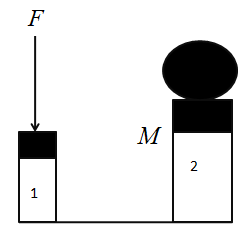
If the larger piston area has $ 250 $ times the smaller piston area, by ignoring the difference in height of fluid between the two pistons, find the minimum force to lift up the stone.
Answer
 Verified
487.5k+ views
Hint: We can answer the above question using Pascal’s law. Hydraulic lift is said to be an application of Pascal's law. Pascal’s law states that the external pressure applied on a confined liquid is distributed evenly throughout the liquid in all directions. Hydraulic lift systems always use incompressible liquids such as oil or water.
Complete Step By Step Answer:
Let the area of the smaller piston can be represented as $ A $ . And the area of the larger piston is $ 250 $ times the area of the smaller piston. Therefore the area of the larger piston is $ 250A $ .
Since from pascal’s law, we know that the pressure at one point in the system is the same throughout the liquid.
$ {P_1} = {P_2} $
We know the pressure formula is given by force divided by area. Therefore,
$ P = \dfrac{F}{A} $
Therefore substituting this in the above equation.
$ \dfrac{{{F_1}}}{{{A_1}}} = \dfrac{{{F_2}}}{{{A_2}}} $ …… (1)
We need to find the force required to lift the mass of $ 1000kg $ the stone. So the weight of this stone can be calculated using the weight formula,
$ W = mg $
Here, $ m $ is the mass of the stone and $ g $ is the gravitational acceleration.
Therefore substituting the mass of the stone in the weight of the stone and also we can substitute for the gravitational acceleration $ 10m/{s^2} $ . Therefore,
$ W = 1000 \times 10 $
$ \Rightarrow W = 10000kg $
We know that, $ F = mg $
Therefore we can substitute this as $ Forc{e_1} $ in the equation (1)
Rearranging equation (1) to get $ Forc{e_2} $ we get,
$ \dfrac{{{A_1} \times {F_1}}}{{{A_2}}} = {F_2} $
$ \Rightarrow \dfrac{{A \times 10000}}{{250A}} = {F_2} $
$ \Rightarrow \dfrac{{1000g}}{{250}} = {F_2} $
$ {F_2} = 40N $
Correct Answer: Therefore the minimum force required to lift the stone of mass $ 1000kg $ is given by $ 40N $ .
Note:
We know that hydraulic lift is one of the applications of Pascal's law. There are also other applications of Pascal's law. They are hydraulic jack, hydraulic brakes, hydraulic pumps, and aircraft hydraulic systems. This law was first given by a French mathematician, physicist, and philosopher Blaise Pascal in the year $ 1647 $ .
Complete Step By Step Answer:
Let the area of the smaller piston can be represented as $ A $ . And the area of the larger piston is $ 250 $ times the area of the smaller piston. Therefore the area of the larger piston is $ 250A $ .
Since from pascal’s law, we know that the pressure at one point in the system is the same throughout the liquid.
$ {P_1} = {P_2} $
We know the pressure formula is given by force divided by area. Therefore,
$ P = \dfrac{F}{A} $
Therefore substituting this in the above equation.
$ \dfrac{{{F_1}}}{{{A_1}}} = \dfrac{{{F_2}}}{{{A_2}}} $ …… (1)
We need to find the force required to lift the mass of $ 1000kg $ the stone. So the weight of this stone can be calculated using the weight formula,
$ W = mg $
Here, $ m $ is the mass of the stone and $ g $ is the gravitational acceleration.
Therefore substituting the mass of the stone in the weight of the stone and also we can substitute for the gravitational acceleration $ 10m/{s^2} $ . Therefore,
$ W = 1000 \times 10 $
$ \Rightarrow W = 10000kg $
We know that, $ F = mg $
Therefore we can substitute this as $ Forc{e_1} $ in the equation (1)
Rearranging equation (1) to get $ Forc{e_2} $ we get,
$ \dfrac{{{A_1} \times {F_1}}}{{{A_2}}} = {F_2} $
$ \Rightarrow \dfrac{{A \times 10000}}{{250A}} = {F_2} $
$ \Rightarrow \dfrac{{1000g}}{{250}} = {F_2} $
$ {F_2} = 40N $
Correct Answer: Therefore the minimum force required to lift the stone of mass $ 1000kg $ is given by $ 40N $ .
Note:
We know that hydraulic lift is one of the applications of Pascal's law. There are also other applications of Pascal's law. They are hydraulic jack, hydraulic brakes, hydraulic pumps, and aircraft hydraulic systems. This law was first given by a French mathematician, physicist, and philosopher Blaise Pascal in the year $ 1647 $ .
Recently Updated Pages
Master Class 11 Computer Science: Engaging Questions & Answers for Success

Master Class 11 Business Studies: Engaging Questions & Answers for Success
Master Class 11 Economics: Engaging Questions & Answers for Success
Master Class 11 English: Engaging Questions & Answers for Success
Master Class 11 Maths: Engaging Questions & Answers for Success
Master Class 11 Biology: Engaging Questions & Answers for Success
Trending doubts
One Metric ton is equal to kg A 10000 B 1000 C 100 class 11 physics CBSE
There are 720 permutations of the digits 1 2 3 4 5 class 11 maths CBSE
Discuss the various forms of bacteria class 11 biology CBSE
Draw a diagram of a plant cell and label at least eight class 11 biology CBSE
State the laws of reflection of light
Explain zero factorial class 11 maths CBSE