




A bottle of soda water is rotated in a vertical circle by holding the neck of the bottle in the hand. Find out where the air bubbles get collected.
A) Near the neck.
B) Near the bottom.
C) In the middle.
D) At the centre of the bottle.
Answer
 Verified
605.1k+ views
Hint:The bottle is rotated with the neck held in hand. So, the bottle undergoes a circular motion and the neck of the bottle acts as the centre of the circular motion. The centripetal force acting on the bottle is directed towards the centre.
Complete step by step answer.
Step 1: Sketch a figure representing the bottle at different positions along its circular path and explain the position of the air bubbles in the bottle.
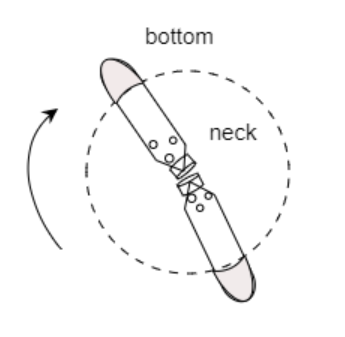
The above figure represents the position of the bottle at different instances as it is rotated in a vertical circle.
Since the motion of the bottle describes a circular path, a centripetal force acts on it. The centripetal force is always directed to the centre of the circle and hence directs the gas bubbles towards the centre. The centrifugal force is however directed away from the centre. The effect of the centrifugal force is maximum at the bottom of the bottle and minimum at the neck. When the bottle is rotated the soda water pushes back the gas bubbles and moves further into the bottle i.e., towards the bottom of the bottle.
So at every instance of the rotation, the gas bubbles get collected near the centre of the circular motion. Here, the neck of the bottle acts as the centre and so they will get collected near the neck of the bottle.
So, option A is correct
Note: The centripetal force pulls the bottle and all its content towards the centre. It is what keeps the bottle along its circular path. The centrifugal force tries to constantly push the contents of the bottle away from the centre. The gas bubbles are way lighter than the soda water. So, the centrifugal force experienced by the gas bubbles will be less compared to the soda water.
Complete step by step answer.
Step 1: Sketch a figure representing the bottle at different positions along its circular path and explain the position of the air bubbles in the bottle.
The above figure represents the position of the bottle at different instances as it is rotated in a vertical circle.
Since the motion of the bottle describes a circular path, a centripetal force acts on it. The centripetal force is always directed to the centre of the circle and hence directs the gas bubbles towards the centre. The centrifugal force is however directed away from the centre. The effect of the centrifugal force is maximum at the bottom of the bottle and minimum at the neck. When the bottle is rotated the soda water pushes back the gas bubbles and moves further into the bottle i.e., towards the bottom of the bottle.
So at every instance of the rotation, the gas bubbles get collected near the centre of the circular motion. Here, the neck of the bottle acts as the centre and so they will get collected near the neck of the bottle.
So, option A is correct
Note: The centripetal force pulls the bottle and all its content towards the centre. It is what keeps the bottle along its circular path. The centrifugal force tries to constantly push the contents of the bottle away from the centre. The gas bubbles are way lighter than the soda water. So, the centrifugal force experienced by the gas bubbles will be less compared to the soda water.
Recently Updated Pages
Master Class 11 English: Engaging Questions & Answers for Success

Master Class 11 Maths: Engaging Questions & Answers for Success
Class 11 Question and Answer - Your Ultimate Solutions Guide
Master Class 11 Biology: Engaging Questions & Answers for Success
Master Class 11 Physics: Engaging Questions & Answers for Success
Master Class 11 Accountancy: Engaging Questions & Answers for Success
Trending doubts
Differentiate between an exothermic and an endothermic class 11 chemistry CBSE
One Metric ton is equal to kg A 10000 B 1000 C 100 class 11 physics CBSE
Difference Between Prokaryotic Cells and Eukaryotic Cells
There are 720 permutations of the digits 1 2 3 4 5 class 11 maths CBSE
Draw a diagram of a plant cell and label at least eight class 11 biology CBSE
1 Quintal is equal to a 110 kg b 10 kg c 100kg d 1000 class 11 physics CBSE