




What would a Bohr model for magnesium look like?
Answer
 Verified
603k+ views
Hint: Draw a nucleus with required number of shells. Since the total number of electrons in a magnesium atom are 12. So start filling them up in the shells around the nucleus one by one keeping in mind the number of electrons a shell can accommodate.
Complete answer:
Magnesium (chemical symbol: Mg) is a s block element and has atomic number 12. It is an extremely important mineral as it is involved in various reactions taking place in our body. Its electronic configuration can be written as follows:-
$[Ne]3{{s}^{2}}$
-Neil Bohr proposed an early model of an atom in which central nuclei containing neutrons and protons are surrounded by electrons revolving around them in different shells. In all electrically neutral atoms, the no. of electrons = no. of protons which are certainly equal to the atomic number of the element which makes it different from every other element.
-Electron filling is done in a consistent manner which is instructed as follows:-
Under the standard conditions, we must start from the innermost shell and fill only 2 electrons in it and move to next.
Then according to octet rule, the next shell must not accommodate more than 8 electrons and so on.
We can now begin with filling of 12 electrons around a nucleus containing 12 protons and 12 neutrons.
-Make a nucleus with 12 protons and 12 neutrons. Now fill 2 electrons in the innermost shell (K-shell) and then 8 electrons in the next shell (L-shell). Since we had 12 electrons among which 10 are already accommodated so last 2 electrons can be fitted in the next shell at the end.
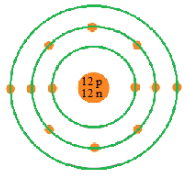
This is the Bohr model of magnesium with 12 electrons revolving around it in different shells (energy levels).
Note: The electrons in the outermost shell or energy level are helpful in finding the properties of that particular element. Also these electrons are known as valence electrons which play a vital role in reactions. The total no. of valence electron of magnesium = 2
Complete answer:
Magnesium (chemical symbol: Mg) is a s block element and has atomic number 12. It is an extremely important mineral as it is involved in various reactions taking place in our body. Its electronic configuration can be written as follows:-
$[Ne]3{{s}^{2}}$
-Neil Bohr proposed an early model of an atom in which central nuclei containing neutrons and protons are surrounded by electrons revolving around them in different shells. In all electrically neutral atoms, the no. of electrons = no. of protons which are certainly equal to the atomic number of the element which makes it different from every other element.
-Electron filling is done in a consistent manner which is instructed as follows:-
Under the standard conditions, we must start from the innermost shell and fill only 2 electrons in it and move to next.
Then according to octet rule, the next shell must not accommodate more than 8 electrons and so on.
We can now begin with filling of 12 electrons around a nucleus containing 12 protons and 12 neutrons.
-Make a nucleus with 12 protons and 12 neutrons. Now fill 2 electrons in the innermost shell (K-shell) and then 8 electrons in the next shell (L-shell). Since we had 12 electrons among which 10 are already accommodated so last 2 electrons can be fitted in the next shell at the end.
This is the Bohr model of magnesium with 12 electrons revolving around it in different shells (energy levels).
Note: The electrons in the outermost shell or energy level are helpful in finding the properties of that particular element. Also these electrons are known as valence electrons which play a vital role in reactions. The total no. of valence electron of magnesium = 2
Recently Updated Pages
If x a + bt + ct2 where x is in meters and t is in class 11 physics CBSE

A car covers the first half distance between two places class 11 physics CBSE
The resultant of two vectors overrightarrow P and overrightarrow class 11 physics CBSE
Find the value of cos 135 class 11 maths CBSE
A mass M is held in place by an applied force F and class 11 physics CBSE
A solution of glucose in water is labelled as 10 dfracwv class 11 chemistry CBSE
Trending doubts
One Metric ton is equal to kg A 10000 B 1000 C 100 class 11 physics CBSE
Find the value of the expression given below sin 30circ class 11 maths CBSE
Draw a diagram of nephron and explain its structur class 11 biology CBSE
10 examples of friction in our daily life
Proton was discovered by A Thomson B Rutherford C Chadwick class 11 chemistry CBSE
Bond order ofO2 O2+ O2 and O22 is in order A O2 langle class 11 chemistry CBSE