




A body that starts from rest accelerates uniformly along a straight line at the rate of \[10{\text{ }}m{s^{ - 2}}\] for \[5\sec \] . It moves for \[2\sec \] with a uniform velocity of \[50{\text{ }}m{s^{ - 1}}\] . Then it retards uniformly and comes to rest in \[3\sec \] . Draw the velocity-time graph of the body and find the total distance travelled by the body.
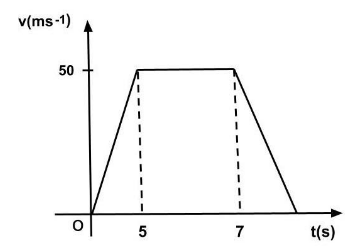
Answer
 Verified
539.7k+ views
Hint: The distance travelled is shown by the area under the speed-time graph. For the motion of a particle, distance-time graphs and acceleration-time graphs can be produced, with time always displayed on the horizontal axis. A particle with a constant speed is represented by a straight line on a distance-time graph.
Complete step by step answer:
Let us first write the given values
Acceleration $\left( a \right) = 10\,m{s^{ - 2}}$
Time $\left( t \right)$ is given as $5\sec $
Therefore the velocity can be found by using equation of motion that is given by:
$v = u + at \\
\Rightarrow v = 0 + 10 \times 5 \\
\Rightarrow v = 50m{s^{ - 1}} \\ $
Now, it moves for \[2\] seconds with a uniform velocity of \[50{\text{ }}m{s^{ - 1}}\] and finally gets retarded to rest in $3\sec $.Using the above information we will draw velocity time graph accordingly;
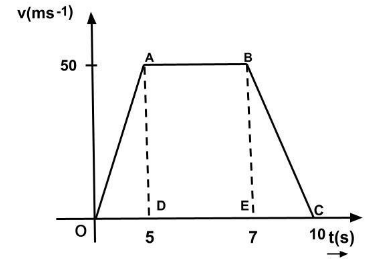
Now, according to the graph: the total distance travelled is \[\left( D \right)\] = Area under the curve. Therefore,
$D = \dfrac{1}{2} \times \left( {OC + AB} \right) \times AD$
$\Rightarrow D = \dfrac{1}{2} \times \left( {10 + 2} \right) \times 50 \\
\Rightarrow D = \dfrac{1}{2} \times 12 \times 50 \\
\therefore D = 300\,m \\ $
Hence, the total distance travelled by the body is $300\,m$.
Note: It's important to remember that finding the area doesn't fully describe displacement because, being a vector quantity, displacement also requires a direction.Finding the location simply provides a number, not a direction. The magnitude of the displacement, which is equivalent to the distance travelled, is represented by the area under the curve (only for constant acceleration).
Complete step by step answer:
Let us first write the given values
Acceleration $\left( a \right) = 10\,m{s^{ - 2}}$
Time $\left( t \right)$ is given as $5\sec $
Therefore the velocity can be found by using equation of motion that is given by:
$v = u + at \\
\Rightarrow v = 0 + 10 \times 5 \\
\Rightarrow v = 50m{s^{ - 1}} \\ $
Now, it moves for \[2\] seconds with a uniform velocity of \[50{\text{ }}m{s^{ - 1}}\] and finally gets retarded to rest in $3\sec $.Using the above information we will draw velocity time graph accordingly;
Now, according to the graph: the total distance travelled is \[\left( D \right)\] = Area under the curve. Therefore,
$D = \dfrac{1}{2} \times \left( {OC + AB} \right) \times AD$
$\Rightarrow D = \dfrac{1}{2} \times \left( {10 + 2} \right) \times 50 \\
\Rightarrow D = \dfrac{1}{2} \times 12 \times 50 \\
\therefore D = 300\,m \\ $
Hence, the total distance travelled by the body is $300\,m$.
Note: It's important to remember that finding the area doesn't fully describe displacement because, being a vector quantity, displacement also requires a direction.Finding the location simply provides a number, not a direction. The magnitude of the displacement, which is equivalent to the distance travelled, is represented by the area under the curve (only for constant acceleration).
Recently Updated Pages
Master Class 5 English: Engaging Questions & Answers for Success

Master Class 5 Maths: Engaging Questions & Answers for Success
Master Class 5 Social Science: Engaging Questions & Answers for Success
Master Class 5 Science: Engaging Questions & Answers for Success
Class 5 Question and Answer - Your Ultimate Solutions Guide
Master Class 9 General Knowledge: Engaging Questions & Answers for Success
Trending doubts
One Metric ton is equal to kg A 10000 B 1000 C 100 class 11 physics CBSE
What is cell theory Who formulated it class 11 biology CBSE
Phyllotaxy is the arrangement of ALeaflets BLeaves class 11 biology CBSE
Difference Between Prokaryotic Cells and Eukaryotic Cells
The symbiotic association of fungi and algae is called class 11 biology CBSE
Cell theory was formulated by A Schleiden and Schwann class 11 biology CBSE