




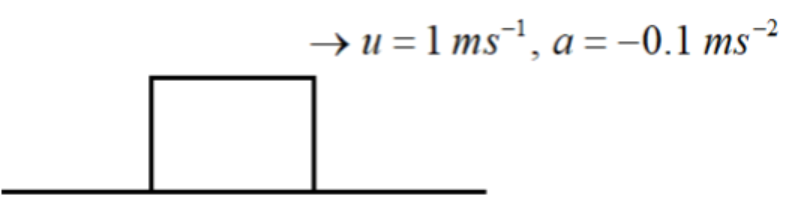
A body starts to slide over a horizontal surface with an initial velocity of a $1m/s$. Due to friction, its velocity decreases at the same rate of $0.1m/{s^2}$ .How much time will it take for the body to stop?
Answer
 Verified
656.7k+ views
Hint - To solve this problem, firstly we will learn about motion, laws of motion and the equations of motion, by using the concept behind them and its relation with our question, use the appropriate formula to find the required values, and by using this information we will easily approach our answer.
Step-By-Step answer:
It is defined as the change of position of an object with respect to time. Example- A book falling off a table, water flowing from the tap, rattling windows, etc. Motion is described in terms of the following terms. Distance, Displacement
Both distance and displacement are used to trace the change in position. Displacement is nothing but the shortest distance between the two distinct points. Displacement is measured as the shortest distance between the initial and final position.
Newton’s Laws of Motion
The first law, also called the law of inertia, every object in a state of uniform motion will remain in that state of motion unless an external force acts on it.
Second law of motion states that force equals the product of mass acceleration.
Third law of motion states that, for every action there is$ = $ and opposite reactions.
Equations of Motion- Three equations of motion which describe the relationship between velocity, time, acceleration and displacement.
First equation of motion is:
$v = u + at$
Second equation of motion is:
$S = ut + \dfrac{1}{2}{a^2}$
Third equation of motion is:
${v^2} = {u^2} + 2aS$
Given,
$u = 1$
$a = - 0.1$
$v = 0$
By first equation of motion, we have
$v = u + at$
$0 = 1 - 0.1 \times t$
$t = 10\sec $
Note - The first equation of motion deals with final velocity, initial velocity, acceleration and time. We can use the first equation of motion to find final velocity, initial velocity, acceleration and time.
Step-By-Step answer:
It is defined as the change of position of an object with respect to time. Example- A book falling off a table, water flowing from the tap, rattling windows, etc. Motion is described in terms of the following terms. Distance, Displacement
Both distance and displacement are used to trace the change in position. Displacement is nothing but the shortest distance between the two distinct points. Displacement is measured as the shortest distance between the initial and final position.
Newton’s Laws of Motion
The first law, also called the law of inertia, every object in a state of uniform motion will remain in that state of motion unless an external force acts on it.
Second law of motion states that force equals the product of mass acceleration.
Third law of motion states that, for every action there is$ = $ and opposite reactions.
Equations of Motion- Three equations of motion which describe the relationship between velocity, time, acceleration and displacement.
First equation of motion is:
$v = u + at$
Second equation of motion is:
$S = ut + \dfrac{1}{2}{a^2}$
Third equation of motion is:
${v^2} = {u^2} + 2aS$
Given,
$u = 1$
$a = - 0.1$
$v = 0$
By first equation of motion, we have
$v = u + at$
$0 = 1 - 0.1 \times t$
$t = 10\sec $
Note - The first equation of motion deals with final velocity, initial velocity, acceleration and time. We can use the first equation of motion to find final velocity, initial velocity, acceleration and time.
Recently Updated Pages
Master Class 11 Social Science: Engaging Questions & Answers for Success

Master Class 11 English: Engaging Questions & Answers for Success
Master Class 11 Accountancy: Engaging Questions & Answers for Success
Master Class 11 Physics: Engaging Questions & Answers for Success
Master Class 11 Computer Science: Engaging Questions & Answers for Success
Master Class 11 Business Studies: Engaging Questions & Answers for Success
Trending doubts
One Metric ton is equal to kg A 10000 B 1000 C 100 class 11 physics CBSE
Find the value of the expression given below sin 30circ class 11 maths CBSE
Draw a diagram of nephron and explain its structur class 11 biology CBSE
10 examples of friction in our daily life
Proton was discovered by A Thomson B Rutherford C Chadwick class 11 chemistry CBSE
The teeth used for biting and cutting food are called class 11 biology CBSE