




A body starts from rest and travels a distance S with uniform acceleration, then moves uniformly a distance 2S and finally comes to rest after moving further 5S under uniform retardation. The ratio of the average velocity to maximum velocity is
(a) 2/5
(b) 3/5
(c) 4/7
(d) 5/7
Answer
 Verified
638.7k+ views
Hint: Use the concept of Motion In A Straight Line. Area of triangle= $\dfrac{1}{2}\times{base}\times{height}$ and Area of rectangle = ${base}\times{height}$.
Complete step by step solution:
Area of the (V–t) curve represents displacement.
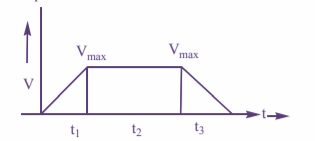
$
S = \dfrac{1}{2}{v_{\max }}{t_1} \Rightarrow {t_1} = \dfrac{{2S}}{{{v_{\max }}}} \\
2S = \dfrac{1}{2}{v_{\max }}{t_2} \Rightarrow {t_2} = \dfrac{{2S}}{{{v_{\max }}}} \\
5S = \dfrac{1}{2}{v_{\max }}{t_2} \Rightarrow {t_3} = \dfrac{{10S}}{{{v_{\max }}}} \\
$
${V_{avg}} = \dfrac{{{\text{Total displacement}}}}{{{\text{Total time}}}}$$\dfrac{{S + 2S + 5S}}{{\dfrac{{2S}}{{{v_{\max }}}} + \dfrac{{2S}}{{{v_{\max }}}} + \dfrac{{10S}}{{{v_{\max }}}}}} = \dfrac{{8S}}{{\left( {\dfrac{{14S}}{{{v_{\max }}}}} \right)}} = {v_{\max }}\dfrac{4}{7}$
The ratio of the average velocity to maximum velocity= \[\dfrac{{{v_{avg}}}}{{{v_{\max }}}} = \dfrac{{{v_{\max }}\dfrac{4}{7}}}{{{v_{\max }}}} = \dfrac{4}{7}\]
Correct Answer: (c) 4/7
Note: Alternative Method-
\[\dfrac{{{v_{avg}}}}{{{v_{\max }}}} = \dfrac{{Total{\text{ }}displacement}}{{2({\text{Total displacement during acceleration and retardation) + (Displacement During uniform velocity)}}}}\]
$\therefore \dfrac{{{v_{avg}}}}{{{v_{\max }}}} = \dfrac{{8S}}{{2(S + 5S) + 2S}} = \dfrac{8}{{14}} = \dfrac{4}{7}$
Complete step by step solution:
Area of the (V–t) curve represents displacement.
$
S = \dfrac{1}{2}{v_{\max }}{t_1} \Rightarrow {t_1} = \dfrac{{2S}}{{{v_{\max }}}} \\
2S = \dfrac{1}{2}{v_{\max }}{t_2} \Rightarrow {t_2} = \dfrac{{2S}}{{{v_{\max }}}} \\
5S = \dfrac{1}{2}{v_{\max }}{t_2} \Rightarrow {t_3} = \dfrac{{10S}}{{{v_{\max }}}} \\
$
${V_{avg}} = \dfrac{{{\text{Total displacement}}}}{{{\text{Total time}}}}$$\dfrac{{S + 2S + 5S}}{{\dfrac{{2S}}{{{v_{\max }}}} + \dfrac{{2S}}{{{v_{\max }}}} + \dfrac{{10S}}{{{v_{\max }}}}}} = \dfrac{{8S}}{{\left( {\dfrac{{14S}}{{{v_{\max }}}}} \right)}} = {v_{\max }}\dfrac{4}{7}$
The ratio of the average velocity to maximum velocity= \[\dfrac{{{v_{avg}}}}{{{v_{\max }}}} = \dfrac{{{v_{\max }}\dfrac{4}{7}}}{{{v_{\max }}}} = \dfrac{4}{7}\]
Correct Answer: (c) 4/7
Note: Alternative Method-
\[\dfrac{{{v_{avg}}}}{{{v_{\max }}}} = \dfrac{{Total{\text{ }}displacement}}{{2({\text{Total displacement during acceleration and retardation) + (Displacement During uniform velocity)}}}}\]
$\therefore \dfrac{{{v_{avg}}}}{{{v_{\max }}}} = \dfrac{{8S}}{{2(S + 5S) + 2S}} = \dfrac{8}{{14}} = \dfrac{4}{7}$
Recently Updated Pages
Basicity of sulphurous acid and sulphuric acid are

Master Class 11 English: Engaging Questions & Answers for Success
Master Class 11 Physics: Engaging Questions & Answers for Success
Master Class 11 Computer Science: Engaging Questions & Answers for Success
Master Class 11 Chemistry: Engaging Questions & Answers for Success
Master Class 11 Social Science: Engaging Questions & Answers for Success
Trending doubts
Difference Between Prokaryotic Cells and Eukaryotic Cells
Two of the body parts which do not appear in MRI are class 11 biology CBSE
One Metric ton is equal to kg A 10000 B 1000 C 100 class 11 physics CBSE
10 examples of friction in our daily life
Draw a diagram of nephron and explain its structur class 11 biology CBSE
What will happen if the mucus is not secreted by the class 11 biology CBSE