




A body rolling down a hill has:
A. K.E. only
B. P.E. only
C. Neither K.E. nor P.E.
D. Both K.E. and P.E.
Answer
 Verified
593.1k+ views
Hint: When a body rolls down a hill it has two types of motion. it has a translation motion as well as it has a rotational motion when a body moves it has a kinetic energy so you can observe which type of energy has a rolling body.
Complete step by step answer:
Let’s take an example to understand this question: we take a sphere rolling down from a hill or an inclined plane of height $h$. When it rolls down at that time it has two types of motion one is translation motion.
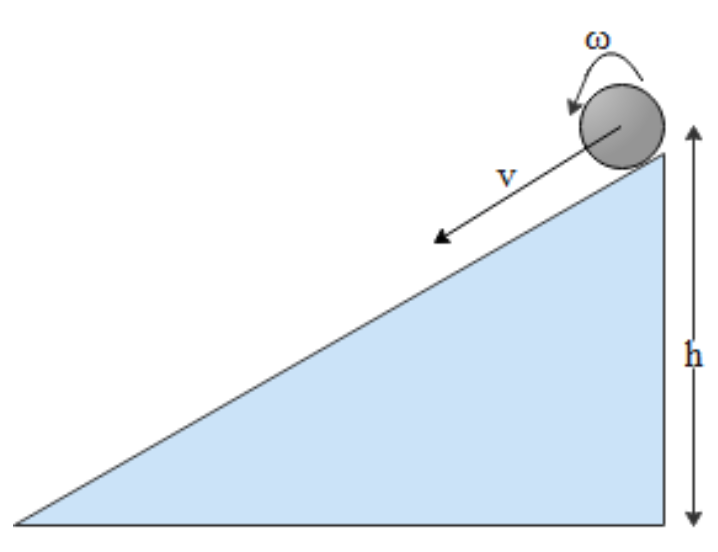
A body rotating about the centre of mass with an angular velocity $\omega $ as well as the body has a translation motion with a velocity $v$ means this body has two velocities it means it also has a kinetic energy.
And as we know when a body situated at $h$ height from ground it has a potential energy due to gravitation of earth. This is equal to $mgh$
So it is clear that when a body rolls down from a hill it has both types of energy kinetic energy as well as potential energy.
When a ball is rolling from the hilltop, the potential energy will decrease and kinetic energy will increase until it reaches the ground.
So, the correct answer is “Option D”.
Note:
Some time student get confused which type of kinetic energy has a rolling body as it is clear when a body roll down is move with a translation velocity $v$ as well as an angular velocity $\omega $ so it has two types of kinetic energy one is translational kinetic energy and rotational kinetic energy
Total kinetic energy = translational kinetic energy + rotational kinetic energy
$K.E = \dfrac{1}{2}m{v^2} + \dfrac{1}{2}I{\omega ^2}$ Where $I \Rightarrow $ Moment of inertia of body
$v \Rightarrow $ Translational velocity or velocity of centre of mass
$\omega \Rightarrow $Angular velocity of body
Complete step by step answer:
Let’s take an example to understand this question: we take a sphere rolling down from a hill or an inclined plane of height $h$. When it rolls down at that time it has two types of motion one is translation motion.
A body rotating about the centre of mass with an angular velocity $\omega $ as well as the body has a translation motion with a velocity $v$ means this body has two velocities it means it also has a kinetic energy.
And as we know when a body situated at $h$ height from ground it has a potential energy due to gravitation of earth. This is equal to $mgh$
So it is clear that when a body rolls down from a hill it has both types of energy kinetic energy as well as potential energy.
When a ball is rolling from the hilltop, the potential energy will decrease and kinetic energy will increase until it reaches the ground.
So, the correct answer is “Option D”.
Note:
Some time student get confused which type of kinetic energy has a rolling body as it is clear when a body roll down is move with a translation velocity $v$ as well as an angular velocity $\omega $ so it has two types of kinetic energy one is translational kinetic energy and rotational kinetic energy
Total kinetic energy = translational kinetic energy + rotational kinetic energy
$K.E = \dfrac{1}{2}m{v^2} + \dfrac{1}{2}I{\omega ^2}$ Where $I \Rightarrow $ Moment of inertia of body
$v \Rightarrow $ Translational velocity or velocity of centre of mass
$\omega \Rightarrow $Angular velocity of body
Recently Updated Pages
Basicity of sulphurous acid and sulphuric acid are

Master Class 11 Business Studies: Engaging Questions & Answers for Success
Master Class 11 Computer Science: Engaging Questions & Answers for Success
Master Class 11 Economics: Engaging Questions & Answers for Success
Master Class 11 Social Science: Engaging Questions & Answers for Success
Master Class 11 English: Engaging Questions & Answers for Success
Trending doubts
One Metric ton is equal to kg A 10000 B 1000 C 100 class 11 physics CBSE
What are the examples of C3 and C4 plants class 11 biology CBSE
State and prove Bernoullis theorem class 11 physics CBSE
Draw a diagram of a plant cell and label at least eight class 11 biology CBSE
10 examples of friction in our daily life
A body is said to be in dynamic equilibrium if A When class 11 physics CBSE