




A body of mass $m$ moving with a constant velocity $v$ hits another body of the mass $m$ moving with same velocity $v$ but in the opposite direction, and sticks to it. The velocity of the compound body after collision is :
(A) Zero
(B) $v$
(C) $2v$
(D) $v/2$
Answer
 Verified
579k+ views
Hint:Use the law of the conservation of the momentum to calculate the final velocity. Substitute the given parameters in the formula of the momentum and cancel the similar terms to know the value of the final velocity of the balls after collision.
Useful formula:
The momentum is given by
$p = mv$
Where $p$ is the momentum, $m$ is the mass of the body and $v$ is the velocity of the body.
Complete step by step solution:
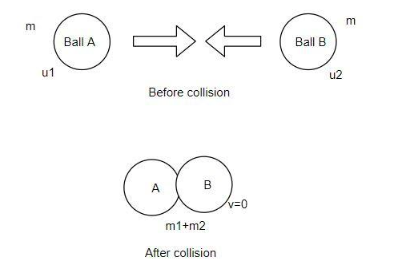
The law of conservation of momentum states that if two or more bodies collide with each other by themselves without the application of any external force, their total momentum before collision must be equal to the total momentum after the collision. Hence
Initial momentum=final momentum
By applying the formula in the above equation,
${m_1}{u_1} - {m_2}{u_2} = {m_1}{v_1} - {m_2}{v_2}$
Here the masses of both the body and the final velocity is the same.
$m{u_1} - m{u_2} = m{v_{}} - {m_{}}{v_{}}$
By simplifying the above equation,
$m\left( {{u_1} - {u_2}} \right) = 2mv$
By cancelling the similar terms in both the sides.
${u_1} - {u_2} = 2v$
Since the velocity of the two balls are same,
${u_1} - {u_2} = 0$
The two body sticks to it forming the compound body so its final velocity is
$v = 0$
Hence the velocity of the compound body is zero.
Thus the option (A) is correct.
Note:After the collision of the two balls, if they stick to each other without moving away from them, both the balls join together. This causes the mass after the collision is the sum of the masses of the balls and the velocity gets to zero after the collision.
Useful formula:
The momentum is given by
$p = mv$
Where $p$ is the momentum, $m$ is the mass of the body and $v$ is the velocity of the body.
Complete step by step solution:
The law of conservation of momentum states that if two or more bodies collide with each other by themselves without the application of any external force, their total momentum before collision must be equal to the total momentum after the collision. Hence
Initial momentum=final momentum
By applying the formula in the above equation,
${m_1}{u_1} - {m_2}{u_2} = {m_1}{v_1} - {m_2}{v_2}$
Here the masses of both the body and the final velocity is the same.
$m{u_1} - m{u_2} = m{v_{}} - {m_{}}{v_{}}$
By simplifying the above equation,
$m\left( {{u_1} - {u_2}} \right) = 2mv$
By cancelling the similar terms in both the sides.
${u_1} - {u_2} = 2v$
Since the velocity of the two balls are same,
${u_1} - {u_2} = 0$
The two body sticks to it forming the compound body so its final velocity is
$v = 0$
Hence the velocity of the compound body is zero.
Thus the option (A) is correct.
Note:After the collision of the two balls, if they stick to each other without moving away from them, both the balls join together. This causes the mass after the collision is the sum of the masses of the balls and the velocity gets to zero after the collision.
Recently Updated Pages
Master Class 11 Computer Science: Engaging Questions & Answers for Success

Master Class 11 Business Studies: Engaging Questions & Answers for Success
Master Class 11 Economics: Engaging Questions & Answers for Success
Master Class 11 English: Engaging Questions & Answers for Success
Master Class 11 Maths: Engaging Questions & Answers for Success
Master Class 11 Biology: Engaging Questions & Answers for Success
Trending doubts
One Metric ton is equal to kg A 10000 B 1000 C 100 class 11 physics CBSE
There are 720 permutations of the digits 1 2 3 4 5 class 11 maths CBSE
Discuss the various forms of bacteria class 11 biology CBSE
Draw a diagram of a plant cell and label at least eight class 11 biology CBSE
State the laws of reflection of light
Explain zero factorial class 11 maths CBSE