




A body of mass ‘m’ is taken from the earth's surface to the height is equal to twice the radius (R) of the earth. The change in potential energy of body will be-
A) mg2R
B) $\dfrac{2}{3}$ mgR
C) 3 mgR
D) $\dfrac{1}{3}$ mgR
Answer
 Verified
644.1k+ views
Hint: We will be drawing a diagram to trace the change in position of the object.
The formula for potential energy will be applied when the object is on the surface of the earth and on height respectively.
$U = - \dfrac{{G{m_1}{m_2}}}{{{R^{}}}}$ where,
G = Gravitational constant
${m_1}$ and ${m_2}$ = Mass of the objects
R = Distance from the centre.
As the options are given in g, the following relationship can be used:
$g = \dfrac{{GM}}{{{R^2}}}$
Complete step by step answer:Mass of body = m (given)
Let mass of the earth = M
Radius of the earth = R (given)
Representing the change in position of the body with diagram:
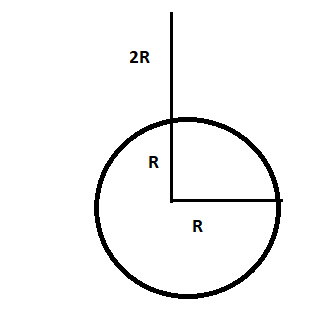
The potential energy (U) is given as:
$U = - \dfrac{{GMm}}{{{R^{}}}}$
Potential energy on the surface (s) of the earth and at height (h) twice the radius (2R) :
${U_s} = - \dfrac{{GMm}}{{{R^{}}}}$ _____________ (1)
$
{U_h} = - \dfrac{{GMm}}{{R + 2{R^{}}}} \\
\\
$
As the distance is measured from the center of the earth.
${U_h} = - \dfrac{{GMm}}{{3{R^{}}}}$ ____________ (2)
The change in potential energy $\left( {\Delta U} \right)$ is given by the difference between (1) and (2)
$\Delta U = {U_h} - {U_s}$
Substituting the values from (1) and (2):
$\Delta {U_{}} = - \dfrac{{GMm}}{{3{R^{}}}} - \left( { - \dfrac{{GMm}}{{{R^{}}}}} \right)$
$\Delta {U_{}} = \dfrac{2}{3}\dfrac{{GMm}}{{{R^{}}}}$ ____________ (3)
But the options are given in g which is acceleration due to gravity whose relationship with G (Gravitational constant) can be given as:
$g = \dfrac{{GM}}{{{R^2}}}$
$G = \dfrac{{g{R^2}}}{M}$
Substituting this value of G in (3):
$\Delta {U_{}} = \dfrac{2}{3}\dfrac{{\dfrac{{g{R^2}}}{M}Mm}}{{{R^{}}}}$
$\Delta {U_{}} = \dfrac{2}{3}mgR$
Therefore, the change in potential energy when a body of mass ‘m’ is taken from the earth's surface to the height equal to twice the radius of the earth will be $\dfrac{2}{3}mgR$, option B)
Note:Negative potential energy represents the force of attraction. Gravitational force is an attractive force and hence the potential energy of the body is taken as negative.
Acceleration due to gravity (g) and gravitational constant (G) both have values 9.8 m/s and$6.67 \times {10^{ - 11}}{m^3}k{g^{ - 1}}{s^{ - 2}}$ respectively.
The formula for potential energy will be applied when the object is on the surface of the earth and on height respectively.
$U = - \dfrac{{G{m_1}{m_2}}}{{{R^{}}}}$ where,
G = Gravitational constant
${m_1}$ and ${m_2}$ = Mass of the objects
R = Distance from the centre.
As the options are given in g, the following relationship can be used:
$g = \dfrac{{GM}}{{{R^2}}}$
Complete step by step answer:Mass of body = m (given)
Let mass of the earth = M
Radius of the earth = R (given)
Representing the change in position of the body with diagram:
The potential energy (U) is given as:
$U = - \dfrac{{GMm}}{{{R^{}}}}$
Potential energy on the surface (s) of the earth and at height (h) twice the radius (2R) :
${U_s} = - \dfrac{{GMm}}{{{R^{}}}}$ _____________ (1)
$
{U_h} = - \dfrac{{GMm}}{{R + 2{R^{}}}} \\
\\
$
As the distance is measured from the center of the earth.
${U_h} = - \dfrac{{GMm}}{{3{R^{}}}}$ ____________ (2)
The change in potential energy $\left( {\Delta U} \right)$ is given by the difference between (1) and (2)
$\Delta U = {U_h} - {U_s}$
Substituting the values from (1) and (2):
$\Delta {U_{}} = - \dfrac{{GMm}}{{3{R^{}}}} - \left( { - \dfrac{{GMm}}{{{R^{}}}}} \right)$
$\Delta {U_{}} = \dfrac{2}{3}\dfrac{{GMm}}{{{R^{}}}}$ ____________ (3)
But the options are given in g which is acceleration due to gravity whose relationship with G (Gravitational constant) can be given as:
$g = \dfrac{{GM}}{{{R^2}}}$
$G = \dfrac{{g{R^2}}}{M}$
Substituting this value of G in (3):
$\Delta {U_{}} = \dfrac{2}{3}\dfrac{{\dfrac{{g{R^2}}}{M}Mm}}{{{R^{}}}}$
$\Delta {U_{}} = \dfrac{2}{3}mgR$
Therefore, the change in potential energy when a body of mass ‘m’ is taken from the earth's surface to the height equal to twice the radius of the earth will be $\dfrac{2}{3}mgR$, option B)
Note:Negative potential energy represents the force of attraction. Gravitational force is an attractive force and hence the potential energy of the body is taken as negative.
Acceleration due to gravity (g) and gravitational constant (G) both have values 9.8 m/s and$6.67 \times {10^{ - 11}}{m^3}k{g^{ - 1}}{s^{ - 2}}$ respectively.
Recently Updated Pages
Which will be the least stable resonating structure class 11 chemistry CBSE

How many 5 digit telephone numbers can be construc-class-11-maths-CBSE
How do you find the angle of the resultant vector class 11 physics CBSE
Draw labelled diagram of the following i Gram seed class 11 biology CBSE
What is the need and importance of classification class 11 biology CBSE
The way in which the sparrows expressed their sorrow class 11 english CBSE
Trending doubts
One Metric ton is equal to kg A 10000 B 1000 C 100 class 11 physics CBSE
Find the value of the expression given below sin 30circ class 11 maths CBSE
1 Quintal is equal to a 110 kg b 10 kg c 100kg d 1000 class 11 physics CBSE
Draw a diagram of nephron and explain its structur class 11 biology CBSE
10 examples of friction in our daily life
Proton was discovered by A Thomson B Rutherford C Chadwick class 11 chemistry CBSE