




A body of mass ‘m’ is performing uniform circular motion in a circle of radius ‘r’ with a constant speed ‘v’. What will be the work done by the centripetal force in moving it through the circular path?
A. mvr
B. 2mvr
C. zero
D. 2mv
Answer
 Verified
596.7k+ views
Hint: Work done by any force acting on any object is given by dot product of force and displacement of the object. In circular motion, force and displacement vectors are perpendicular to each other. Calculate the dot product to obtain the work done by centripetal force.
Complete answer:
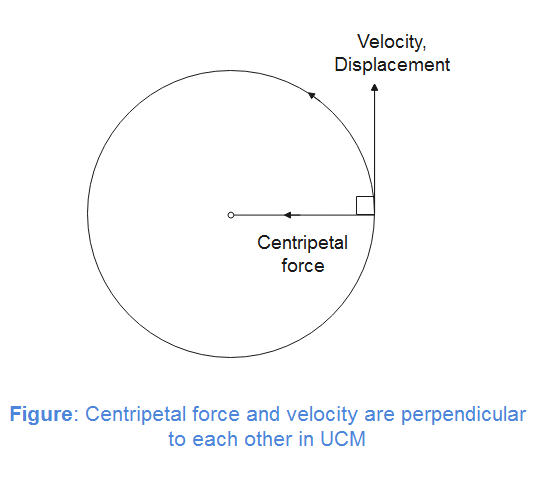
Work done by any force acting on any object is given by dot product of force and displacement of the object. In circular motion, centripetal force acts towards the centre of the circle and velocity of the particle is tangential to the circle. To put it another way, centripetal force and displacement vectors on the particle are perpendicular to each other. Dot product of perpendicular vectors is always zero. Therefore, work done by the centripetal force in uniform circular motion, which is the dot product of centripetal force and displacement of the particle, is zero.
So, the correct answer is “Option C”.
Additional Information:
Circular motion of a body is said to be the motion of the body in circular trajectory around a point. Uniform circular motion is a kind of circular motion in which speed of the particle is constant. In circular motion, direction of the particle changes constantly. The force responsible for the change in the direction is known as centripetal force which always acts perpendicular to the velocity of the particle.
Note:
Work done by centripetal force in uniform circular motion is always zero. Centripetal force in uniform circular motion always acts perpendicular to the direction of motion of the particle and is directed towards the centre of the circle.
Complete answer:
Work done by any force acting on any object is given by dot product of force and displacement of the object. In circular motion, centripetal force acts towards the centre of the circle and velocity of the particle is tangential to the circle. To put it another way, centripetal force and displacement vectors on the particle are perpendicular to each other. Dot product of perpendicular vectors is always zero. Therefore, work done by the centripetal force in uniform circular motion, which is the dot product of centripetal force and displacement of the particle, is zero.
So, the correct answer is “Option C”.
Additional Information:
Circular motion of a body is said to be the motion of the body in circular trajectory around a point. Uniform circular motion is a kind of circular motion in which speed of the particle is constant. In circular motion, direction of the particle changes constantly. The force responsible for the change in the direction is known as centripetal force which always acts perpendicular to the velocity of the particle.
Note:
Work done by centripetal force in uniform circular motion is always zero. Centripetal force in uniform circular motion always acts perpendicular to the direction of motion of the particle and is directed towards the centre of the circle.
Recently Updated Pages
Master Class 11 Social Science: Engaging Questions & Answers for Success

Master Class 11 English: Engaging Questions & Answers for Success
Master Class 11 Maths: Engaging Questions & Answers for Success
Master Class 11 Chemistry: Engaging Questions & Answers for Success
Master Class 11 Biology: Engaging Questions & Answers for Success
Master Class 11 Physics: Engaging Questions & Answers for Success
Trending doubts
Differentiate between an exothermic and an endothermic class 11 chemistry CBSE
One Metric ton is equal to kg A 10000 B 1000 C 100 class 11 physics CBSE
Difference Between Prokaryotic Cells and Eukaryotic Cells
There are 720 permutations of the digits 1 2 3 4 5 class 11 maths CBSE
Draw a diagram of a plant cell and label at least eight class 11 biology CBSE
1 Quintal is equal to a 110 kg b 10 kg c 100kg d 1000 class 11 physics CBSE