



A body of mass 4 kg is tied to one end of a rope of length 40 cm and whirled in a horizontal circle. The maximum number of revolutions per minute it can be whirled so that the rope does not snap as the rope can withstand to a tension of 6.4 Newton, will be –
A. 1.91
B. 19.1
C. 191
D. 1910
Answer
 Verified
578.1k+ views
Hint: Firstly, we will find the value of the velocity of the body using the formula that relates the tension in the rope with the length of the rope, the mass and velocity of the body. Using this velocity of the body, we will find the number of revolutions per minute by using the formula that relates the angular frequency with the velocity of the body and length of the rope.
Formula used:
\[\begin{align}
& T=\dfrac{m{{v}^{2}}}{r} \\
& w=\dfrac{v}{r} \\
\end{align}\]
Complete step by step answer:
From the data, we have the data as follows.
The mass of the body, m = 4 kg
The length of the string = the radius of the circle it forms, r = 40 cm
r = 0.4 m
The tension in the rope, T = 6.4 N
The formula used to calculate the tension in the rope is,
\[T=\dfrac{m{{v}^{2}}}{r}\]
Where m is the mass of the body, v is the velocity of the body and r is the length of the rope.
A diagram representing the tension in the rope is,
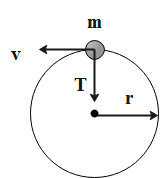
Substitute the given values in the above equation.
\[\begin{align}
& 6.4=\dfrac{4\times {{v}^{2}}}{0.4} \\
& \Rightarrow {{v}^{2}}=\dfrac{6.4\times 0.4}{4} \\
\end{align}\]
Continue further calculation.
\[\begin{align}
& {{v}^{2}}=0.64 \\
& \Rightarrow v=0.8\dfrac{m}{s} \\
\end{align}\]
Now, consider the formula that relates the angular frequency with the velocity of the body and the length of the rope.
\[w=\dfrac{v}{r}\]
Where v is the velocity of the body and r is the length of the rope.
Substitute the given values in the above equation.
\[\begin{align}
& w=\dfrac{0.8}{0.4} \\
& \Rightarrow w=0.2\dfrac{rad}{\sec } \\
\end{align}\]
Continue the further calculation to convert the unit from rad per sec to rev per min. So, we have,
\[\begin{align}
& w=\dfrac{0.2}{2\pi }\times 60 \\
& \Rightarrow w=1.91\dfrac{rev}{\min } \\
\end{align}\]
The maximum number of revolutions per minute is 1.91.
As the maximum number of revolutions per minute it can be whirled so that the rope does not snap as the rope can withstand a tension of 6.4 Newton, will be 1.91, thus, the option (A) is correct.
Note:
The units of the parameters should be taken care of. In this case, we have converted the unit of the radius of the circle, that is, the length of tope from cm to m. And even, we have converted the unit of the angular frequency from rad per sec to rev per min, so, this one should be known.
Formula used:
\[\begin{align}
& T=\dfrac{m{{v}^{2}}}{r} \\
& w=\dfrac{v}{r} \\
\end{align}\]
Complete step by step answer:
From the data, we have the data as follows.
The mass of the body, m = 4 kg
The length of the string = the radius of the circle it forms, r = 40 cm
r = 0.4 m
The tension in the rope, T = 6.4 N
The formula used to calculate the tension in the rope is,
\[T=\dfrac{m{{v}^{2}}}{r}\]
Where m is the mass of the body, v is the velocity of the body and r is the length of the rope.
A diagram representing the tension in the rope is,
Substitute the given values in the above equation.
\[\begin{align}
& 6.4=\dfrac{4\times {{v}^{2}}}{0.4} \\
& \Rightarrow {{v}^{2}}=\dfrac{6.4\times 0.4}{4} \\
\end{align}\]
Continue further calculation.
\[\begin{align}
& {{v}^{2}}=0.64 \\
& \Rightarrow v=0.8\dfrac{m}{s} \\
\end{align}\]
Now, consider the formula that relates the angular frequency with the velocity of the body and the length of the rope.
\[w=\dfrac{v}{r}\]
Where v is the velocity of the body and r is the length of the rope.
Substitute the given values in the above equation.
\[\begin{align}
& w=\dfrac{0.8}{0.4} \\
& \Rightarrow w=0.2\dfrac{rad}{\sec } \\
\end{align}\]
Continue the further calculation to convert the unit from rad per sec to rev per min. So, we have,
\[\begin{align}
& w=\dfrac{0.2}{2\pi }\times 60 \\
& \Rightarrow w=1.91\dfrac{rev}{\min } \\
\end{align}\]
The maximum number of revolutions per minute is 1.91.
As the maximum number of revolutions per minute it can be whirled so that the rope does not snap as the rope can withstand a tension of 6.4 Newton, will be 1.91, thus, the option (A) is correct.
Note:
The units of the parameters should be taken care of. In this case, we have converted the unit of the radius of the circle, that is, the length of tope from cm to m. And even, we have converted the unit of the angular frequency from rad per sec to rev per min, so, this one should be known.
Recently Updated Pages
Master Class 11 Computer Science: Engaging Questions & Answers for Success

Master Class 11 Business Studies: Engaging Questions & Answers for Success
Master Class 11 Economics: Engaging Questions & Answers for Success
Master Class 11 English: Engaging Questions & Answers for Success
Master Class 11 Maths: Engaging Questions & Answers for Success
Master Class 11 Biology: Engaging Questions & Answers for Success
Trending doubts
One Metric ton is equal to kg A 10000 B 1000 C 100 class 11 physics CBSE
There are 720 permutations of the digits 1 2 3 4 5 class 11 maths CBSE
Discuss the various forms of bacteria class 11 biology CBSE
Draw a diagram of a plant cell and label at least eight class 11 biology CBSE
State the laws of reflection of light
Explain zero factorial class 11 maths CBSE