




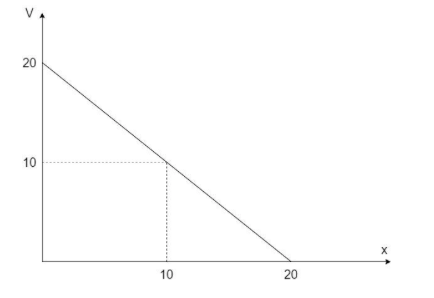
A body of mass 2 kg is moving in a straight line for which the v – x graph is shown in the figure. Magnitude of the force acting on the body at $x = 10m$ is $5k$ N. Find the value of k.
Answer
 Verified
574.8k+ views
Hint:In this problem, the mass of the body is given. The only unknown to calculate the force is the acceleration. To find the acceleration, a relationship among the acceleration and the velocity-displacement must be deduced based on the calculus-based definitions such as:
$v = \dfrac{{dx}}{{dt}}\& a = \dfrac{{dv}}{{dt}}$
where x = displacement, v = velocity and a = acceleration.
Complete step by step solution:
The velocity of a body is defined as the rate of change of displacement per unit time. The differential form is given by:
$v = \dfrac{{dx}}{{dt}}$
Hence, we see that the velocity is a function of displacement and time.
$v = f\left( {x,t} \right)$
The acceleration of the body is the rate of change of velocity per unit time. The differential form is:
$a = \dfrac{{dv}}{{dt}} = f'\left( {x,t} \right)$
If $y = f\left( {x,t} \right)$, applying Chain rule of differentiation to the equation, we get –
$\dfrac{{dy}}{{dt}} = \dfrac{{\delta y}}{{\delta x}}\dfrac{{dx}}{{dt}} + \dfrac{{\delta y}}{{\delta t}}\dfrac{{dx}}{{dx}}$
Applying the Chain rule to the acceleration, we get –
$a = \dfrac{{dv}}{{dt}} = \dfrac{{\delta v}}{{\delta x}}\dfrac{{dx}}{{dt}} + \dfrac{{\delta v}}{{\delta t}}\dfrac{{dt}}{{dt}}$
The value $\dfrac{{\delta v}}{{\delta t}}$ , means rate of change of velocity with respect to time with displacement being constant. But, if the displacement is constant, it implies that there is no change in the velocity of the body. Hence, we get –
$\dfrac{{\delta v}}{{\delta t}} = 0$
Thus,
$a = v\dfrac{{\delta v}}{{\delta x}}$ since, $v = \dfrac{{dx}}{{dt}}$
Consider the graph of velocity v/s displacement for a body of mass 2kg as shown:
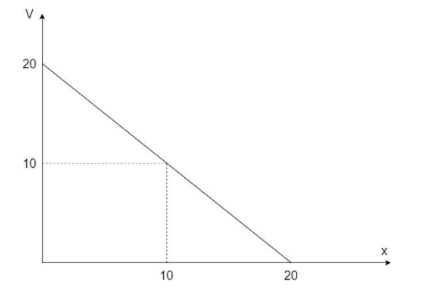
The term $\dfrac{{\delta v}}{{\delta x}}$ indicates the slope of the graph between velocity and displacement with time being constant. Now, we have a graph of velocity v/s displacement in the above equation. Hence, we can say,
$a = v \times s$
where s = slope of the graph.
The slope of the graph, $s = $$\dfrac{{20 - 10}}{{20 - 10}} = 1$
The value of velocity at $x = 10m,v = 10m{s^{ - 1}}$
Substituting, we get –
$a = v \times s$
$a = 10 \times 1 = 10m{s^{ - 2}}$
Given the mass, $m = 2kg$
The force, $F = ma = 2 \times 10 = 20N$
Given that force, $F = 5k$, by comparing, we get –
$5k = 20 \Rightarrow k = 4$
The value of $k = 4$
Note:The students must be aware of the basic rule of calculus that – If there exists a function $y = f\left( x \right)$, i) The differential – $\dfrac{{dy}}{{dx}}$ represents the slope of the tangent to the curve
ii) The integral – $\int {y.dx} $ represents the area under the curve.
$v = \dfrac{{dx}}{{dt}}\& a = \dfrac{{dv}}{{dt}}$
where x = displacement, v = velocity and a = acceleration.
Complete step by step solution:
The velocity of a body is defined as the rate of change of displacement per unit time. The differential form is given by:
$v = \dfrac{{dx}}{{dt}}$
Hence, we see that the velocity is a function of displacement and time.
$v = f\left( {x,t} \right)$
The acceleration of the body is the rate of change of velocity per unit time. The differential form is:
$a = \dfrac{{dv}}{{dt}} = f'\left( {x,t} \right)$
If $y = f\left( {x,t} \right)$, applying Chain rule of differentiation to the equation, we get –
$\dfrac{{dy}}{{dt}} = \dfrac{{\delta y}}{{\delta x}}\dfrac{{dx}}{{dt}} + \dfrac{{\delta y}}{{\delta t}}\dfrac{{dx}}{{dx}}$
Applying the Chain rule to the acceleration, we get –
$a = \dfrac{{dv}}{{dt}} = \dfrac{{\delta v}}{{\delta x}}\dfrac{{dx}}{{dt}} + \dfrac{{\delta v}}{{\delta t}}\dfrac{{dt}}{{dt}}$
The value $\dfrac{{\delta v}}{{\delta t}}$ , means rate of change of velocity with respect to time with displacement being constant. But, if the displacement is constant, it implies that there is no change in the velocity of the body. Hence, we get –
$\dfrac{{\delta v}}{{\delta t}} = 0$
Thus,
$a = v\dfrac{{\delta v}}{{\delta x}}$ since, $v = \dfrac{{dx}}{{dt}}$
Consider the graph of velocity v/s displacement for a body of mass 2kg as shown:
The term $\dfrac{{\delta v}}{{\delta x}}$ indicates the slope of the graph between velocity and displacement with time being constant. Now, we have a graph of velocity v/s displacement in the above equation. Hence, we can say,
$a = v \times s$
where s = slope of the graph.
The slope of the graph, $s = $$\dfrac{{20 - 10}}{{20 - 10}} = 1$
The value of velocity at $x = 10m,v = 10m{s^{ - 1}}$
Substituting, we get –
$a = v \times s$
$a = 10 \times 1 = 10m{s^{ - 2}}$
Given the mass, $m = 2kg$
The force, $F = ma = 2 \times 10 = 20N$
Given that force, $F = 5k$, by comparing, we get –
$5k = 20 \Rightarrow k = 4$
The value of $k = 4$
Note:The students must be aware of the basic rule of calculus that – If there exists a function $y = f\left( x \right)$, i) The differential – $\dfrac{{dy}}{{dx}}$ represents the slope of the tangent to the curve
ii) The integral – $\int {y.dx} $ represents the area under the curve.
Recently Updated Pages
Master Class 11 English: Engaging Questions & Answers for Success

Master Class 11 Maths: Engaging Questions & Answers for Success
Master Class 11 Biology: Engaging Questions & Answers for Success
Master Class 11 Physics: Engaging Questions & Answers for Success
Master Class 11 Accountancy: Engaging Questions & Answers for Success
Class 11 Question and Answer - Your Ultimate Solutions Guide
Trending doubts
One Metric ton is equal to kg A 10000 B 1000 C 100 class 11 physics CBSE
Discuss the various forms of bacteria class 11 biology CBSE
Draw a diagram of a plant cell and label at least eight class 11 biology CBSE
State the laws of reflection of light
Explain zero factorial class 11 maths CBSE
10 examples of friction in our daily life