




A body of mass $1Kg$, initially at rest, explodes and breaks into three fragments of masses in the ratio $1:1:3$. The two pieces of equal mass fly off perpendicular to each other with a speed of $30m{s^{ - 1}}$ each. What is the velocity of the heavier fragment?
Answer
 Verified
574.8k+ views
Hint: To solve this question, we should use the concept of conservation of linear momentum. We should always remember that the total or net momentum of a system is always conserved before and after any event.
Formulae used:
Law of conservation of momentum,
$momentu{m_{before}} = momentu{m_{after}}$
Here $momentu{m_{before}}$ is the momentum of the system before explosion and
$momentu{m_{after}}$ is the momentum of the system after an explosion.
$\vec p = m\vec v$
Here $\vec p$ is the momentum of the body, $m$ is the mass of the body and $\vec v$ is the velocity of the body.
Complete step by step answer:
In the question, it is given that the mass of the body was $1Kg$ and it exploded into three fragments.
Let the masses of individual fragments be ${m_1}$, ${m_2}$ and ${m_3}$. It is given in the question that the masses are in the ratio $1:1:3$. So the values of mass of each fragment is,
${m_1} = 1 \times \dfrac{1}{5} = 0.2Kg$,
${m_2} = 1 \times \dfrac{1}{5} = 0.2Kg$ and
${m_3} = 1 \times \dfrac{3}{5} = 0.6Kg$.
We know that the momentum of the system is always conserved. So,
$M\vec u = {m_1}{\vec v_1} + {m_2}{\vec v_2} + {m_3}{\vec v_3}$
Here $M$ is the mass of the particle before explosion,
$u$ is the velocity of the particle before explosion,
${m_1}$, ${m_2}$ and ${m_3}$ are the masses of the fragments after explosion and
${v_1}$, ${v_2}$ and ${v_3}$ are the velocities of the fragments after the explosion.
We know that the body is at rest before explosion as it’s already given in the question. So,
$u = 0$
$ \Rightarrow 0 = {m_1}{\vec v_1} + {m_2}{\vec v_2} + {m_3}{\vec v_3}$
Substituting the values of ${m_1}$, ${m_2}$ and ${m_3}$ in the above equation, we get
$ \Rightarrow 0 = 0.2{\vec v_1} + 0.2{\vec v_2} + 0.6{\vec v_3}$
$ \Rightarrow {\vec v_1} + {\vec v_2} = - 3{\vec v_3}$
Let this be equation 1.
In the question, it is said that two of the particles with equal mass fly off perpendicular to each other with a speed of $30m{s^{ - 1}}$ each.
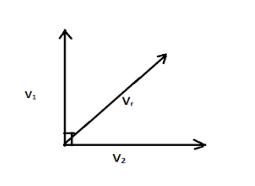
The resultant of the velocities ${v_1}$ and ${v_2}$ will be
$ \Rightarrow {\vec V_r} = {\vec v_1} + {\vec v_2}$
$ \Rightarrow {V_r} = \sqrt {v_1^2 + v_2^2 + {v_1}{v_2}\cos \theta } = \sqrt {{{30}^2} + {{30}^2} + \left( {30 \times 30 \times \cos 90^\circ } \right)} = 42.42m{s^{ - 1}}$
Here ${\vec V_r}$ is the resultant due to the velocities ${v_1}$ and ${v_2}$
$\theta $ is the angle between the velocities ${v_1}$ and ${v_2}$.
Equation 1 can be rewritten as,
$ \Rightarrow {\vec V_r} = - 3{\vec v_3}$
\[ \Rightarrow {\vec v_3} = - \dfrac{1}{3}{\vec V_r}\]
Let this be equation 2.
From equation 2, it is clearly evident that the velocity of the heavier particle will be one-third of the resultant velocity due to ${v_1}$ and ${v_2}$. The negative sign indicates the direction of ${v_3}$is in the opposite direction of the resultant velocity.
\[ \Rightarrow {v_3} = - \dfrac{1}{3}{V_r}\]
\[ \Rightarrow {v_3} = \dfrac{1}{3} \times 42.42 = 14.14m{s^{ - 1}}\]
Therefore the velocity of the heavier particle will be \[14.14m{s^{ - 1}}\] in the opposite direction of the resultant of ${v_1}$ and ${v_2}$.
Note:While solving these types of questions we should be very careful about the direction given in the question as momentum is a vector quantity. Also while using the conservation of momentum equation we should consider all the particles given in the system before and after an explosion or collision.
Formulae used:
Law of conservation of momentum,
$momentu{m_{before}} = momentu{m_{after}}$
Here $momentu{m_{before}}$ is the momentum of the system before explosion and
$momentu{m_{after}}$ is the momentum of the system after an explosion.
$\vec p = m\vec v$
Here $\vec p$ is the momentum of the body, $m$ is the mass of the body and $\vec v$ is the velocity of the body.
Complete step by step answer:
In the question, it is given that the mass of the body was $1Kg$ and it exploded into three fragments.
Let the masses of individual fragments be ${m_1}$, ${m_2}$ and ${m_3}$. It is given in the question that the masses are in the ratio $1:1:3$. So the values of mass of each fragment is,
${m_1} = 1 \times \dfrac{1}{5} = 0.2Kg$,
${m_2} = 1 \times \dfrac{1}{5} = 0.2Kg$ and
${m_3} = 1 \times \dfrac{3}{5} = 0.6Kg$.
We know that the momentum of the system is always conserved. So,
$M\vec u = {m_1}{\vec v_1} + {m_2}{\vec v_2} + {m_3}{\vec v_3}$
Here $M$ is the mass of the particle before explosion,
$u$ is the velocity of the particle before explosion,
${m_1}$, ${m_2}$ and ${m_3}$ are the masses of the fragments after explosion and
${v_1}$, ${v_2}$ and ${v_3}$ are the velocities of the fragments after the explosion.
We know that the body is at rest before explosion as it’s already given in the question. So,
$u = 0$
$ \Rightarrow 0 = {m_1}{\vec v_1} + {m_2}{\vec v_2} + {m_3}{\vec v_3}$
Substituting the values of ${m_1}$, ${m_2}$ and ${m_3}$ in the above equation, we get
$ \Rightarrow 0 = 0.2{\vec v_1} + 0.2{\vec v_2} + 0.6{\vec v_3}$
$ \Rightarrow {\vec v_1} + {\vec v_2} = - 3{\vec v_3}$
Let this be equation 1.
In the question, it is said that two of the particles with equal mass fly off perpendicular to each other with a speed of $30m{s^{ - 1}}$ each.
The resultant of the velocities ${v_1}$ and ${v_2}$ will be
$ \Rightarrow {\vec V_r} = {\vec v_1} + {\vec v_2}$
$ \Rightarrow {V_r} = \sqrt {v_1^2 + v_2^2 + {v_1}{v_2}\cos \theta } = \sqrt {{{30}^2} + {{30}^2} + \left( {30 \times 30 \times \cos 90^\circ } \right)} = 42.42m{s^{ - 1}}$
Here ${\vec V_r}$ is the resultant due to the velocities ${v_1}$ and ${v_2}$
$\theta $ is the angle between the velocities ${v_1}$ and ${v_2}$.
Equation 1 can be rewritten as,
$ \Rightarrow {\vec V_r} = - 3{\vec v_3}$
\[ \Rightarrow {\vec v_3} = - \dfrac{1}{3}{\vec V_r}\]
Let this be equation 2.
From equation 2, it is clearly evident that the velocity of the heavier particle will be one-third of the resultant velocity due to ${v_1}$ and ${v_2}$. The negative sign indicates the direction of ${v_3}$is in the opposite direction of the resultant velocity.
\[ \Rightarrow {v_3} = - \dfrac{1}{3}{V_r}\]
\[ \Rightarrow {v_3} = \dfrac{1}{3} \times 42.42 = 14.14m{s^{ - 1}}\]
Therefore the velocity of the heavier particle will be \[14.14m{s^{ - 1}}\] in the opposite direction of the resultant of ${v_1}$ and ${v_2}$.
Note:While solving these types of questions we should be very careful about the direction given in the question as momentum is a vector quantity. Also while using the conservation of momentum equation we should consider all the particles given in the system before and after an explosion or collision.
Recently Updated Pages
Master Class 11 Computer Science: Engaging Questions & Answers for Success

Master Class 11 Business Studies: Engaging Questions & Answers for Success
Master Class 11 Economics: Engaging Questions & Answers for Success
Master Class 11 English: Engaging Questions & Answers for Success
Master Class 11 Maths: Engaging Questions & Answers for Success
Master Class 11 Biology: Engaging Questions & Answers for Success
Trending doubts
One Metric ton is equal to kg A 10000 B 1000 C 100 class 11 physics CBSE
There are 720 permutations of the digits 1 2 3 4 5 class 11 maths CBSE
Discuss the various forms of bacteria class 11 biology CBSE
Draw a diagram of a plant cell and label at least eight class 11 biology CBSE
State the laws of reflection of light
10 examples of friction in our daily life