




A body of mass $0.5Kg$ is projected under gravity with a speed of $98m/s$at an angle of $30^\circ $with the horizontal. The change in momentum (in magnitude) of the body when its strike the ground is
A. $98{\text{ N - }}s$
B. $49{\text{ N - }}s$
C. $196{\text{ N - }}s$
D. $24.5{\text{ N - s}}$
Answer
 Verified
586.2k+ views
Hint: Concept of final and initial velocity of a projectile thrown at an angle with the horizontal and change in momentum which is both horizontal change in momentum and vertical change in momentum.
(1). Momentum, $P = $mass$ \times $velocity
(2). Change in momentum $ = $final momentum $–$ Initial momentum
Complete step by step answer:
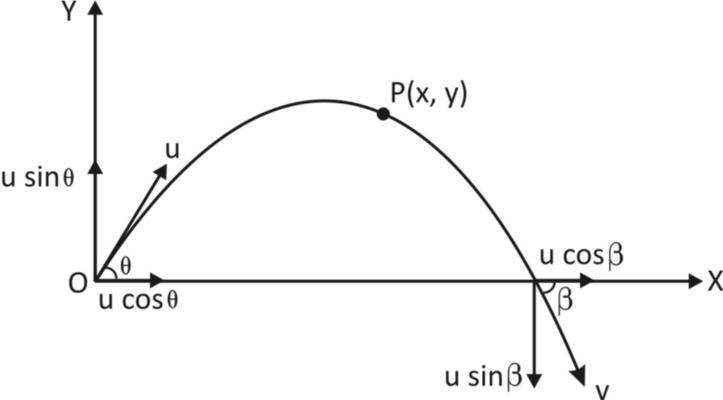
Let us consider a projectile as shown in the figure with initial velocity $v$at an angle $\theta $ with the horizontal.
Let it finally hit the ground after time of flight, $t$with final velocity $v$making an angle $\beta $with the horizontal.
Now, let at any instant, $t$, when the body is at point $P\left( {x,y} \right)$velocity, $v$will have two rectangular components.
Horizontal component of velocity,
${v_x} = u\cos \theta $…….. (as ${a_x} = 0$)
And vertical component of velocity,
${v_y} = u\sin \theta - gt$……….. (Using $v = u + at$ and $a = - g$)
Resultant velocity at point$P$,
\[
v = \sqrt {v{x^2} + v{y^2}} = \sqrt {{{\left( {u\cos \theta } \right)}^2} + {{\left( {u\sin \theta - gt} \right)}^2}} \\
v = \sqrt {{u^2} + {g^2}{t^2} - 2ugt\sin \theta } \\
\]
At end point, $t = $time of flight $t = \dfrac{{2u\sin \theta }}{g}$
So, \[
v = \sqrt {{u^2} + {g^2}\left( {\dfrac{{2u\sin \theta }}{g}} \right) - 2ug\left( {\dfrac{{2u\sin \theta }}{g}} \right)\sin \theta } \\
= \sqrt {{u^2}} = u \\
\]
$ \Rightarrow $Final velocity $ = $initial velocity
If velocity makes angle $\beta $with the horizontal, then
$
\tan \beta = \dfrac{{{v_y}}}{{{v_x}}} = \dfrac{{u\sin \theta - gt}}{{u\cos \theta }} \\
\tan \beta = \dfrac{{u\sin \theta - g \cdot \dfrac{{2u\sin \theta }}{g}}}{{u\cos \theta }} \\
\tan \beta = - \dfrac{{u\sin \theta }}{{u\cos \theta }} = - \tan \theta = \tan \left( { - \theta } \right) \\
\beta = - \theta \\
$
So, direction changes
Now, horizontal change in
Momentum $ = m{v_x} - m{u_x}$
\[
= mv\cos \beta - mu\cos \theta \\
= mu\cos \left( { - \theta } \right) - mu\cos \theta \\
- \left( {as{\text{ v}} = u,{\text{ }}\theta = - \beta } \right) \\
= mu\cos \theta - mu\cos \theta \\
= 0 \\
\]
So, no horizontal change in momentum vertical change in momentum
$
= m{v_y} - m{u_y} \\
= mv\sin \beta - mu\sin \theta \\
= mu\sin \left( { - \theta } \right) - mu\sin \theta \\
= - mu\sin \theta - mu\sin \theta \\
= - 2mu\sin \theta \\
$
So, net change in momentum is the sum of both.
Net change in momentum $ = \left| { - 2mu\sin \theta } \right|$
Here $
m = 0.5Kg,{\text{ }}u = 98m/s \\
\theta = 30^\circ \\
$
So, change in momentum $ = \left| { - 2 \times 0.5 \times 98 \times \sin 30} \right|$
$
= 2 \times \dfrac{1}{2} \times 98 \times \dfrac{1}{2} \\
= \dfrac {{98}}{2} \\
= 49Ns \\
$
So, the correct answer is “Option B”.
Note:
Here we have found only the magnitude of net change in momentum, so we can ignore negative signs. Also as there is no net horizontal acceleration to the body projected so change in horizontal velocity will be zero and hence change in horizontal momentum is also zero while in vertical direction, acceleration due to gravity occurs in vertically downward direction to which vertical change in momentum corresponds.
(1). Momentum, $P = $mass$ \times $velocity
(2). Change in momentum $ = $final momentum $–$ Initial momentum
Complete step by step answer:
Let us consider a projectile as shown in the figure with initial velocity $v$at an angle $\theta $ with the horizontal.
Let it finally hit the ground after time of flight, $t$with final velocity $v$making an angle $\beta $with the horizontal.
Now, let at any instant, $t$, when the body is at point $P\left( {x,y} \right)$velocity, $v$will have two rectangular components.
Horizontal component of velocity,
${v_x} = u\cos \theta $…….. (as ${a_x} = 0$)
And vertical component of velocity,
${v_y} = u\sin \theta - gt$……….. (Using $v = u + at$ and $a = - g$)
Resultant velocity at point$P$,
\[
v = \sqrt {v{x^2} + v{y^2}} = \sqrt {{{\left( {u\cos \theta } \right)}^2} + {{\left( {u\sin \theta - gt} \right)}^2}} \\
v = \sqrt {{u^2} + {g^2}{t^2} - 2ugt\sin \theta } \\
\]
At end point, $t = $time of flight $t = \dfrac{{2u\sin \theta }}{g}$
So, \[
v = \sqrt {{u^2} + {g^2}\left( {\dfrac{{2u\sin \theta }}{g}} \right) - 2ug\left( {\dfrac{{2u\sin \theta }}{g}} \right)\sin \theta } \\
= \sqrt {{u^2}} = u \\
\]
$ \Rightarrow $Final velocity $ = $initial velocity
If velocity makes angle $\beta $with the horizontal, then
$
\tan \beta = \dfrac{{{v_y}}}{{{v_x}}} = \dfrac{{u\sin \theta - gt}}{{u\cos \theta }} \\
\tan \beta = \dfrac{{u\sin \theta - g \cdot \dfrac{{2u\sin \theta }}{g}}}{{u\cos \theta }} \\
\tan \beta = - \dfrac{{u\sin \theta }}{{u\cos \theta }} = - \tan \theta = \tan \left( { - \theta } \right) \\
\beta = - \theta \\
$
So, direction changes
Now, horizontal change in
Momentum $ = m{v_x} - m{u_x}$
\[
= mv\cos \beta - mu\cos \theta \\
= mu\cos \left( { - \theta } \right) - mu\cos \theta \\
- \left( {as{\text{ v}} = u,{\text{ }}\theta = - \beta } \right) \\
= mu\cos \theta - mu\cos \theta \\
= 0 \\
\]
So, no horizontal change in momentum vertical change in momentum
$
= m{v_y} - m{u_y} \\
= mv\sin \beta - mu\sin \theta \\
= mu\sin \left( { - \theta } \right) - mu\sin \theta \\
= - mu\sin \theta - mu\sin \theta \\
= - 2mu\sin \theta \\
$
So, net change in momentum is the sum of both.
Net change in momentum $ = \left| { - 2mu\sin \theta } \right|$
Here $
m = 0.5Kg,{\text{ }}u = 98m/s \\
\theta = 30^\circ \\
$
So, change in momentum $ = \left| { - 2 \times 0.5 \times 98 \times \sin 30} \right|$
$
= 2 \times \dfrac{1}{2} \times 98 \times \dfrac{1}{2} \\
= \dfrac {{98}}{2} \\
= 49Ns \\
$
So, the correct answer is “Option B”.
Note:
Here we have found only the magnitude of net change in momentum, so we can ignore negative signs. Also as there is no net horizontal acceleration to the body projected so change in horizontal velocity will be zero and hence change in horizontal momentum is also zero while in vertical direction, acceleration due to gravity occurs in vertically downward direction to which vertical change in momentum corresponds.
Recently Updated Pages
Master Class 11 Business Studies: Engaging Questions & Answers for Success

Master Class 11 Economics: Engaging Questions & Answers for Success
Master Class 11 Computer Science: Engaging Questions & Answers for Success
Master Class 11 English: Engaging Questions & Answers for Success
Master Class 11 Maths: Engaging Questions & Answers for Success
Master Class 11 Biology: Engaging Questions & Answers for Success
Trending doubts
One Metric ton is equal to kg A 10000 B 1000 C 100 class 11 physics CBSE
Discuss the various forms of bacteria class 11 biology CBSE
Draw a diagram of a plant cell and label at least eight class 11 biology CBSE
State the laws of reflection of light
Explain zero factorial class 11 maths CBSE
10 examples of friction in our daily life