




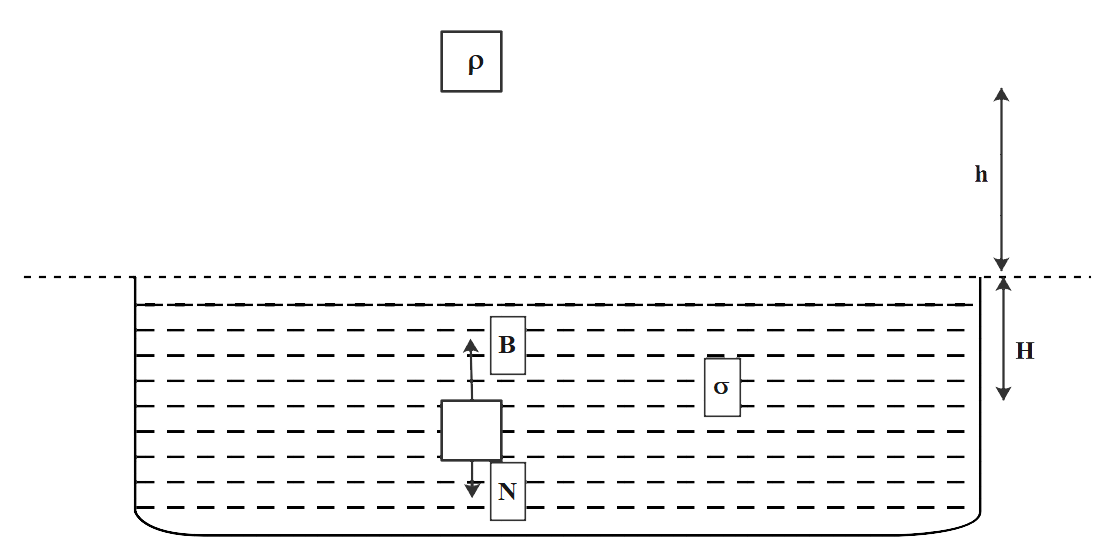
A body of density \[\rho \] is dropped from rest from a height h into a lake of density \[\sigma ,\left( \sigma >\rho \right)\]. The maximum depth the body sinks inside the liquid is (neglect viscous effect of liquid):
A. \[\dfrac{h\rho }{\sigma -\rho }\]
B. \[\dfrac{h\sigma }{\sigma -\rho }\]
C. \[\dfrac{h\rho }{\sigma }\]
D. \[\dfrac{h\sigma }{\rho }\]
Answer
 Verified
617.4k+ views
Hint:In this question we have been asked to calculate the maximum depth a body will sink in the liquid when dropped from height ‘h’. It is given that the density of the body is \[\rho \] and the density of the lake is \[\sigma \]. We know that, if an object is dropped in liquid, the object will float or sink in the lake due to the amount of Buoyancy force. Therefore, to calculate the depth we shall first calculate the force acting on the body after it is dropped in the lake.
Formula used:
\[{{v}^{2}}={{u}^{2}}+2as\]
Complete solution:
It is given that the body is dropped from a height ‘h’ into a lake. Now, let us assume that the body sinks to a height of ‘H’ as shown in the figure.
Now, from second kinematic equation
We know,
\[{{v}^{2}}={{u}^{2}}+2as\] ……………… (1)
Since the velocity of the body is at rest u = 0. The body is falling due to gravity, therefore a = g
After substituting the values
We get,
\[{{v}^{2}}=0+2gh\]
Therefore,
\[v=\sqrt{2gh}\] ……………. (2)
Now, we know that mass of a body can be given as the product of density of the body and its volume. Therefore, the force N is given as,
\[N=\rho Vg\]
From the diagram, the buoyant force is B is given as,
\[B=\sigma Vg\]
From diagram we can say that,
\[F=B-N\]
After substituting the values
We get,
\[F=\sigma Vg-\rho Vg\]
We can also write,
\[\rho Va=\sigma Vg-\rho Vg\] ………….. (\[\because \]F=ma; m=density\[\times \]volume)
Solving for ‘a’
We get,
\[a=g\left( \dfrac{\sigma -\rho }{\rho } \right)\] …………….. (3)
Now, we know that when the body will be at rest when it is submerged in liquid at depth ‘H’ as shown in the figure.
Therefore,
From (1) and (3)
We get,
\[0={{\left( \sqrt{2gh} \right)}^{2}}-2g\left( \dfrac{\sigma -\rho }{\rho } \right)\times H\]
Therefore,
\[H=\left( \dfrac{h\rho }{\sigma -\rho } \right)\]
Therefore, the correct answer is option A.
Note:
The kinetic equation also known as kinematic equation is a set of equations that are used to define the motion of a body moving with constant acceleration. The three kinetic equations give the relation between distance, final and initial speeds and acceleration of a particle. The kinetic equations are very useful to calculate the velocity or acceleration of a particle provided other quantities are provided.
Formula used:
\[{{v}^{2}}={{u}^{2}}+2as\]
Complete solution:
It is given that the body is dropped from a height ‘h’ into a lake. Now, let us assume that the body sinks to a height of ‘H’ as shown in the figure.
Now, from second kinematic equation
We know,
\[{{v}^{2}}={{u}^{2}}+2as\] ……………… (1)
Since the velocity of the body is at rest u = 0. The body is falling due to gravity, therefore a = g
After substituting the values
We get,
\[{{v}^{2}}=0+2gh\]
Therefore,
\[v=\sqrt{2gh}\] ……………. (2)
Now, we know that mass of a body can be given as the product of density of the body and its volume. Therefore, the force N is given as,
\[N=\rho Vg\]
From the diagram, the buoyant force is B is given as,
\[B=\sigma Vg\]
From diagram we can say that,
\[F=B-N\]
After substituting the values
We get,
\[F=\sigma Vg-\rho Vg\]
We can also write,
\[\rho Va=\sigma Vg-\rho Vg\] ………….. (\[\because \]F=ma; m=density\[\times \]volume)
Solving for ‘a’
We get,
\[a=g\left( \dfrac{\sigma -\rho }{\rho } \right)\] …………….. (3)
Now, we know that when the body will be at rest when it is submerged in liquid at depth ‘H’ as shown in the figure.
Therefore,
From (1) and (3)
We get,
\[0={{\left( \sqrt{2gh} \right)}^{2}}-2g\left( \dfrac{\sigma -\rho }{\rho } \right)\times H\]
Therefore,
\[H=\left( \dfrac{h\rho }{\sigma -\rho } \right)\]
Therefore, the correct answer is option A.
Note:
The kinetic equation also known as kinematic equation is a set of equations that are used to define the motion of a body moving with constant acceleration. The three kinetic equations give the relation between distance, final and initial speeds and acceleration of a particle. The kinetic equations are very useful to calculate the velocity or acceleration of a particle provided other quantities are provided.
Recently Updated Pages
Basicity of sulphurous acid and sulphuric acid are

Master Class 12 Economics: Engaging Questions & Answers for Success
Master Class 12 Biology: Engaging Questions & Answers for Success
Master Class 11 English: Engaging Questions & Answers for Success
Master Class 11 Physics: Engaging Questions & Answers for Success
Master Class 11 Computer Science: Engaging Questions & Answers for Success
Trending doubts
Draw a labelled sketch of the human eye class 12 physics CBSE
Why is the cell called the structural and functional class 12 biology CBSE
Draw ray diagrams each showing i myopic eye and ii class 12 physics CBSE
Which are the Top 10 Largest Countries of the World?
Differentiate between homogeneous and heterogeneous class 12 chemistry CBSE
Which is the correct genotypic ratio of mendel dihybrid class 12 biology CBSE