




A body of 5 kg weight kept on a rough inclined plane of angle ${30}^\circ $ starts sliding with a constant velocity. Then the coefficient of friction is
(assuming $g = 10m/{s^2}$)
$\begin{align}
& {\text{A}}{\text{. }}\dfrac{1}{{\sqrt 3 }} \\
& {\text{B}}{\text{. 2}} \\
&{\text{C}}{\text{. }}\sqrt 3 \\
& {\text{D}}{\text{. }}\dfrac{2}{{\sqrt 3 }} \\
\end{align} $
Answer
 Verified
610.2k+ views
Hint: As the block slides on the inclined plane, the frictional force comes into action due to the weight of the block. We need to draw a free body diagram showing various forces acting on the block then by equating various forces and solving equations, we shall be able to find the value of the coefficient of friction.
Complete step-by-step solution:
We are given a body whose mass is given as
$m = 5kg$
It is placed on an inclined plane and is sliding down with a constant velocity. We can draw the following free body diagram for the given situation.
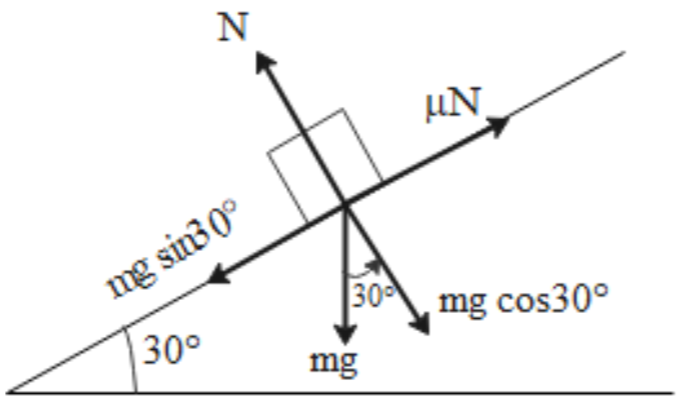
We have resolved the weight mg of the block into its horizontal and vertical components with respect to the inclined plane. There is a normal reaction force N acting on the block. As the block slides on the inclined plane, the frictional force acts along the plane in the direction opposite to the direction of motion of the block. This force is dependent on the normal reaction force N acting on the block.
Now based on the diagram, we can write the following equations of motion for the block.
$\begin{align}
& N = mg\cos 30^\circ \\
&\Rightarrow \mu N = mg\sin 30^\circ \\
\end{align} $
Now we can insert the values of various known parameters in these equations. Doing so, we get
$\begin{align}
& N = 5 \times 10 \times \dfrac{{\sqrt 3 }}{2} = 25\sqrt 3 N \\
&\Rightarrow \mu = \dfrac{{mg\sin 30^\circ }}{N} = \dfrac{{5 \times 10 \times \dfrac{1}{2}}}{{25\sqrt 3 }} = \dfrac{1}{{\sqrt 3 }} \\
\end{align} $
This is the required solution. Hence, the correct answer is option A.
Note: 1. The greater the weight of the block, the greater is the normal reaction force and greater the frictional force between the block and the surface of the inclined plane.
2. We can also obtain the same solution by considering the constant velocity of the block as it slides down. In this case, we can take net acceleration equal to zero and then solve for the coefficient of friction.
Complete step-by-step solution:
We are given a body whose mass is given as
$m = 5kg$
It is placed on an inclined plane and is sliding down with a constant velocity. We can draw the following free body diagram for the given situation.
We have resolved the weight mg of the block into its horizontal and vertical components with respect to the inclined plane. There is a normal reaction force N acting on the block. As the block slides on the inclined plane, the frictional force acts along the plane in the direction opposite to the direction of motion of the block. This force is dependent on the normal reaction force N acting on the block.
Now based on the diagram, we can write the following equations of motion for the block.
$\begin{align}
& N = mg\cos 30^\circ \\
&\Rightarrow \mu N = mg\sin 30^\circ \\
\end{align} $
Now we can insert the values of various known parameters in these equations. Doing so, we get
$\begin{align}
& N = 5 \times 10 \times \dfrac{{\sqrt 3 }}{2} = 25\sqrt 3 N \\
&\Rightarrow \mu = \dfrac{{mg\sin 30^\circ }}{N} = \dfrac{{5 \times 10 \times \dfrac{1}{2}}}{{25\sqrt 3 }} = \dfrac{1}{{\sqrt 3 }} \\
\end{align} $
This is the required solution. Hence, the correct answer is option A.
Note: 1. The greater the weight of the block, the greater is the normal reaction force and greater the frictional force between the block and the surface of the inclined plane.
2. We can also obtain the same solution by considering the constant velocity of the block as it slides down. In this case, we can take net acceleration equal to zero and then solve for the coefficient of friction.
Recently Updated Pages
Master Class 11 Social Science: Engaging Questions & Answers for Success

Master Class 11 English: Engaging Questions & Answers for Success
Master Class 11 Maths: Engaging Questions & Answers for Success
Master Class 11 Chemistry: Engaging Questions & Answers for Success
Master Class 11 Biology: Engaging Questions & Answers for Success
Master Class 11 Physics: Engaging Questions & Answers for Success
Trending doubts
Differentiate between an exothermic and an endothermic class 11 chemistry CBSE
One Metric ton is equal to kg A 10000 B 1000 C 100 class 11 physics CBSE
Difference Between Prokaryotic Cells and Eukaryotic Cells
There are 720 permutations of the digits 1 2 3 4 5 class 11 maths CBSE
Draw a diagram of a plant cell and label at least eight class 11 biology CBSE
Two of the body parts which do not appear in MRI are class 11 biology CBSE