




When a body moves in a uniform circular motion, changes in velocity and speed will be
A. velocity changes but speed remains constant
B. velocity remains constant but speed changes
C. both remain constant
D. both change
Answer
 Verified
621.6k+ views
Hint: Speed is a scalar quantity while velocity is a vector quantity. If the direction of a scalar quantity is changing then there is no change in the scalar quantity. But if the direction of a vector quantity is changing, it means that the vector quantity is also changing.
Complete answer:
A body is said to be in a uniform circular motion if it is moving in a circular orbit about a point such that its angular velocity and speed is remaining constant as it moves along its trajectory.
A body which is moving in a circular motion is undergoing change in its direction at every point of the trajectory.
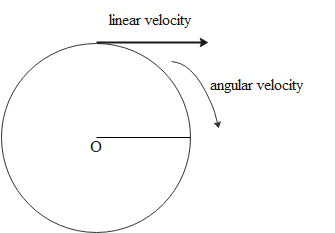
We know that linear velocity is a vector quantity while speed is a scalar quantity. A vector quantity changes if there is a change in the direction of the object while a scalar quantity is not affected by the change in direction of the object. The magnitude of velocity is the speed of the object.
Now since in uniform circular motion speed of the object remains constant and the direction of the object keeps changing at every point of the trajectory then the velocity of the object is constant and is changing at every point of the trajectory while its magnitude which is the speed remains constant.
So, the correct answer is “Option A”.
Note:
Angular velocity and linear velocity of an object are two different quantities which should not be confused together. The angular velocity is due to the circular motion of the object while linear velocity is the translational component of the object. A body in circular motion possesses the angular velocity and the linear velocity can be measured at every point of the trajectory.
Complete answer:
A body is said to be in a uniform circular motion if it is moving in a circular orbit about a point such that its angular velocity and speed is remaining constant as it moves along its trajectory.
A body which is moving in a circular motion is undergoing change in its direction at every point of the trajectory.
We know that linear velocity is a vector quantity while speed is a scalar quantity. A vector quantity changes if there is a change in the direction of the object while a scalar quantity is not affected by the change in direction of the object. The magnitude of velocity is the speed of the object.
Now since in uniform circular motion speed of the object remains constant and the direction of the object keeps changing at every point of the trajectory then the velocity of the object is constant and is changing at every point of the trajectory while its magnitude which is the speed remains constant.
So, the correct answer is “Option A”.
Note:
Angular velocity and linear velocity of an object are two different quantities which should not be confused together. The angular velocity is due to the circular motion of the object while linear velocity is the translational component of the object. A body in circular motion possesses the angular velocity and the linear velocity can be measured at every point of the trajectory.
Recently Updated Pages
Master Class 11 Social Science: Engaging Questions & Answers for Success

Master Class 11 English: Engaging Questions & Answers for Success
Master Class 11 Maths: Engaging Questions & Answers for Success
Master Class 11 Chemistry: Engaging Questions & Answers for Success
Master Class 11 Biology: Engaging Questions & Answers for Success
Master Class 11 Physics: Engaging Questions & Answers for Success
Trending doubts
One Metric ton is equal to kg A 10000 B 1000 C 100 class 11 physics CBSE
Difference Between Prokaryotic Cells and Eukaryotic Cells
How many of the following diseases can be studied with class 11 biology CBSE
Which of the following enzymes is used for carboxylation class 11 biology CBSE
Draw a diagram of a plant cell and label at least eight class 11 biology CBSE
Two of the body parts which do not appear in MRI are class 11 biology CBSE