




A body is travelling in a circle at a constant speed. It
A. Has constant velocity
B. Has no acceleration
C. Has an inward acceleration
D. Has an outward acceleration
E. None of these
Answer
 Verified
604.5k+ views
Hint: A body moving in a circle changes its direction at every point on the motion. So, there is a change in its velocity and thus it has some acceleration. This acceleration has two components. The tangential component of the acceleration \[\overrightarrow{{{a}_{T}}}\] is responsible for the change in speed and the centripetal acceleration \[\overrightarrow{{{a}_{C}}}\] is responsible for the change in direction of the particle.
Complete step by step answer:
Velocity and speed are quite different quantities. Speed is a scalar quantity that refers to how fast the object is moving. It can be defined as the distance travelled by the body per unit time. Meanwhile, velocity is a vector quantity, it has both magnitude and direction. It refers to the rate at which the object changes its position. It is defined as displacement per unit time.
Change in Velocity per unit time is called Acceleration.
A body moving in a circle changes its direction at every point on the motion. So, there is a change in its velocity and thus it has some acceleration. This acceleration has two components as shown in the diagram.
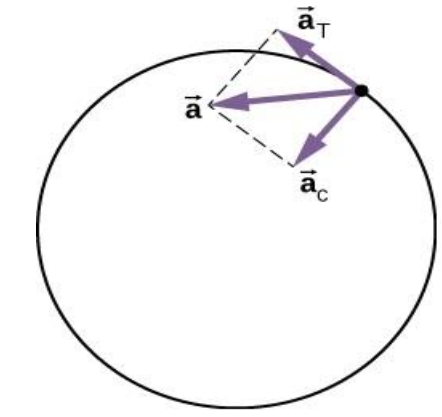
The tangential component of the acceleration \[\overrightarrow{{{a}_{T}}}\] is responsible for the change in speed and the centripetal acceleration \[\overrightarrow{{{a}_{C}}}\] is responsible for the change in direction of the particle.
Coming to the question at hand, the body is travelling in a circle with constant speed. Therefore, the tangential component of the acceleration \[\overrightarrow{{{a}_{T}}}\] is zero and it has only the centripetal acceleration \[\overrightarrow{{{a}_{C}}}\] which is directed towards the centre. So, it has an inward acceleration.
Therefore, Option C is correct.
Note:
The component of acceleration directed towards the centre of a body moving is very important and is called centripetal acceleration. This acceleration is the result of the force that makes the body move in a circle, called the centripetal force. This force is directed towards the centre of the circle and can be frictional, gravitational or any other form of force. Centripetal force is used for banking of roads, planetary motions etc.
Complete step by step answer:
Velocity and speed are quite different quantities. Speed is a scalar quantity that refers to how fast the object is moving. It can be defined as the distance travelled by the body per unit time. Meanwhile, velocity is a vector quantity, it has both magnitude and direction. It refers to the rate at which the object changes its position. It is defined as displacement per unit time.
Change in Velocity per unit time is called Acceleration.
A body moving in a circle changes its direction at every point on the motion. So, there is a change in its velocity and thus it has some acceleration. This acceleration has two components as shown in the diagram.
The tangential component of the acceleration \[\overrightarrow{{{a}_{T}}}\] is responsible for the change in speed and the centripetal acceleration \[\overrightarrow{{{a}_{C}}}\] is responsible for the change in direction of the particle.
Coming to the question at hand, the body is travelling in a circle with constant speed. Therefore, the tangential component of the acceleration \[\overrightarrow{{{a}_{T}}}\] is zero and it has only the centripetal acceleration \[\overrightarrow{{{a}_{C}}}\] which is directed towards the centre. So, it has an inward acceleration.
Therefore, Option C is correct.
Note:
The component of acceleration directed towards the centre of a body moving is very important and is called centripetal acceleration. This acceleration is the result of the force that makes the body move in a circle, called the centripetal force. This force is directed towards the centre of the circle and can be frictional, gravitational or any other form of force. Centripetal force is used for banking of roads, planetary motions etc.
Recently Updated Pages
Master Class 11 Social Science: Engaging Questions & Answers for Success

Master Class 11 English: Engaging Questions & Answers for Success
Master Class 11 Maths: Engaging Questions & Answers for Success
Master Class 11 Chemistry: Engaging Questions & Answers for Success
Master Class 11 Biology: Engaging Questions & Answers for Success
Master Class 11 Physics: Engaging Questions & Answers for Success
Trending doubts
Differentiate between an exothermic and an endothermic class 11 chemistry CBSE
One Metric ton is equal to kg A 10000 B 1000 C 100 class 11 physics CBSE
Difference Between Prokaryotic Cells and Eukaryotic Cells
There are 720 permutations of the digits 1 2 3 4 5 class 11 maths CBSE
Two of the body parts which do not appear in MRI are class 11 biology CBSE
Which gas is abundant in air class 11 chemistry CBSE