




A body is thrown vertically upward with velocity $u$, the greatest height h up to which it will rise is \[h=\dfrac{{{u}^{2}}}{2g}\]
\[\begin{align}
& A.\dfrac{u}{g} \\
& B.\dfrac{{{u}^{2}}}{2g} \\
& C.\dfrac{{{u}^{2}}}{g} \\
& D.\dfrac{u}{2g} \\
\end{align}\]
Answer
 Verified
613.8k+ views
Hint: The newton’s third equation of motion has been used to solve the question.
That is written as,
\[{{v}^{2}}={{u}^{2}}+2as\]
In which \[v\] is the final velocity with which body travels, \[u\] is the initial velocity with which body travels,\[a\] is the acceleration taking place and \[s\] is the distance travelled of the body. These specific terms can be replaced using the appropriate terms when the motion is in free fall. These all may help us to solve this question.
Complete step-by-step answer:
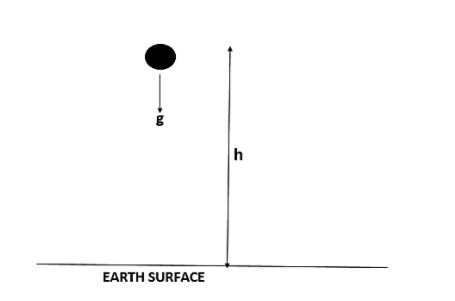
Here, according to newton’s third equation of motion, we can write that,
\[{{v}^{2}}={{u}^{2}}+2as\]
Here the final velocity with which the body is being finally found is considered to be zero when the object reaches its maximum height. Therefore we can write,
\[v=0\]
The acceleration of the body will be equal to the acceleration due to gravity as it is a free fall.
\[a=-g\]
And also the distance the body will travel will be equal to the maximum height.
\[s=h\]
Substituting these all in the equation of motion will give,
\[{{0}^{2}}={{u}^{2}}-2gh\]
Rearranging the terms will give,
\[h=\dfrac{{{u}^{2}}}{2g}\]
So, the correct answer is “Option B”.
Note: In mechanics, free fall is referred to as any motion of a body occurring where gravity is the only force experiencing upon it. According to the concepts of relativity in which gravitation is indicated to a space-time curvature, the body in free fall will be having no force experiencing on it. In the space or vacuum where there are no free air molecules or supportive surfaces, the astronauts are only experienced upon by gravity. Therefore they are coming towards Earth at the acceleration of gravity.
That is written as,
\[{{v}^{2}}={{u}^{2}}+2as\]
In which \[v\] is the final velocity with which body travels, \[u\] is the initial velocity with which body travels,\[a\] is the acceleration taking place and \[s\] is the distance travelled of the body. These specific terms can be replaced using the appropriate terms when the motion is in free fall. These all may help us to solve this question.
Complete step-by-step answer:
Here, according to newton’s third equation of motion, we can write that,
\[{{v}^{2}}={{u}^{2}}+2as\]
Here the final velocity with which the body is being finally found is considered to be zero when the object reaches its maximum height. Therefore we can write,
\[v=0\]
The acceleration of the body will be equal to the acceleration due to gravity as it is a free fall.
\[a=-g\]
And also the distance the body will travel will be equal to the maximum height.
\[s=h\]
Substituting these all in the equation of motion will give,
\[{{0}^{2}}={{u}^{2}}-2gh\]
Rearranging the terms will give,
\[h=\dfrac{{{u}^{2}}}{2g}\]
So, the correct answer is “Option B”.
Note: In mechanics, free fall is referred to as any motion of a body occurring where gravity is the only force experiencing upon it. According to the concepts of relativity in which gravitation is indicated to a space-time curvature, the body in free fall will be having no force experiencing on it. In the space or vacuum where there are no free air molecules or supportive surfaces, the astronauts are only experienced upon by gravity. Therefore they are coming towards Earth at the acceleration of gravity.
Recently Updated Pages
Master Class 11 Social Science: Engaging Questions & Answers for Success

Master Class 11 English: Engaging Questions & Answers for Success
Master Class 11 Maths: Engaging Questions & Answers for Success
Master Class 11 Chemistry: Engaging Questions & Answers for Success
Master Class 11 Biology: Engaging Questions & Answers for Success
Master Class 11 Physics: Engaging Questions & Answers for Success
Trending doubts
Differentiate between an exothermic and an endothermic class 11 chemistry CBSE
There are 720 permutations of the digits 1 2 3 4 5 class 11 maths CBSE
Which gas is abundant in air class 11 chemistry CBSE
Draw a diagram of nephron and explain its structur class 11 biology CBSE
Explain zero factorial class 11 maths CBSE
Difference between unicellular and multicellular o class 11 biology CBSE