




A body is projected vertically upwards at time t = 0 and it is seen at a height H at time t1 and t2 second during its flight. The maximum height attained is (g is acceleration due to gravity).
(a)\[\dfrac{g{{\left( {{t}_{2}}-{{t}_{1}} \right)}^{2}}}{8}\]
(b)\[\dfrac{g{{\left( {{t}_{1}}+{{t}_{2}} \right)}^{2}}}{4}\]
(c)\[\dfrac{g{{\left( {{t}_{1}}+{{t}_{2}} \right)}^{2}}}{8}\]
(d)\[\dfrac{g{{\left( {{t}_{2}}-{{t}_{1}} \right)}^{2}}}{4}\]
Answer
 Verified
568.8k+ views
Hint:In order to calculate the maximum height attained, we need to refer the following figure is drawn below,
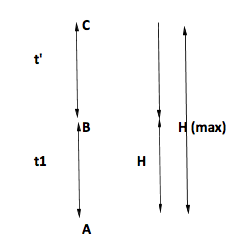
Let time taken by the body to fall from point \[C\text{ }to\text{ }B\]is\[t'\].
Then,
\[{t_1} + 2t' = {t_2}\]
\[t' = \dfrac{{{t_2} - {t_1}}}{2}\]…………(i)
Total time taken to reach point C,
\[T={{t}_{1}}+{t}'\]
\[={{t}_{1}}+\dfrac{{{t}_{2}}-{{t}_{1}}}{2}\]
$ = \dfrac{{2{t_1} + {t_2} - {t_1}}}{2}$
\[ = \dfrac{{{t_1} + {t_2}}}{2}\]
Maximum height attained,
\[{H_{max}} = \dfrac{1}{2}{\mkern 1mu} g{\mkern 1mu} {T^2}\]
\[=\dfrac{1}{2}g{{\dfrac{{{t}_{1}}+{{t}_{2}}}{2}}^{2}}\]
Hence, the answer to this question is option (b)
Additional Information: Projectile motion is a form of motion in which an object moves in a bilaterally symmetrical and parabolic path. The path traced by the object is called its trajectory. Projectile motion occurs only when there is some force applied at the beginning of the trajectory. After this initial thrust, the only interference is from gravity. In real life, many applications are found using projectile motion.
Note:While solving this question, we should be aware of the different types of formula used here. Especially projectile motion and how the different values of the variable of the formula is used from the question. The formula is modified and used here to take out the required solution for the problem given here. Different formulae are used here which must be taken into consideration while solving the question. The figure provided here must be observed carefully and study the case here.
Let time taken by the body to fall from point \[C\text{ }to\text{ }B\]is\[t'\].
Then,
\[{t_1} + 2t' = {t_2}\]
\[t' = \dfrac{{{t_2} - {t_1}}}{2}\]…………(i)
Total time taken to reach point C,
\[T={{t}_{1}}+{t}'\]
\[={{t}_{1}}+\dfrac{{{t}_{2}}-{{t}_{1}}}{2}\]
$ = \dfrac{{2{t_1} + {t_2} - {t_1}}}{2}$
\[ = \dfrac{{{t_1} + {t_2}}}{2}\]
Maximum height attained,
\[{H_{max}} = \dfrac{1}{2}{\mkern 1mu} g{\mkern 1mu} {T^2}\]
\[=\dfrac{1}{2}g{{\dfrac{{{t}_{1}}+{{t}_{2}}}{2}}^{2}}\]
Hence, the answer to this question is option (b)
Additional Information: Projectile motion is a form of motion in which an object moves in a bilaterally symmetrical and parabolic path. The path traced by the object is called its trajectory. Projectile motion occurs only when there is some force applied at the beginning of the trajectory. After this initial thrust, the only interference is from gravity. In real life, many applications are found using projectile motion.
Note:While solving this question, we should be aware of the different types of formula used here. Especially projectile motion and how the different values of the variable of the formula is used from the question. The formula is modified and used here to take out the required solution for the problem given here. Different formulae are used here which must be taken into consideration while solving the question. The figure provided here must be observed carefully and study the case here.
Recently Updated Pages
Master Class 11 Computer Science: Engaging Questions & Answers for Success

Master Class 11 Business Studies: Engaging Questions & Answers for Success
Master Class 11 Economics: Engaging Questions & Answers for Success
Master Class 11 English: Engaging Questions & Answers for Success
Master Class 11 Maths: Engaging Questions & Answers for Success
Master Class 11 Biology: Engaging Questions & Answers for Success
Trending doubts
One Metric ton is equal to kg A 10000 B 1000 C 100 class 11 physics CBSE
There are 720 permutations of the digits 1 2 3 4 5 class 11 maths CBSE
Discuss the various forms of bacteria class 11 biology CBSE
Draw a diagram of a plant cell and label at least eight class 11 biology CBSE
State the laws of reflection of light
Explain zero factorial class 11 maths CBSE