




A body is launched from the ground and it follows a parabolic path. The total range of the projectile is $40\;m$. When the body has a horizontal displacement of $10\;m$ its height above the ground is $7.5\;m$. Calculate the angle of the launch.
\[\begin{align}
& A{{.30}^{{}^\circ }} \\
& B{{.45}^{{}^\circ }} \\
& C{{.60}^{{}^\circ }} \\
& D{{.75}^{{}^\circ }} \\
\end{align}\]
Answer
 Verified
581.1k+ views
Hint: A body experiences a projectile motion when the object is projected at an inclination from the ground. Then the body follows a curved path, which is parabolic in nature and is called the ballistic trajectory. Here, we need to calculate the angle of inclination of the projectile motion.
Formula used:
$y=xtan\theta-\dfrac{1}{2}g\dfrac{x^{2}}{u^{2}cos^{2}\theta}$
Complete answer:
Let $u$ be the initial velocity of the body which is projected at an angle $\theta$ from the horizontal. Let $H$ and $R$ be the maximum distances along the x and y-axis respectively, during the time of flight $T$. Then the initial velocity $u$ can be resolved into two components along the x and y axis respectively .We know that the distance covered by the body along the x and y-axis respectively is given as, $R$ and $H$ which is the maximum horizontal range and maximum height attained by the object.
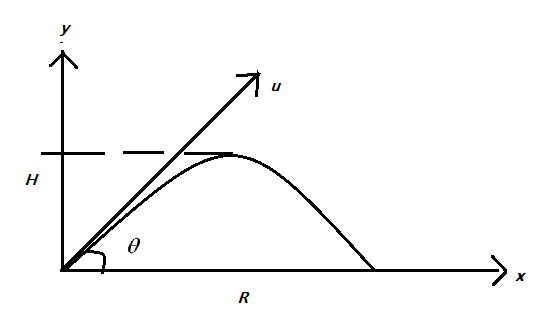
Here, given that $R=40m$ and $y=7.5m$ at$x=10m$
Then from the trajectory of projectile, we have $y=xtan\theta-\dfrac{1}{2}g\dfrac{x^{2}}{u^{2}cos^{2}\theta}$
Then during $y=7.5m$ at $x=10m$, we have, $7.5=10tan\theta-\dfrac{1}{2}g\dfrac{(10)^{2}}{u^{2}cos^{2}\theta}$
When, $y=0$, we have $x=40$, which is the range of the projectile.
Then we have, $40tan\theta=\dfrac{1}{2}g\dfrac{(40)^{2}}{u^{2}cos^{2}\theta}$
$\implies u^{2} sin\theta cos\theta=\dfrac{40^{2}\times g}{2\times 40}$
$\implies u^{2}=\dfrac{20g}{sin\theta cos\theta}$
Then form the above two equations, we get, $7.5=10tan\theta-\dfrac{1}{2}g\dfrac{(10)^{2}}{\dfrac{20g}{sin\theta cos\theta }cos^{2}\theta}$
$\implies 7.5=10tan\theta-\dfrac{5}{2}\dfrac{1}{\dfrac{cos\theta}{sin\theta}}$
$\implies 7.5=10tan\theta-\dfrac{5}{2}tan\theta$
$\implies 7.5=7.5 tan\theta$
$\implies tan \theta=1$
$\implies \theta =tan^{-1} 1$
$\implies \theta=45^{\circ}$
So, the correct answer is “Option B”.
Note:
When the object is on the air, the only force acting on the body is the force due to gravitation, which pulls the object back to the surface at the speed of acceleration due to gravity. Note that the range of the projected body is greater than the distance the body will cover, when dropped from the same height. Here, however, we are using the equation of trajectory of the projectile to solve the problem.
Formula used:
$y=xtan\theta-\dfrac{1}{2}g\dfrac{x^{2}}{u^{2}cos^{2}\theta}$
Complete answer:
Let $u$ be the initial velocity of the body which is projected at an angle $\theta$ from the horizontal. Let $H$ and $R$ be the maximum distances along the x and y-axis respectively, during the time of flight $T$. Then the initial velocity $u$ can be resolved into two components along the x and y axis respectively .We know that the distance covered by the body along the x and y-axis respectively is given as, $R$ and $H$ which is the maximum horizontal range and maximum height attained by the object.
Here, given that $R=40m$ and $y=7.5m$ at$x=10m$
Then from the trajectory of projectile, we have $y=xtan\theta-\dfrac{1}{2}g\dfrac{x^{2}}{u^{2}cos^{2}\theta}$
Then during $y=7.5m$ at $x=10m$, we have, $7.5=10tan\theta-\dfrac{1}{2}g\dfrac{(10)^{2}}{u^{2}cos^{2}\theta}$
When, $y=0$, we have $x=40$, which is the range of the projectile.
Then we have, $40tan\theta=\dfrac{1}{2}g\dfrac{(40)^{2}}{u^{2}cos^{2}\theta}$
$\implies u^{2} sin\theta cos\theta=\dfrac{40^{2}\times g}{2\times 40}$
$\implies u^{2}=\dfrac{20g}{sin\theta cos\theta}$
Then form the above two equations, we get, $7.5=10tan\theta-\dfrac{1}{2}g\dfrac{(10)^{2}}{\dfrac{20g}{sin\theta cos\theta }cos^{2}\theta}$
$\implies 7.5=10tan\theta-\dfrac{5}{2}\dfrac{1}{\dfrac{cos\theta}{sin\theta}}$
$\implies 7.5=10tan\theta-\dfrac{5}{2}tan\theta$
$\implies 7.5=7.5 tan\theta$
$\implies tan \theta=1$
$\implies \theta =tan^{-1} 1$
$\implies \theta=45^{\circ}$
So, the correct answer is “Option B”.
Note:
When the object is on the air, the only force acting on the body is the force due to gravitation, which pulls the object back to the surface at the speed of acceleration due to gravity. Note that the range of the projected body is greater than the distance the body will cover, when dropped from the same height. Here, however, we are using the equation of trajectory of the projectile to solve the problem.
Recently Updated Pages
Master Class 11 Computer Science: Engaging Questions & Answers for Success

Master Class 11 Business Studies: Engaging Questions & Answers for Success
Master Class 11 Economics: Engaging Questions & Answers for Success
Master Class 11 English: Engaging Questions & Answers for Success
Master Class 11 Maths: Engaging Questions & Answers for Success
Master Class 11 Biology: Engaging Questions & Answers for Success
Trending doubts
One Metric ton is equal to kg A 10000 B 1000 C 100 class 11 physics CBSE
There are 720 permutations of the digits 1 2 3 4 5 class 11 maths CBSE
Discuss the various forms of bacteria class 11 biology CBSE
Draw a diagram of a plant cell and label at least eight class 11 biology CBSE
State the laws of reflection of light
Explain zero factorial class 11 maths CBSE