




When a body is immersed in a liquid. In which direction buoyant force acts?
A) upwards
B) downwards
C) sideways
D) at all directions
Answer
 Verified
584.7k+ views
Hint: Buoyant force is the force acting on a body when the body is immersed in any fluid (liquid or gas). It generally acts on the outer surface of the body. We also know that where pressure will be more there force will be also more. Since the pressure difference depending upon the weight of the liquid or mass above it.
Complete step by step answer:
We know whenever a body is immersed in a liquid then there is a force that acts towards the outer surface of the body.
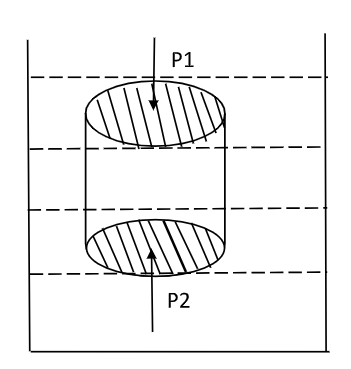
To find the direction of buoyant force let us consider a cylindrical object immersed in a liquid as shown in the below figure,
Now, we know that pressure always acts perpendicular to a surface.
So, on the top surface of the cylinder pressure will act vertically downwards (let say $P_1$) and on bottom, it acts vertically upwards (let say $P_2$).
Now, a variation of pressure with depth is given by,
$P = h\rho g$ where, $h$ = depth of point from the free surface, $\rho$ is the density of the fluid, and $g$ = acceleration due to gravity
It’s observed that $P_2$ > $P_1$ because the bottom surface is at more depth than the upper and also the weight of the liquid, is more at lower surface.
So that means overall pressure acts in an upward direction. Therefore, the net force also acts in an upward direction. Hence the correct option is A.
Note:
We have not considered the pressure difference in horizontal direction because any two points which are diametrically opposite will be at the same depth and hence, under the influence of the same pressure acting in opposite directions. So, they will cancel each other. Therefore, there is no pressure difference and hence no net force in the horizontal direction.
Complete step by step answer:
We know whenever a body is immersed in a liquid then there is a force that acts towards the outer surface of the body.
To find the direction of buoyant force let us consider a cylindrical object immersed in a liquid as shown in the below figure,
Now, we know that pressure always acts perpendicular to a surface.
So, on the top surface of the cylinder pressure will act vertically downwards (let say $P_1$) and on bottom, it acts vertically upwards (let say $P_2$).
Now, a variation of pressure with depth is given by,
$P = h\rho g$ where, $h$ = depth of point from the free surface, $\rho$ is the density of the fluid, and $g$ = acceleration due to gravity
It’s observed that $P_2$ > $P_1$ because the bottom surface is at more depth than the upper and also the weight of the liquid, is more at lower surface.
So that means overall pressure acts in an upward direction. Therefore, the net force also acts in an upward direction. Hence the correct option is A.
Note:
We have not considered the pressure difference in horizontal direction because any two points which are diametrically opposite will be at the same depth and hence, under the influence of the same pressure acting in opposite directions. So, they will cancel each other. Therefore, there is no pressure difference and hence no net force in the horizontal direction.
Recently Updated Pages
Master Class 11 Computer Science: Engaging Questions & Answers for Success

Master Class 11 Business Studies: Engaging Questions & Answers for Success
Master Class 11 Economics: Engaging Questions & Answers for Success
Master Class 11 English: Engaging Questions & Answers for Success
Master Class 11 Maths: Engaging Questions & Answers for Success
Master Class 11 Biology: Engaging Questions & Answers for Success
Trending doubts
One Metric ton is equal to kg A 10000 B 1000 C 100 class 11 physics CBSE
There are 720 permutations of the digits 1 2 3 4 5 class 11 maths CBSE
Discuss the various forms of bacteria class 11 biology CBSE
Draw a diagram of a plant cell and label at least eight class 11 biology CBSE
State the laws of reflection of light
Explain zero factorial class 11 maths CBSE