




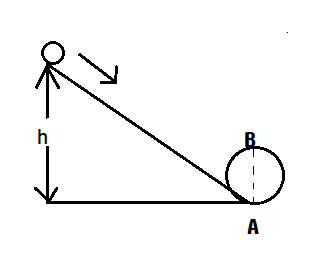
A body initially at rest and sliding along a frictionless track from a height h (as shown in the figure) just completes a vertical circle of diameter AB = D. the height h is equal to?
1- \[\dfrac{3D}{2}\]
2- D
3- \[\dfrac{7D}{5}\]
4- \[\dfrac{5D}{4}\]
Answer
 Verified
579.6k+ views
Hint: The body moves down the track and the track is frictionless, so there is a question of friction force coming into play. Also, it is given that the body completes a vertical circle so we can use the energy conservation at the top and the bottom to arrive at a meaningful solution.
Complete step by step answer:
Energy at the top= Energy at the bottom
At top there is only potential energy and at the bottom the energy is completely kinetic, so,
\[mgh=\dfrac{m{{v}^{2}}}{2}\]
\[h=\dfrac{{{v}^{2}}}{2g}\]-----(1)
For completing the vertical circle, the velocity at the lowest point must satisfy the condition, \[v\ge \sqrt{5gr}\] where r is the radius and equal to half of diameter.
So, eq (1) becomes,
$
h=\dfrac{5gr}{2g} \\
\implies h=\dfrac{5}{2}r \\
\therefore h=\dfrac{5}{4}D \\
$
So, the correct answer is “Option 4”.
Additional Information:
Motion in a vertical circle is not uniform circular motion. Also the law of conservation of energy holds until and unless no external force acts on the system and there is no loss of energy in the form of heat and light.
Note:
while doing such problems we should be careful to see whether the body completes the vertical circle or not. Also, if the track is not frictionless, there will come friction force and we have to take that into account too. The weight of the body always acts downwards.
Complete step by step answer:
Energy at the top= Energy at the bottom
At top there is only potential energy and at the bottom the energy is completely kinetic, so,
\[mgh=\dfrac{m{{v}^{2}}}{2}\]
\[h=\dfrac{{{v}^{2}}}{2g}\]-----(1)
For completing the vertical circle, the velocity at the lowest point must satisfy the condition, \[v\ge \sqrt{5gr}\] where r is the radius and equal to half of diameter.
So, eq (1) becomes,
$
h=\dfrac{5gr}{2g} \\
\implies h=\dfrac{5}{2}r \\
\therefore h=\dfrac{5}{4}D \\
$
So, the correct answer is “Option 4”.
Additional Information:
Motion in a vertical circle is not uniform circular motion. Also the law of conservation of energy holds until and unless no external force acts on the system and there is no loss of energy in the form of heat and light.
Note:
while doing such problems we should be careful to see whether the body completes the vertical circle or not. Also, if the track is not frictionless, there will come friction force and we have to take that into account too. The weight of the body always acts downwards.
Recently Updated Pages
Master Class 11 Computer Science: Engaging Questions & Answers for Success

Master Class 11 Business Studies: Engaging Questions & Answers for Success
Master Class 11 Economics: Engaging Questions & Answers for Success
Master Class 11 English: Engaging Questions & Answers for Success
Master Class 11 Maths: Engaging Questions & Answers for Success
Master Class 11 Biology: Engaging Questions & Answers for Success
Trending doubts
One Metric ton is equal to kg A 10000 B 1000 C 100 class 11 physics CBSE
There are 720 permutations of the digits 1 2 3 4 5 class 11 maths CBSE
Discuss the various forms of bacteria class 11 biology CBSE
Draw a diagram of a plant cell and label at least eight class 11 biology CBSE
State the laws of reflection of light
Explain zero factorial class 11 maths CBSE