




A body having a uniform speed will always have uniform velocity.
$(a)$ True
$(b)$ False
Answer
 Verified
617.1k+ views
Hint: In this question think of the concept of uniform circular motion, uniform as the speed of the circular motion remains constant throughout, however the velocity at any point is always tangent to that circular motion. This will help approaching the problem.
Complete step-by-step answer:
Consider an example: A particle moving in a circular path with a uniform circular motion.
Now as we know that in a circular motion the direction of the particle is always changing at every instant of time as shown in the figure it is not uniform so the velocity of the particle is also changed as the velocity is a vector quantity (magnitude as well as direction), but speed is a scalar quantity (magnitude only).
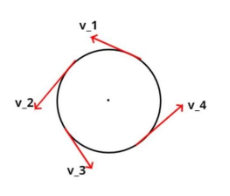
The body has velocity ${v_1},{v_2},{v_3},{\text{ and }}{v_4}$ at different interval of times as shown in the figure, but the speed of the body is uniform.
So we can say that a body has constant speed as well as variable velocity.
On the other hand, a car cannot be slowing down yet still be going the same speed and direction. So the car has uniform speed as well as velocity.
So we can say that a body having uniform speed cannot have uniform velocities at all the time.
So the given question statement is false.
Hence option (B) is the required answer.
Note: Any example depicting the change of direction of motion however the magnitude of speed not changing can be an example depicting uniform speed but non-uniform motion. The major difference between speed and velocity is that velocity is a vector quantity that has both magnitude as well as direction however speed is scalar that is it does not have any direction and is only categorized with magnitude.
Complete step-by-step answer:
Consider an example: A particle moving in a circular path with a uniform circular motion.
Now as we know that in a circular motion the direction of the particle is always changing at every instant of time as shown in the figure it is not uniform so the velocity of the particle is also changed as the velocity is a vector quantity (magnitude as well as direction), but speed is a scalar quantity (magnitude only).
The body has velocity ${v_1},{v_2},{v_3},{\text{ and }}{v_4}$ at different interval of times as shown in the figure, but the speed of the body is uniform.
So we can say that a body has constant speed as well as variable velocity.
On the other hand, a car cannot be slowing down yet still be going the same speed and direction. So the car has uniform speed as well as velocity.
So we can say that a body having uniform speed cannot have uniform velocities at all the time.
So the given question statement is false.
Hence option (B) is the required answer.
Note: Any example depicting the change of direction of motion however the magnitude of speed not changing can be an example depicting uniform speed but non-uniform motion. The major difference between speed and velocity is that velocity is a vector quantity that has both magnitude as well as direction however speed is scalar that is it does not have any direction and is only categorized with magnitude.
Recently Updated Pages
Basicity of sulphurous acid and sulphuric acid are

Master Class 11 Business Studies: Engaging Questions & Answers for Success
Master Class 11 Computer Science: Engaging Questions & Answers for Success
Master Class 11 Economics: Engaging Questions & Answers for Success
Master Class 11 Social Science: Engaging Questions & Answers for Success
Master Class 11 English: Engaging Questions & Answers for Success
Trending doubts
One Metric ton is equal to kg A 10000 B 1000 C 100 class 11 physics CBSE
The largest wind power cluster is located in the state class 11 social science CBSE
Explain zero factorial class 11 maths CBSE
State and prove Bernoullis theorem class 11 physics CBSE
Which among the following are examples of coming together class 11 social science CBSE
Can anyone list 10 advantages and disadvantages of friction