




A boat, which has a speed of 5km/h in still water, crosses a river of width 1km along the shortest path possible in 15 minutes. Find the velocity of the river?
Answer
 Verified
579.6k+ views
Hint: Speed is a scalar quantity and in this, we do not have to consider the direction of motion. On the other hand velocity is a vector quantity; it has both magnitude as well as direction.
Step by step answer:
Speed in still water is 5 km/h
Let the velocity of the river be m km/h
Width of the river is 1 km and time taken is 15 minutes, that is \[\dfrac{1}{4}\]hour.
Using the formula, \[d=s\times t\]
\[d=5\times \dfrac{1}{4}=1.25km\]
Now the situation is described below
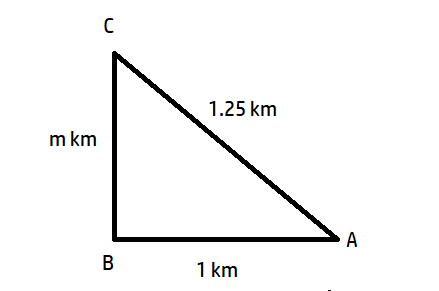
If the river had been still, the boat would have moved from A to B, 1 km but, the boat moves from A to C
\[
\Rightarrow C{{B}^{2}}=A{{C}^{2}}-A{{B}^{2}} \\
\Rightarrow C{{B}^{2}}={{1.25}^{2}}-{{1}^{2}} \\
\Rightarrow C{{B}^{2}}=0.5625 \\
\therefore CB=0.75 \\
\]
The covered distance by the river water in 15 minutes is 0.75km.
Now, the velocity of the river is
\[v=\dfrac{d}{t}=\dfrac{0.75}{\dfrac{1}{4}}=3\]km/h
Additional information: Instantaneous speed is defined as the speed of a body at any instant of time. Suppose a body is moving, it starts its motion from time, t=0. Suppose if we want to know the speed of the body at a time, t=5s then this speed will be termed as instantaneous speed.
On the other hand, the average speed of a body is defined as the ratio of the total distance covered by the body to the total time taken by it to cover that distance.
Note: This problem involves the movement of the boat in still water and in moving water. We have used the Pythagoras theorem, because we have used the vector form to solve this problem.
Step by step answer:
Speed in still water is 5 km/h
Let the velocity of the river be m km/h
Width of the river is 1 km and time taken is 15 minutes, that is \[\dfrac{1}{4}\]hour.
Using the formula, \[d=s\times t\]
\[d=5\times \dfrac{1}{4}=1.25km\]
Now the situation is described below
If the river had been still, the boat would have moved from A to B, 1 km but, the boat moves from A to C
\[
\Rightarrow C{{B}^{2}}=A{{C}^{2}}-A{{B}^{2}} \\
\Rightarrow C{{B}^{2}}={{1.25}^{2}}-{{1}^{2}} \\
\Rightarrow C{{B}^{2}}=0.5625 \\
\therefore CB=0.75 \\
\]
The covered distance by the river water in 15 minutes is 0.75km.
Now, the velocity of the river is
\[v=\dfrac{d}{t}=\dfrac{0.75}{\dfrac{1}{4}}=3\]km/h
Additional information: Instantaneous speed is defined as the speed of a body at any instant of time. Suppose a body is moving, it starts its motion from time, t=0. Suppose if we want to know the speed of the body at a time, t=5s then this speed will be termed as instantaneous speed.
On the other hand, the average speed of a body is defined as the ratio of the total distance covered by the body to the total time taken by it to cover that distance.
Note: This problem involves the movement of the boat in still water and in moving water. We have used the Pythagoras theorem, because we have used the vector form to solve this problem.
Recently Updated Pages
Master Class 11 Computer Science: Engaging Questions & Answers for Success

Master Class 11 Business Studies: Engaging Questions & Answers for Success
Master Class 11 Economics: Engaging Questions & Answers for Success
Master Class 11 English: Engaging Questions & Answers for Success
Master Class 11 Maths: Engaging Questions & Answers for Success
Master Class 11 Biology: Engaging Questions & Answers for Success
Trending doubts
One Metric ton is equal to kg A 10000 B 1000 C 100 class 11 physics CBSE
There are 720 permutations of the digits 1 2 3 4 5 class 11 maths CBSE
Discuss the various forms of bacteria class 11 biology CBSE
Draw a diagram of a plant cell and label at least eight class 11 biology CBSE
State the laws of reflection of light
Explain zero factorial class 11 maths CBSE