




A block placed on a rough inclined plane of length $4.0\,m$ just begins to slide down when the upper end of the plane is $1.0\,m$ high from the ground. Calculate the coefficient of static friction.
Answer
 Verified
555k+ views
Hint: In static friction, the frictional force resists force that is applied to an object, and object remains at rest until force of static friction is overcome. Mathematically the coefficient of static friction is defined as ratio of applied force to the normal reaction. It’s denoted by ${\mu _s} = \dfrac{{\vec F}}{{{{\vec F}_N}}}$.
Complete step by step answer:
Let us first draw the diagram, Draw a line $AB$ representing inclined plane of length $4m$ and a perpendicular height $CB$ of length $1m$ and form a right angle triangle$ABC$.
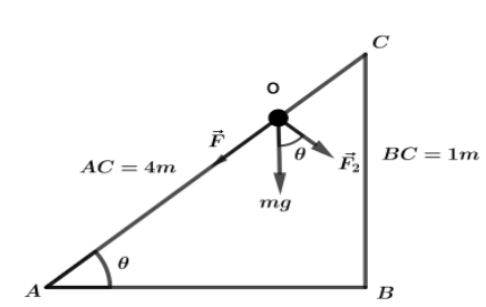
Here, in the diagram $O$ represents the object and $mg$ is the force of gravity acting on the object. Let $\theta $ be the angle between $AC$ and $AB$ then, from the geometry of figure, the applied force acting on the object is represented by $\vec F$ and the normal reaction on object is represented by ${\vec F_2}$.From geometry, we can see that the magnitude of force $\vec F$ is given by,
$\vec F = mg\sin \theta \to (i)$
And the magnitude of normal reaction force ${\vec F_2} = mg\cos \theta \to (ii)$
We also know that coefficient of static friction ${\mu _s} = \dfrac{{\vec F}}{{{{\vec F}_N}}}$
Using equation $(i)$ and equation $(ii)$ we have,
${\mu _s} = \dfrac{{mg\sin \theta }}{{mg\cos \theta }} \\
\Rightarrow {\mu _s} = \tan \theta \to (iii) \\ $
Now In right angle triangle$ABC$, using Pythagoras theorem
$AB = \sqrt {16 - 1} $
$\Rightarrow AB = \sqrt {15} $
Again, in triangle $ABC$
$\tan \theta = \dfrac{{BC}}{{AB}} \\
\Rightarrow \tan \theta = \dfrac{1}{{\sqrt {15} }} \\
\Rightarrow \tan \theta = 0.258 \\ $
From equation $(iii)$ we get
$\therefore {\mu _s} = 0.258$
Hence, the coefficient of static friction is ${\mu _s} = 0.258$.
Note:Normal reaction force is a contact force. It’s perpendicular to the surface and applied force is always in the direction of motion of an object. Coefficient of static friction is a dimensionless constant that characterizes the nature of the contact between the two surfaces.
Complete step by step answer:
Let us first draw the diagram, Draw a line $AB$ representing inclined plane of length $4m$ and a perpendicular height $CB$ of length $1m$ and form a right angle triangle$ABC$.
Here, in the diagram $O$ represents the object and $mg$ is the force of gravity acting on the object. Let $\theta $ be the angle between $AC$ and $AB$ then, from the geometry of figure, the applied force acting on the object is represented by $\vec F$ and the normal reaction on object is represented by ${\vec F_2}$.From geometry, we can see that the magnitude of force $\vec F$ is given by,
$\vec F = mg\sin \theta \to (i)$
And the magnitude of normal reaction force ${\vec F_2} = mg\cos \theta \to (ii)$
We also know that coefficient of static friction ${\mu _s} = \dfrac{{\vec F}}{{{{\vec F}_N}}}$
Using equation $(i)$ and equation $(ii)$ we have,
${\mu _s} = \dfrac{{mg\sin \theta }}{{mg\cos \theta }} \\
\Rightarrow {\mu _s} = \tan \theta \to (iii) \\ $
Now In right angle triangle$ABC$, using Pythagoras theorem
$AB = \sqrt {16 - 1} $
$\Rightarrow AB = \sqrt {15} $
Again, in triangle $ABC$
$\tan \theta = \dfrac{{BC}}{{AB}} \\
\Rightarrow \tan \theta = \dfrac{1}{{\sqrt {15} }} \\
\Rightarrow \tan \theta = 0.258 \\ $
From equation $(iii)$ we get
$\therefore {\mu _s} = 0.258$
Hence, the coefficient of static friction is ${\mu _s} = 0.258$.
Note:Normal reaction force is a contact force. It’s perpendicular to the surface and applied force is always in the direction of motion of an object. Coefficient of static friction is a dimensionless constant that characterizes the nature of the contact between the two surfaces.
Recently Updated Pages
Master Class 12 Economics: Engaging Questions & Answers for Success

Master Class 12 English: Engaging Questions & Answers for Success
Master Class 12 Social Science: Engaging Questions & Answers for Success
Master Class 12 Maths: Engaging Questions & Answers for Success
Master Class 12 Physics: Engaging Questions & Answers for Success
Master Class 11 Social Science: Engaging Questions & Answers for Success
Trending doubts
One Metric ton is equal to kg A 10000 B 1000 C 100 class 11 physics CBSE
Difference Between Prokaryotic Cells and Eukaryotic Cells
Two of the body parts which do not appear in MRI are class 11 biology CBSE
1 ton equals to A 100 kg B 1000 kg C 10 kg D 10000 class 11 physics CBSE
Draw a diagram of nephron and explain its structur class 11 biology CBSE
10 examples of friction in our daily life