




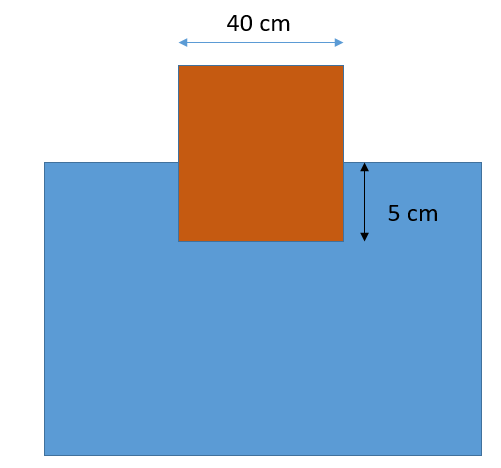
A block of wood side 40cm floats in water in such a way that its lower face is 5cm below the free surface of water. What is the weight of the blocks?
A. 64Kg
B. 16Kg
C. 8 Kg
D. Cannot be determined as the density of wood is not given.
Answer
 Verified
637.5k+ views
Hint: To solve this problem we used the Archimedes principle which states that the upward buoyant force exerted on a body is immersed in a fluid is equal to the weight of the fluid that the body displaces. Archimedes' principle describes how things can float on water.
Complete step by step answer:
We can see that in the figure given above, the wooden block is submerged partially in the water.
So the volume of the wooden box part that is submerged is
${V_s} = L \times B \times H$
Here ${V_s}$ is the volume of the submerged portion of the block, L and B are the length and breadth of the submerged portion which is equal to 40 cm each respectively. And the Height of the submerged portion is H=5cm.
\[ \Rightarrow {V_s} = \left( {40\;{\rm{cm}} \times 40\;{\rm{cm}} \times 5\;{\rm{cm}}} \right)\]
\[ \Rightarrow {V_s} = \left( {40 \times 40 \times 5} \right){\rm{c}}{{\rm{m}}^3} \times \dfrac{{{{10}^{ - 6}}{{\rm{m}}^{\rm{3}}}}}{{1\;{\rm{c}}{{\rm{m}}^3}}}\]
\[ \Rightarrow {V_s} = \left( {40 \times 40 \times 5} \right) \times \dfrac{{{{10}^{ - 6}}{{\rm{m}}^{\rm{3}}}}}{1}\]
We know that density of water is ${\rho _w} = {10^3}{\rm{Kg/}}{{\rm{m}}^3}$
We know that the Weight of the wooden block is W=Mg where M is the mass of the block and $g$ is the acceleration due to gravity.
We know that the weight of water displaced by the wooden block is given by, ${W_1} = {V_s} \times {\rho _w} \times g$ and here ${V_s}$ is the volume of the submerged portion of the block, ${\rho _w}$ is the density of water and g is the acceleration due to gravity.
Now by using Archimedes principle, we can say that,
Weight of wooden block = weight of water displaced
$Mg{\rm{ }} = {\rm{ }}{V_{im}} \times {\rho _w} \times g$
$M{\rm{ }} = {\rm{ }}(40 \times 40 \times 5){\rm{ }} \times {10^{ - 6}}{m^3} \times {10^3}Kg/{m^3}$.
$M{\rm{ }} = {\rm{ }}8kg$
Therefore, the weight of the block is 8kg. Hence, option (C) is the correct option.
Additional information:
The buoyant force depends on the mass of the object and weight of the object, but it is independent of the density of the liquid. The flotation of the object is always dependent on the Buoyant force. The buoyant force must be negative, positive, and neutral.
Note:
In today’s life, Archimedes' principle is very useful to calculate the volume of the object which has an irregular shape. It can also be determined the density and specific gravity of the object. When the object is submerged, it weighs less because the Buoyant force pushes the object in an upward direction. Mostly Archimedes principle describes the behaviour of any body and in any type of a fluid, whether it is ship or balloon.
Complete step by step answer:
We can see that in the figure given above, the wooden block is submerged partially in the water.
So the volume of the wooden box part that is submerged is
${V_s} = L \times B \times H$
Here ${V_s}$ is the volume of the submerged portion of the block, L and B are the length and breadth of the submerged portion which is equal to 40 cm each respectively. And the Height of the submerged portion is H=5cm.
\[ \Rightarrow {V_s} = \left( {40\;{\rm{cm}} \times 40\;{\rm{cm}} \times 5\;{\rm{cm}}} \right)\]
\[ \Rightarrow {V_s} = \left( {40 \times 40 \times 5} \right){\rm{c}}{{\rm{m}}^3} \times \dfrac{{{{10}^{ - 6}}{{\rm{m}}^{\rm{3}}}}}{{1\;{\rm{c}}{{\rm{m}}^3}}}\]
\[ \Rightarrow {V_s} = \left( {40 \times 40 \times 5} \right) \times \dfrac{{{{10}^{ - 6}}{{\rm{m}}^{\rm{3}}}}}{1}\]
We know that density of water is ${\rho _w} = {10^3}{\rm{Kg/}}{{\rm{m}}^3}$
We know that the Weight of the wooden block is W=Mg where M is the mass of the block and $g$ is the acceleration due to gravity.
We know that the weight of water displaced by the wooden block is given by, ${W_1} = {V_s} \times {\rho _w} \times g$ and here ${V_s}$ is the volume of the submerged portion of the block, ${\rho _w}$ is the density of water and g is the acceleration due to gravity.
Now by using Archimedes principle, we can say that,
Weight of wooden block = weight of water displaced
$Mg{\rm{ }} = {\rm{ }}{V_{im}} \times {\rho _w} \times g$
$M{\rm{ }} = {\rm{ }}(40 \times 40 \times 5){\rm{ }} \times {10^{ - 6}}{m^3} \times {10^3}Kg/{m^3}$.
$M{\rm{ }} = {\rm{ }}8kg$
Therefore, the weight of the block is 8kg. Hence, option (C) is the correct option.
Additional information:
The buoyant force depends on the mass of the object and weight of the object, but it is independent of the density of the liquid. The flotation of the object is always dependent on the Buoyant force. The buoyant force must be negative, positive, and neutral.
Note:
In today’s life, Archimedes' principle is very useful to calculate the volume of the object which has an irregular shape. It can also be determined the density and specific gravity of the object. When the object is submerged, it weighs less because the Buoyant force pushes the object in an upward direction. Mostly Archimedes principle describes the behaviour of any body and in any type of a fluid, whether it is ship or balloon.
Recently Updated Pages
Basicity of sulphurous acid and sulphuric acid are

Master Class 11 English: Engaging Questions & Answers for Success
Master Class 11 Physics: Engaging Questions & Answers for Success
Master Class 11 Computer Science: Engaging Questions & Answers for Success
Master Class 11 Chemistry: Engaging Questions & Answers for Success
Master Class 11 Social Science: Engaging Questions & Answers for Success
Trending doubts
Difference Between Prokaryotic Cells and Eukaryotic Cells
Two of the body parts which do not appear in MRI are class 11 biology CBSE
One Metric ton is equal to kg A 10000 B 1000 C 100 class 11 physics CBSE
10 examples of friction in our daily life
Draw a diagram of nephron and explain its structur class 11 biology CBSE
What will happen if the mucus is not secreted by the class 11 biology CBSE