




A block of weight $100N$ is pushed by a force $F$ on a horizontal rough plane moves with an acceleration $1m/{s^2}$, when force is doubled its acceleration becomes $10m/{s^2}$. The coefficient of friction is____$\left( {g = 10m/{s^2}} \right)$
$\eqalign{
& \left( {\text{A}} \right){\text{ }}0.2 \cr
& \left( {\text{B}} \right){\text{ }}0.4 \cr
& \left( {\text{C}} \right){\text{ }}0.8 \cr
& \left( {\text{D}} \right){\text{ }}0.5 \cr} $
Answer
 Verified
612.6k+ views
Hint: Firstly calculate the mathematical expressions for the force when then the only force is applied on the block, after that calculate the force equation when the force becomes double. Then solve both equations and then find the value of the coefficient.
Formula used:
$F - {f_s} = ma$
Complete answer:
The given setup can be completely understood by the following diagram:
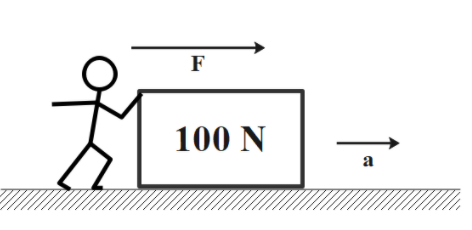
Given that,
Weight, $W = 100N$
Acceleration, $a = 1m/{s^2}$
Acceleration when force is double, $a = 10m/{s^2}$
Now, Let the External Force be $F$ and frictional force be $f$
Then,
$\matrix
{\;F - {f_s} = ma} \\
{\; \Rightarrow F - \mu N = ma{\text{ }}\left[ {\because {f_s} = \mu N} \right]} \\
{\; \Rightarrow F - \mu 100 = 10 \times 1} \\
{\; \Rightarrow F - \mu 100 = 10....\left( I \right)} \\ $
We know, When Force is doubled,
Then,
$\matrix
{2F - {f_s} = ma} \\
{ \Rightarrow 2F - \mu N = ma} \\
{ \Rightarrow 2F - \mu 100 = 10 \times 10} \\
{ \Rightarrow 2F - \mu 100 = 100....\left( {II} \right)} \\
\; \\ $
Now, from equation $\left( I \right)$ and $\left( {II} \right)$
$F = 90N$
Now, put the value of $F$ in equation $\left( I \right)$
$\matrix
{90 - \mu 100 = 10} \\
{ \Rightarrow - \mu 100 = 10 - 90} \\
{ \Rightarrow \mu = \dfrac{{80}}{{100}}} \\
{\therefore \mu = 0.8} \\ $
Hence, the coefficient of restitution is $0.8$.
So, the correct option is C.
Additional Information:
The coefficient of friction is defined because of the ratio of the force required to maneuver two sliding surfaces over one another, and therefore the force holding them together. When surfaces in touch move relative to every other, the friction between the 2 surfaces converts K.E. into thermal energy (that is, it converts work to heat). This property can have dramatic consequences, as illustrated by the utilization of friction created by rubbing pieces of wood together to start out a fireplace. K.E. is converted to thermal energy whenever motion with friction occurs.
Note:
Friction isn't itself a fundamental force. Dry friction arises from a mixture of inter-surface adhesion, surface roughness, surface deformation, and surface contamination. Friction may be a non-conservative force - work done against friction is path-dependent. Within the presence of friction, some K.E. is usually transformed into thermal energy, so energy isn't conserved.
Formula used:
$F - {f_s} = ma$
Complete answer:
The given setup can be completely understood by the following diagram:
Given that,
Weight, $W = 100N$
Acceleration, $a = 1m/{s^2}$
Acceleration when force is double, $a = 10m/{s^2}$
Now, Let the External Force be $F$ and frictional force be $f$
Then,
$\matrix
{\;F - {f_s} = ma} \\
{\; \Rightarrow F - \mu N = ma{\text{ }}\left[ {\because {f_s} = \mu N} \right]} \\
{\; \Rightarrow F - \mu 100 = 10 \times 1} \\
{\; \Rightarrow F - \mu 100 = 10....\left( I \right)} \\ $
We know, When Force is doubled,
Then,
$\matrix
{2F - {f_s} = ma} \\
{ \Rightarrow 2F - \mu N = ma} \\
{ \Rightarrow 2F - \mu 100 = 10 \times 10} \\
{ \Rightarrow 2F - \mu 100 = 100....\left( {II} \right)} \\
\; \\ $
Now, from equation $\left( I \right)$ and $\left( {II} \right)$
$F = 90N$
Now, put the value of $F$ in equation $\left( I \right)$
$\matrix
{90 - \mu 100 = 10} \\
{ \Rightarrow - \mu 100 = 10 - 90} \\
{ \Rightarrow \mu = \dfrac{{80}}{{100}}} \\
{\therefore \mu = 0.8} \\ $
Hence, the coefficient of restitution is $0.8$.
So, the correct option is C.
Additional Information:
The coefficient of friction is defined because of the ratio of the force required to maneuver two sliding surfaces over one another, and therefore the force holding them together. When surfaces in touch move relative to every other, the friction between the 2 surfaces converts K.E. into thermal energy (that is, it converts work to heat). This property can have dramatic consequences, as illustrated by the utilization of friction created by rubbing pieces of wood together to start out a fireplace. K.E. is converted to thermal energy whenever motion with friction occurs.
Note:
Friction isn't itself a fundamental force. Dry friction arises from a mixture of inter-surface adhesion, surface roughness, surface deformation, and surface contamination. Friction may be a non-conservative force - work done against friction is path-dependent. Within the presence of friction, some K.E. is usually transformed into thermal energy, so energy isn't conserved.
Recently Updated Pages
Master Class 11 Social Science: Engaging Questions & Answers for Success

Master Class 11 Chemistry: Engaging Questions & Answers for Success
Master Class 12 Business Studies: Engaging Questions & Answers for Success
Master Class 12 Chemistry: Engaging Questions & Answers for Success
Master Class 12 Biology: Engaging Questions & Answers for Success
Class 12 Question and Answer - Your Ultimate Solutions Guide
Trending doubts
One Metric ton is equal to kg A 10000 B 1000 C 100 class 11 physics CBSE
Difference Between Prokaryotic Cells and Eukaryotic Cells
How many of the following diseases can be studied with class 11 biology CBSE
Two of the body parts which do not appear in MRI are class 11 biology CBSE
Which of the following enzymes is used for carboxylation class 11 biology CBSE
Explain zero factorial class 11 maths CBSE